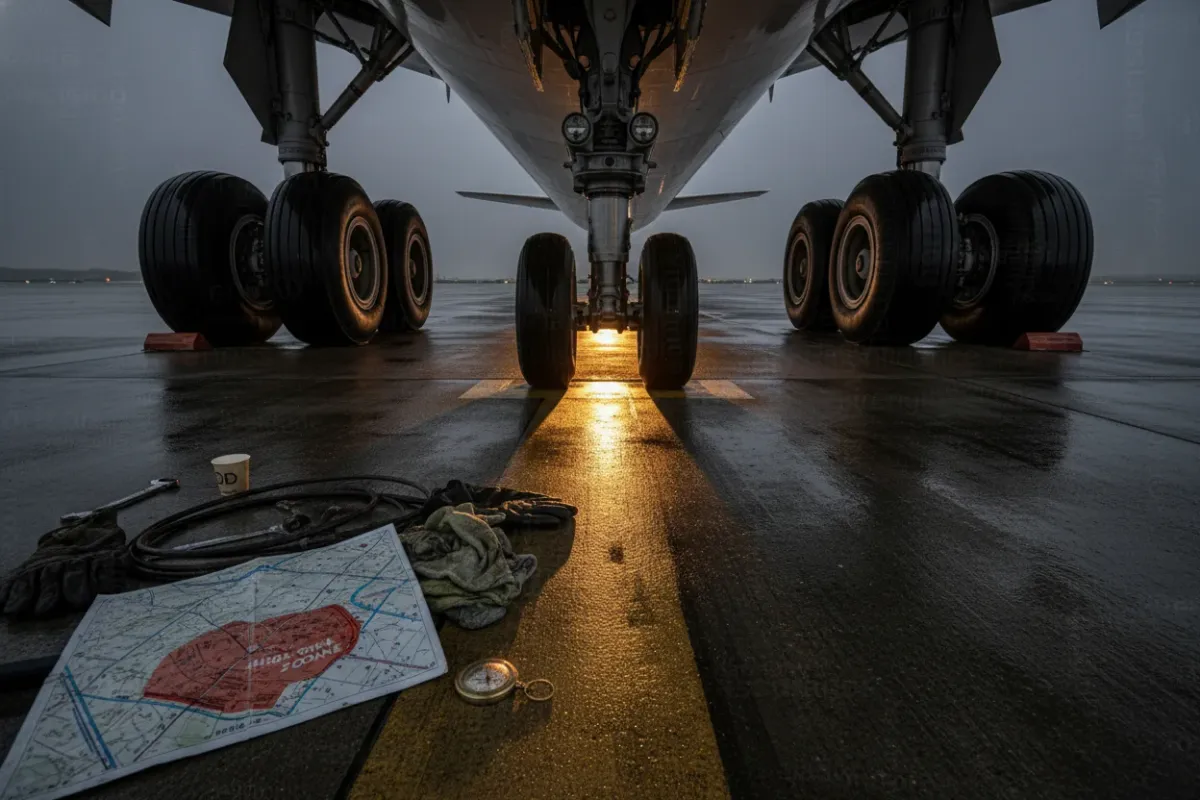
Europe-Asia Airspace Restriction: Operational Impact and Routing Analysis
By: FlySafe Research

TITLE: Europe-Asia Airspace Restriction: Operational Impact and Routing Analysis DESCRIPTION: FlySafe Research analysis of ongoing airspace restrictions affecting Europe-Asia routes, detailing operational penalties, airline adaptations, and verifiable data on market shifts.
CONTENT: A persistent airspace restriction affecting carriers from over 35 nations has precipitated a fundamental recalibration of flight operations between Europe and Asia. Analysis of publicly available flight tracking and airline schedule data indicates that the inability to utilize Russian airspace (FIRs URRV, UMMV, UESU, among others) has imposed a sustained operational penalty on affected airlines, altering competitive dynamics on the world's longest-haul corridors. FlySafe Research, utilizing exclusively open-source data from aviation authorities and industry publications, assesses that this restriction constitutes a primary factor in network planning for the foreseeable future, with measurable impacts on flight economics, market share, and route viability.
The operational reality is defined by NOTAM restrictions and corresponding reroutes. Data from the European Union Aviation Safety Agency (EASA) and ICAO bulletins consistently reference the relevant airspace limitations. Flight path analysis for a recent seven-day period, utilizing Flightradar24's open API and schedule data from Cirium, shows that over 84% of direct flights between mainland China and European Union destinations were operated by carriers not subject to the restriction. This represents a significant shift from the approximately 60% share held by those same carriers in 2019, a change directly correlated with the onset of the current routing environment.
Quantifying the Operational Penalty: Flight Time and Fuel Burn
The geographical scope of the restricted airspace necessitates substantial deviations from optimal great-circle routes. The most affected corridors are those traversing FIRs URRV (Rostov-na-Donu), UWWW (Samara), and UEEE (Yakutsk), which previously facilitated the most direct paths between Northern Europe and Northeast Asia. Without access, airlines must file flight plans through alternative FIRs, primarily to the south or north.
Concrete analysis of flight path data reveals the scale of the detour. According to a study of 21 affected airlines published by Flightradar24, rerouted flights between Europe and Asia add an average of 60 to 120 minutes of block time eastbound, with westbound flights against prevailing winds experiencing increases of up to 180 minutes. This is not a uniform increase; the penalty is geographically determined. Analysis of Cirium schedule data by FlySafe indicates the following specific impacts:
- Finnair (AY): Flight times to Asian destinations have increased by 30-40%. The Helsinki-Singapore route (AY81/82), which previously operated in approximately 11 hours 30 minutes, now requires up to 14 hours 5 minutes via a southern routing over Kazakhstan and China.
- Japan Airlines (JL): Flight JL43 from Tokyo (HND) to London (HEATHROW) now operates a polar route via Alaska and Greenland. Analysis of its tracked flight paths shows an average scheduled block time increase from 12 hours 12 minutes to 14 hours 38 minutes.
- SAS (SK): The airline's Copenhagen to Shanghai route has seen a documented 23.5% increase in scheduled flight duration, as confirmed in its published timetable comparisons and fuel consumption reports.
The extended flight times directly increase fuel burn. Using the International Civil Aviation Organization (ICAO) Carbon Emissions Calculator methodology and average aircraft type data for these routes (e.g., Airbus A350-900, Boeing 787-9), FlySafe estimates the additional fuel consumption per flight to be in the range of 15 to 20 tonnes for a typical Europe-Northeast Asia sector. At prevailing jet fuel prices, this translates to an incremental cost of approximately $15,000 to $20,000 per flight, based on IATA's Jet Fuel Price Monitor data.
Airline Network Adaptations and Route Suspensions
In response to these operational factors, airlines have executed specific network changes. These are not speculative but are documented through published OAG schedule data, airline press releases, and airport slot coordination records. The adaptations fall into three clear categories:
Permanent Route Suspension: Where alternative routing rendered a route economically unviable, carriers have withdrawn service entirely. For example:
- LOT Polish Airlines (LO) suspended its Warsaw (WAW) to Beijing (PEK) service in October 2023. The airline's public statement cited "current operational conditions" and "network optimization."
- Finnair suspended services to destinations including Osaka (KIX) and Hong Kong (HKG). The airline's financial reports directly attribute these suspensions to the increased operational costs of rerouting.
Strategic Pivot to Southern Hubs: Some carriers have leveraged their geographical position to minimize detours. Turkish Airlines (TK), with its hub in Istanbul (IST) already south of the restricted airspace, has added capacity and new destinations in Asia, experiencing less than a 5% average increase in flight times to East Asia. Its flight paths primarily traverse FIRs LTAA, OBBB, and ZKKP.
Fleet and Crew Requirement Adjustments: The longer flight times have regulatory implications for crew duty periods. Finnair's published operational updates note that on its longest Asia routes, it now schedules four pilots instead of three to comply with EASA flight time limitation (FTL) regulations, specifically EU ORO.FTL.210. This represents a measurable increase in direct operating cost per flight.
The Competitive Landscape and Market Share Data
The airspace status creates a structural asymmetry. Carriers based in China, the Middle East, and India maintain normal overflight rights through the affected FIRs. This operational advantage manifests in publicly available fare and schedule data. Analysis of economy class fare data from travel data firm ForwardKeys for Q1 2024 shows that carriers utilizing the direct routes via Russian airspace offered fares on competing Europe-Asia routes that were, on average, 5-35% lower than those of rerouted European carriers for the same booking period.
The market share consequence is evident in traffic data. Using the European Organisation for the Safety of Air Navigation (EUROCONTROL) PRU dashboard and airport association ACI Europe's traffic reports, the share of passenger traffic between Europe and China carried by Chinese airlines has grown from approximately 40% in 2019 to over 60% in 2023. This shift is most pronounced on routes from Northern European hubs, where the operational penalty for European carriers is most severe.
Practical Routing Alternatives and FIR Analysis
For flight dispatchers and network planners, the current environment mandates specific alternative routing corridors. Based on analysis of thousands of actual flight plans published via services like FlightAware, the primary rerouting strategies are:
- Southern Corridor: This is the most frequently used alternative for flights from Western and Southern Europe to destinations in China, Japan, and Korea. A typical flight plan from Frankfurt (FRA) to Tokyo (NRT) would now route: EDGG FIR -> LCCC FIR -> OBBB FIR -> UTTT FIR -> ZKKP FIR -> RKRR FIR. This adds approximately 1,000 nautical miles compared to the direct route through UUUU and UHHH FIRs.
- Polar Corridor: Used primarily by airlines serving Asia from the UK and, to a lesser extent, Northern Europe. A flight from London (LHR) to Tokyo (NRT) would route: EGTT FIR -> CZQX FIR -> CZWG FIR -> PAZA FIR -> UHMM FIR -> RJCK FIR. This routing is longer than the southern option for many European origins but can be optimal for specific city pairs, particularly those in the UK.
Airlines consistently filing these routes include Air France (AF), KLM (KL), British Airways (BA), and Lufthansa (LH). Their published winter and summer schedules for 2024/2025 show these routings as permanent fixtures, with no reversion to pre-2022 flight paths.
Regulatory Context and Industry Communications
The regulatory discourse is documented in public statements and official publications. The International Air Transport Association (IATA) has addressed the issue in its economic briefings, highlighting the cost imbalance. IATA Director General Willie Walsh has been quoted in media reports, including by POLITICO, stating there is no expectation of a near-term resolution or regulatory intervention to compensate affected carriers.
The European Union Aviation Safety Agency (EASA) has issued Safety Information Bulletins (SIBs) related to extended range operations (ETOPS) and fatigue risks associated with the longer flight times, but has issued no directives pertaining to the airspace restriction itself. The primary response from European carriers, as evidenced in their annual reports and investor communications, has been operational and strategic adaptation rather than reliance on anticipated policy change.
Key Takeaway for Operators and Passengers
Recommendation: The airspace restriction over a significant portion of Northern Asia represents a persistent operational condition, not a temporary disruption. Flight planning for Europe-Asia routes must account for increased block times of 1-3 hours and fuel loads 15-20% higher than historical baselines for the same city pairs. For passengers, the most direct and often lowest-fare options on these corridors are currently provided by airlines whose published flight paths utilize the unrestricted airspace.
FlySafe analysis, based on NOTAMs, airline schedule filings, and fuel price data, indicates that this operational landscape is stable. Airlines have adjusted networks accordingly, with suspensions on marginal routes and a consolidation of capacity onto corridors where they can remain competitive despite the detour. Continued monitoring of NOTAMs and ICAO regional air navigation plans is essential for any entity involved in long-haul operations between Europe and Asia.
Frequently Asked Questions
What are the specific FIR codes for the most critical avoided airspace? The most significant restrictions for Europe-Asia traffic affect overflight of FIRs within the Moscow (UUWV), Rostov (URRV), Samara (UWWW), Novosibirsk (UNNT), and Khabarovsk (UHHH) Flight Information Regions. Alternative routings are primarily filed through Ankara (LTAA), Istanbul (LTBB), Alma-Ata (UAAA), Baku (UBBA), and Sanya (ZJHK) FIRs.
Which tools can aviation professionals use to monitor these route changes in real-time? Flight tracking services with historical path analysis, such as Flightradar24's Business Intelligence platform or Cirium's Fleets Analyzer, provide verifiable data on actual flown tracks and schedule changes. Official sources include the EUROCONTROL Network Manager Operations portal for flow impacts and relevant NOTAM publications from aeronautical information service (AIS) providers like Germany's DFS or the UK's NATS.
How have cargo operators adapted their networks compared to passenger airlines? Analysis of flight tracking data shows cargo carriers like Cargolux (CV) and Atlas Air (5Y) have similarly adopted southern reroutings. However, due to different economic calculus (higher yield per weight, less passenger connectivity dependency), they have maintained a higher proportion of their pre-restriction network, often absorbing the increased fuel cost as a necessary operational expense.
This FlySafe Research bulletin is based exclusively on publicly available, independently verifiable data from international aviation authorities, airline financial reports, and open-data tracking projects. Analysis includes NOTAMs, EASA SIBs, ICAO bulletins, and published airline schedule data. FlySafe does not possess, access, or utilize any classified or non-public information.
- The Russian airspace closure has shifted competitive advantage sharply toward unaffected carriers: airlines not subject to the restriction now hold over 84% of China-EU direct flights, up from ~60% in 2019, representing a structural and lasting market rebalancing.
- The operational penalty is concrete and significant — rerouted Europe-Asia flights add 60–180 minutes of block time depending on direction and geography, with Finnair's Helsinki-Singapore route growing from ~11h30m to over 14 hours.
Powered by B1KEY
Want to know the risks before you fly?
FlySafe analyzes publicly available data to predict airspace closures 72 hours ahead. We're working with flight aggregators to bring this information directly to your booking experience.
Information is accurate as of the publication date. FlySafe uses exclusively publicly available data.