By: FlySafe Research
On February 2026, a full-scale prototype of the AutoFlight V5000 Matrix lifted off vertically, transitioned to fixed-wing cruise, and returned to a vertical landing at a test facility in Kunshan, Jiangsu Province. It was the first time an eVTOL aircraft in the 5-ton weight class had completed a full mode transition flight sequence. The demonstration did not involve a subscale model or a partial envelope test — it was the complete vertical-cruise-vertical cycle on a platform with a maximum take-off weight of 5,700 kg.
FlySafe analysis shows that the V5000 Matrix represents a category shift for the electric vertical take-off and landing sector. Current mainstream eVTOL designs typically feature take-off weights between 1.5 and 3 tons and seat capacities of four to six passengers. The Matrix nearly doubles the upper end of that weight range while more than doubling passenger capacity, introducing operational considerations that extend well beyond the urban air mobility corridors currently envisioned for lighter platforms.
Aircraft Configuration and Specifications
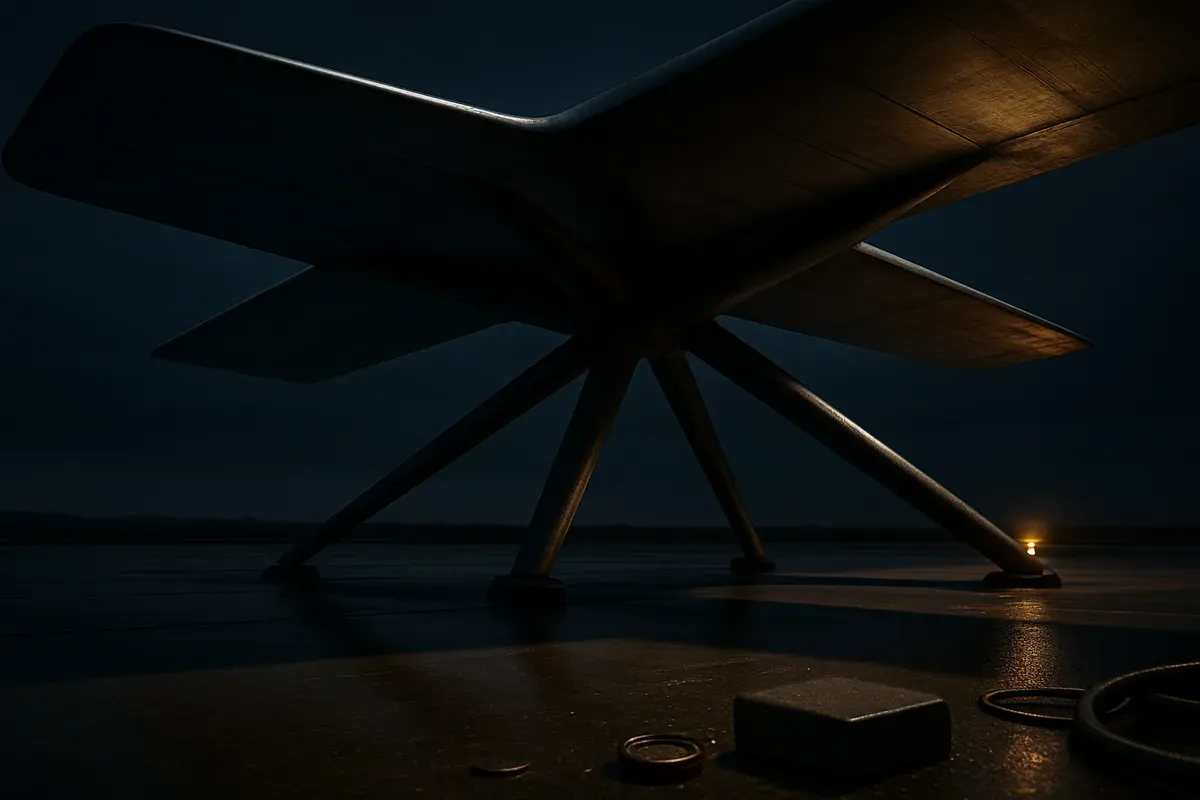
The V5000 Matrix employs a compound wing "Lift and Cruise" configuration built around a triplane layout with a six-arm structure. According to AutoFlight's official announcement, the aircraft features a 20-metre wingspan, 17.1-metre length, and 3.3-metre height, with a cabin providing 13.9 cubic metres of interior volume.
The propulsion system relies on 20 motors distributed across the six-rail compound wing configuration. This architecture is designed to provide redundancy: the loss of any individual motor does not compromise the aircraft's ability to maintain controlled flight. As New Atlas reported, the 20-motor layout supports both the full transition flight envelope and fault tolerance across multiple failure scenarios.
The "Lift and Cruise" approach — where dedicated lift motors handle vertical flight phases and separate systems manage forward cruise — is described by AutoFlight as one of the most challenging aspects of eVTOL flight. The company states that its engineering confidence in the configuration derives from the operation of large-scale cargo versions of its aircraft, with hundreds of hours flown and thousands of transitions completed on earlier platforms.
Two variants have been announced. The passenger configuration offers flexible seating for up to 10 business-class seats or six VIP seats, accommodating a pilot and nine passengers. The cargo variant is designed for a maximum payload of 1,500 kg (approximately 3,300 lb) and can accommodate two AKE standard air cargo containers — a detail that signals alignment with existing air freight logistics infrastructure.
Range: The Defining Differentiator
Range has been the persistent constraint limiting eVTOL platforms to short urban hops and airport shuttle routes. The V5000 Matrix addresses this with two power configurations that produce dramatically different operational envelopes.
The pure electric version offers a maximum range of 250 km (155 miles). While this figure is competitive with other eVTOL designs, it remains suited primarily to regional point-to-point operations and intra-urban corridors.
The hybrid-electric variant, however, extends range to 1,500 km (932 miles). According to AutoFlight's LinkedIn announcement, this figure is "way beyond what present-day eVTOLs generally have." That characterization is accurate. A 1,500 km range places the hybrid Matrix in competition not just with other eVTOL platforms but with conventional turboprop regional aircraft on certain route segments.
For context, a 1,500 km operational radius could theoretically cover routes such as Shanghai to Beijing, Munich to Rome, or Los Angeles to Denver — distances that are currently served by conventional fixed-wing regional and narrowbody aircraft. This does not mean the Matrix will operate those routes imminently, but it does mean the aircraft's operational envelope overlaps with existing controlled airspace corridors and terminal area procedures in ways that lighter, shorter-range eVTOLs do not.
Airspace and Operational Implications
The introduction of a 5-ton eVTOL with the range and passenger capacity of a small regional aircraft raises several considerations for airspace planners, regulators, and operators.
Airspace status: Current regulatory frameworks for advanced air mobility (AAM) have been developed primarily around lighter eVTOL platforms operating in low-altitude urban corridors, typically below Class B and Class C airspace floors. The V5000 Matrix, with its hybrid range of 1,500 km, would necessarily operate across multiple airspace classes, FIR boundaries, and potentially oceanic control areas on longer segments. Existing AAM integration concepts — including NASA's UAM corridor studies on automation requirements for powered lift aircraft — were not designed with 5-ton, 10-passenger platforms in mind.
Affected routes: The cargo variant's compatibility with AKE standard air cargo containers suggests potential integration into existing air freight networks. Regional cargo feeder routes currently served by aging turboprop freighters — particularly in archipelagic regions of Southeast Asia, island networks in the Pacific, and dispersed logistics hubs in China — represent plausible early adoption corridors for a platform with 1,500 kg payload capacity and vertical take-off capability.
Recommendation: Aviation authorities evaluating AAM integration should consider that the 5-ton weight class represents a qualitative shift in how eVTOL traffic interacts with conventional aviation. Separation standards, terminal area procedures, and pilot certification requirements developed for sub-3-ton platforms may require revision to accommodate aircraft of the Matrix's size and performance envelope.
Cost Structure and Commercial Viability
According to Caixin Global, the V5000 Matrix aims for up to 30% lower per-seat and per-ton costs compared to smaller eVTOL platforms. This figure, if achieved in operational service, would address one of the fundamental economic barriers to eVTOL adoption: the inability of four-to-six-seat aircraft to achieve competitive unit economics on anything other than premium point-to-point routes.
The logic is straightforward. A 10-seat aircraft with a maximum take-off weight of 5,700 kg distributes fixed operational costs — vertiport infrastructure, maintenance, pilot salaries, airspace access fees — across nearly twice the revenue-generating capacity of a typical five-seat eVTOL. The cargo variant further expands revenue potential by enabling mixed-use operations where the same platform type serves passenger routes during peak hours and freight operations during off-peak periods.
As Global Times reported, current mainstream eVTOL models typically carry four to six passengers with take-off weights of 1.5 to 3 tons. The Matrix's step up to 10 passengers and 5.7 tons represents an attempt to close the gap between eVTOL novelty and airline-grade economics.
Certification and Timeline Uncertainty
Despite the successful transition flight demonstration, AutoFlight has not disclosed a certification timeline for the V5000 Matrix. As noted by Aerospace Global News, this absence is significant. The certification of eVTOL aircraft has proven to be a protracted process even for lighter, simpler platforms. Joby Aviation, Archer, and Lilium have each experienced multi-year certification campaigns for aircraft in the 2-ton class.
A 5-ton eVTOL introduces additional certification complexity. Structural loads during transition from vertical to cruise flight increase nonlinearly with aircraft weight. The 20-motor propulsion architecture, while providing redundancy, also creates a more complex failure mode analysis. The hybrid-electric variant adds the certification burden of an integrated combustion-electric powertrain, a category that lacks established type certification precedent in eVTOL applications.
Based on publicly available data only, no civil aviation authority has yet published specific certification guidance for eVTOL platforms in the 5-ton weight class. EASA's Special Condition for VTOL aircraft (SC-VTOL) and the FAA's Part 21.17(b) special conditions pathway were both developed with lighter platforms as the primary reference. Whether these frameworks can accommodate the Matrix without significant amendment remains an open regulatory question.
What This Means for the Sector
The V5000 Matrix demonstration establishes a proof point. As EVVTOL Tech Nation reported, "heavier, farther-reaching eVTOL flight is no longer theoretical." The aircraft has physically completed the vertical-cruise-vertical sequence at scale.
The operational implications, however, remain contingent on certification, infrastructure development, and regulatory accommodation. A platform that can carry 10 passengers or 1,500 kg of cargo over 1,500 km blurs the boundary between advanced air mobility and conventional regional aviation. This boundary-blurring is precisely what makes the Matrix significant from an airspace planning perspective — and precisely what makes its path to operational service complex.
FlySafe will continue to monitor the V5000 Matrix's development trajectory, certification progress, and any associated NOTAM activity or airspace integration trials as they emerge. Analysis is based on publicly available data only.
Frequently Asked Questions
How far can the V5000 Matrix fly on hybrid power?
The hybrid-electric variant of the V5000 Matrix has a stated maximum range of 1,500 km (932 miles). The pure electric configuration offers a maximum range of 250 km (155 miles). These figures represent manufacturer claims and have not yet been independently verified through certification flight testing.
How much cargo can the V5000 Matrix carry in freight configuration?
The cargo variant supports a maximum payload of 1,500 kg (approximately 3,300 lb) and is designed to accommodate two AKE standard air cargo containers, aligning the platform with existing air freight logistics infrastructure.
How does the V5000 Matrix transition from vertical to horizontal flight?
The Matrix uses a "Lift and Cruise" configuration with 20 propulsion motors distributed across a six-rail compound wing in a triplane layout. Dedicated lift motors handle vertical flight phases, and the aircraft transitions to wing-borne cruise flight, completing the full vertical take-off, cruise, and vertical landing sequence as demonstrated during its February 2026 test flight.
How does the per-seat cost of the V5000 Matrix compare to smaller eVTOLs?
AutoFlight targets up to 30% lower per-seat and per-ton costs compared to smaller eVTOL platforms, achieved through the higher passenger capacity (10 seats) and payload that distribute fixed operational costs more efficiently. These economics have not yet been validated in commercial service.
What provides redundancy if one of the V5000 Matrix's 20 propulsion motors fails?
The 20-motor architecture distributed across the six-arm compound wing structure is designed so that the failure of any individual motor does not compromise the aircraft's ability to maintain controlled flight. The redundancy is inherent in the distributed propulsion layout, which provides multiple independent thrust sources across the airframe.
- The V5000 Matrix is the first eVTOL in the 5-ton weight class to complete a full vertical-cruise-vertical transition flight on a full-scale prototype — not a subscale model — marking a genuine category shift beyond the 1.5–3 ton mainstream designs currently dominating the sector.
- Its 20-motor distributed propulsion across a triplane compound wing provides fault tolerance across multiple failure scenarios, with engineering confidence backed by hundreds of flight hours on earlier cargo platforms.
Powered by B1KEY
Live tools behind the analysis.
The signals FlySafe writes about are also published live — continuously verified by the Sentinel pipeline.
Information is accurate as of the publication date. FlySafe uses exclusively publicly available data.