By: FlySafe Research
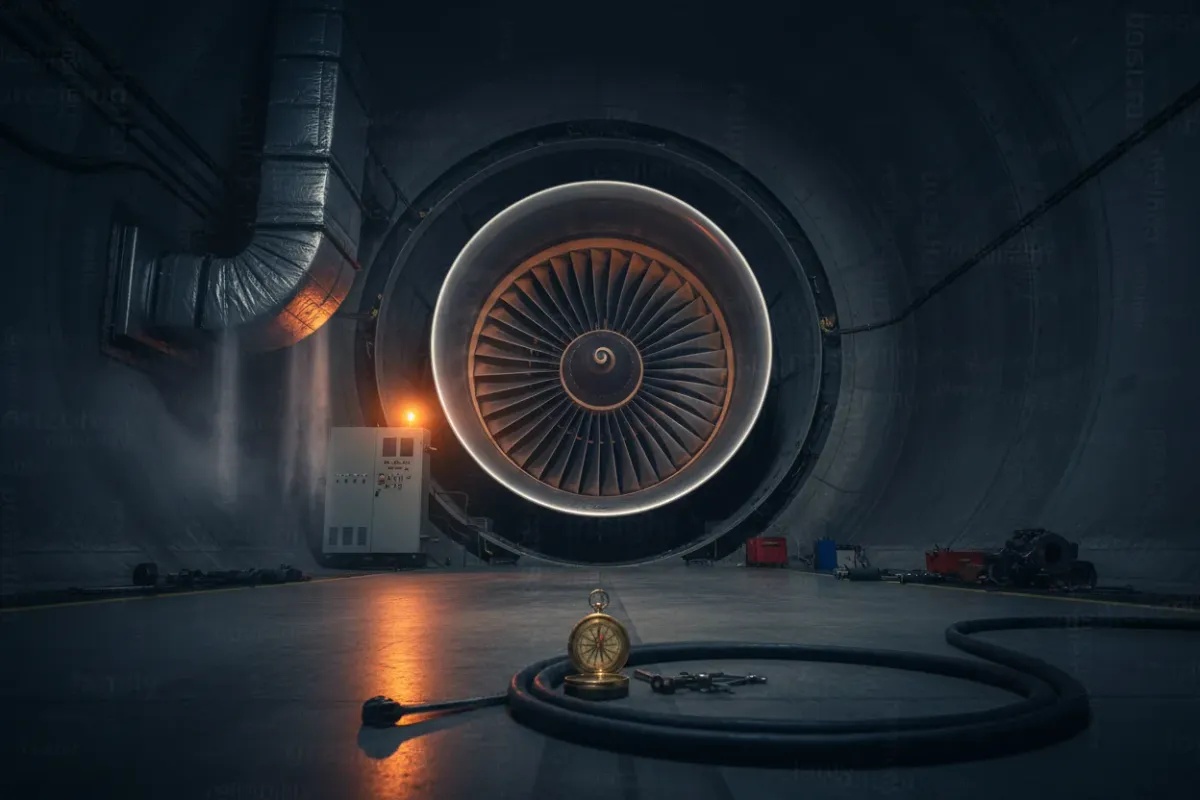
How Engine Test Facilities Underpin Global Aviation Safety
Every commercial engine that enters service has already endured conditions far more severe than any airline route will ever demand. At dedicated test facilities operated by the world's leading original equipment manufacturers, powerplants are subjected to simulated bird ingestion, hailstorms, crosswinds, and temperature extremes that push materials and aerodynamics well past their design envelope. According to Aerospace Testing International, OEMs invest billions in building and upgrading these sites globally to ensure that safety, reliability, and regulatory certification goals are met.
FlySafe analysis shows that understanding how engines are validated before they reach operational fleets is essential context for any airspace risk assessment. An engine's performance under duress — and the rigor of the testing regime behind it — directly influences route reliability, diversion rates, and the broader safety posture of the global fleet.
This article examines the infrastructure, technology, and processes behind the world's foremost engine test facilities, drawing on publicly available data from manufacturers, research institutions, and regulatory frameworks.
The Architecture of a Modern Engine Test Cell
A modern engine test cell is far more than a concrete enclosure with an exhaust duct. These purpose-built structures must replicate the full spectrum of atmospheric conditions an engine will encounter across its operational life — from sub-zero cold soaks at altitude to hot-and-high takeoff scenarios. The five leading facilities profiled by Aerospace Testing International have all been built or extensively upgraded in the past 15 years, reflecting a generational shift in test capability.
Airflow management is a central engineering challenge. Test cells must deliver enormous volumes of conditioned air to the engine inlet while simultaneously managing the acoustic signature generated by a powerplant running at full thrust. The balance between aerodynamic fidelity and noise attenuation requires sophisticated inlet and exhaust silencer systems, often spanning dozens of meters. Facilities designed for wide-body engines such as the GEnx family must handle mass flow rates that would be unthinkable in earlier-generation cells.
Temperature conditioning systems allow engineers to cycle intake air from well below freezing to temperatures representative of Middle Eastern or South Asian summer conditions within a single test campaign. Humidity control adds another layer of complexity, as ice crystal ingestion testing demands precise moisture content at specific temperature bands.
Instrumentation density has increased dramatically. Modern test engines are fitted with hundreds — sometimes exceeding a thousand — individual sensors measuring gas path temperatures, pressures, vibration signatures, shaft speeds, fuel flow, and emissions composition. High-speed data acquisition systems capture these parameters at rates sufficient to resolve transient events that last only milliseconds, such as compressor surge or fan blade release dynamics.
Certification and Validation: From Hardware to Approval
The path from a prototype engine to a certified powerplant is measured in years and governed by exacting regulatory frameworks. As noted by MTU Aero Engines, the verification and validation phase for new engine programs requires that hardware be adapted, instrumented, and delivered well in advance of scheduled test runs. For the PW545D program — in which MTU has held a 25 percent stake since 1993 — new materials and technologies were introduced to improve fuel efficiency, increase thrust, and extend time on wing, each parameter requiring its own validation sequence.
According to MTU's Gehring, "For us as the manufacturer and for our customers, the safety of MTU products is a top priority. But we also look at efficiency, energy consumption, maintenance intervals, and numerous technical measurements." This statement underscores the breadth of the certification envelope: safety is the non-negotiable baseline, but modern certification also demands demonstrated performance across efficiency, durability, and maintainability metrics.
The certification process typically involves several distinct test phases:
- Component rig testing: Individual modules (fan, compressor, combustor, turbine) are tested in isolation to validate aerodynamic and mechanical performance against design predictions.
- Core engine testing: The gas generator section is assembled and run to confirm thermodynamic cycle performance.
- Full engine testing: The complete powerplant undergoes performance mapping, endurance running, and operability assessments including surge margin verification.
- Certification testing: Formal tests witnessed or reviewed by regulatory authorities, including blade-off containment, bird ingestion, rain and hail ingestion, and endurance cycles.
Each phase generates vast quantities of data that must be compiled, analyzed, and presented to certification authorities — a process that, as noted by Allied Market Research, is increasingly supported by digital tools that connect raw material inputs with final part outputs. The ability to track which raw materials were used, how they were processed, and how they performed during testing is described as "becoming non-negotiable" in the current regulatory environment.
Additive Manufacturing and the New Testing Frontier
One of the most significant shifts in engine testing over the past decade has been the integration of additive manufacturing — commonly known as 3D printing — into the production and validation pipeline. At Pratt & Whitney's West Palm Beach facility, engineers are especially active in the testing and development of additive manufacturing processes for the TJ150 small jet engine, according to Aerospace Testing International.
Additive manufacturing introduces unique validation challenges. Unlike conventionally forged or cast components, additively manufactured parts can exhibit microstructural variability depending on build orientation, laser parameters, and powder batch characteristics. Test facilities must therefore validate not only the finished component but also the repeatability of the manufacturing process itself.
Research from institutions including Fraunhofer and GE Additive, as referenced in IRJET, has demonstrated that combining artificial intelligence with smart manufacturing tools leads to improved mechanical properties in additively produced components. This convergence of AI and advanced manufacturing is reshaping how test campaigns are designed, with machine learning ensemble models helping to identify optimal process windows before physical testing begins.
Newer materials and advanced processes such as powder metals and advanced ceramics require longer approval times unless sufficient test data is available, as noted by Allied Market Research. Companies that use software to gather and display certification data can move faster through the approval process — a competitive advantage that is helping smaller suppliers meet the standards of large OEMs.
AI-Driven Inspection and Monitoring
The integration of artificial intelligence into engine test and inspection workflows represents a paradigm shift in how anomalies are detected and analyzed. In April 2026, Waygate Technologies and GE Aerospace introduced new automated inspection templates — Menu Directed Inspection (MDI) — for GEnx-1B and -2B engines. The rollout is part of a Joint Technology Development Agreement initiated in 2023 and integrates AI-guided workflows into Waygate's Mentor Visual iQ+ video borescope. The system ensures that inspectors consistently capture high-quality images and reduces variability between operators — a critical factor when inspection findings determine whether an engine returns to service or enters the shop.
Beyond borescope inspection, AI-enhanced Engine Health Management systems have been successfully implemented by organizations including NASA, Pratt & Whitney, and Lufthansa Technik. According to IRJET research, these systems have achieved reduced unplanned removals and optimized shop visit scheduling. Edge AI deployment onboard aircraft enables near-instant fault alerts, while cloud-based analytics platforms provide deeper prognostic insights across entire fleets.
Case studies from Rolls-Royce, GE, Siemens, Lufthansa Technik, and NASA demonstrate the practical value of AI in applications ranging from defect detection in additive manufacturing to Remaining Useful Life prediction and service bulletin automation. The volume of data generated during engine test campaigns — thousands of parameters sampled at high frequency over hundreds of hours — makes machine learning ensemble approaches essential for extracting actionable patterns that human analysts alone could not identify within practical timescales.
Sustainable Aviation Fuel Testing and the RISE Program
Engine test facilities are also at the forefront of validating powerplant compatibility with sustainable aviation fuel. According to GE Aerospace, all GE Aerospace jet engines can operate on approved SAF blends today — a status achieved through extensive test campaigns that began in 2006. The company continues working closely with SAF producers, regulators, and operators to help increase adoption and is helping lead the industry toward developing SAF formulations that do not require blending with conventional jet fuel.
The Revolutionary Innovation for Sustainable Engines (RISE) program — a technology development and demonstration initiative by CFM International, the 50-50 joint company between GE Aerospace and Safran Aircraft Engines — represents the next generation of propulsion validation. Open fan architecture, one of the key technologies of the RISE program, demands entirely new test cell configurations to accommodate the larger diameter and different aerodynamic characteristics of unducted fan designs.
Historical research from NASA documents the long arc of alternative fuel investigation in commercial aviation. A 2008 technical memorandum authored by researchers from Boeing, NASA Glenn Research Center, MTU Aero Engines, and the Air Force Research Laboratory examined the practicality of using alternative fuels across near-term, mid-term, and far-term aircraft platforms. The current approach of "drop-in" jet fuel replacements traces directly to this foundational work, now validated through decades of test cell campaigns.
Robotics, Automation, and the Future of Engine MRO Testing
The next evolution in engine test facility capability centers on robotics and automation. Pratt & Whitney plans to add robotics and automation to processes at its West Palm Beach facility, which is expected to be the first MRO in the world to service the GTF Advantage engine when it enters service, as reported by Aerospace Testing International.
Automated test procedures reduce human error in repetitive test sequences, improve data consistency, and allow facilities to operate at higher throughput without compromising safety margins. Robotic handling systems can position and connect heavy engine modules with a precision and repeatability that manual operations cannot match, reducing the risk of handling damage during the frequent assembly and disassembly cycles that characterize development testing.
Software-led processes are also transforming the certification data pipeline. The ability to digitally trace every raw material batch through processing, assembly, testing, and into service creates an unbroken chain of evidence that regulators increasingly expect. This digital thread, as noted by industry observers, is essential in an industry where every part needs to perform under extreme conditions.
Key Takeaway
Recommendation: Aviation stakeholders — from airlines evaluating fleet acquisitions to regulators assessing certification submissions — should recognize that the capabilities of the test facilities behind an engine program are as consequential as the engine's published specifications. The billions invested in test infrastructure, AI-driven inspection systems, additive manufacturing validation, and SAF compatibility testing represent the hidden foundation upon which operational safety and route reliability are built.
FlySafe analysis shows that the sophistication of engine validation regimes is a significant factor in the long-term safety profile of specific powerplant families. As test facilities continue integrating automation, artificial intelligence, and next-generation propulsion architectures, the margin of safety embedded in certified engines is expected to continue its upward trajectory.
Analysis based on publicly available data only.
Frequently Asked Questions
How do engineers make a large engine think it is running outdoors when testing it indoors?
Modern test cells use inlet conditioning systems that control temperature, pressure, and humidity to replicate atmospheric conditions from sub-zero altitudes to hot desert environments. Massive air handling systems deliver conditioned airflow at the correct mass flow rate, while exhaust detuners and augmentor tubes manage the efflux to maintain realistic back-pressure conditions around the engine.
How is airflow management balanced with acoustic signature in test cells?
Facilities use multi-layer silencer systems in both the intake and exhaust stacks, typically constructed from perforated panels backed by acoustic absorption material. The cell geometry is designed so that airflow reaches the engine inlet with minimal distortion while the silencer elements attenuate noise to comply with local environmental regulations — often requiring attenuation of 40 dB or more.
How many performance parameters are monitored simultaneously during engine tests?
Modern development engines carry hundreds to over a thousand individual sensors measuring gas path temperatures, pressures, shaft speeds, vibration, fuel flow, oil system parameters, and emissions composition. High-speed data acquisition systems sample these at rates sufficient to capture transient events lasting only milliseconds, generating terabytes of data per test campaign.
How are engine anomalies and failures detected and analyzed during testing?
Real-time monitoring systems flag parameter exceedances against predefined limits, triggering automated shutdowns when safety thresholds are breached. Post-test analysis employs machine learning ensemble models to identify subtle trends across the full dataset. AI-driven inspection tools — such as the Waygate-GE Aerospace MDI system — further augment human inspectors by standardizing image capture and reducing operator variability during borescope examinations.
- Every commercial engine is subjected to conditions far more extreme than any actual route demands — including simulated bird ingestion, hailstorms, and temperature extremes beyond the design envelope — before it ever enters service, with OEMs investing billions in these facilities to meet safety and certification requirements.
- Modern test cells must simultaneously solve competing engineering problems: delivering massive volumes of precisely conditioned air (temperature, humidity, mass flow) to replicate real-world atmospheric extremes while managing the enormous acoustic output of a full-thrust powerplant through sophisticated silencer systems spanning dozens of meters.
Powered by B1KEY
Live tools behind the analysis.
The signals FlySafe writes about are also published live — continuously verified by the Sentinel pipeline.
Information is accurate as of the publication date. FlySafe uses exclusively publicly available data.