By: FlySafe Research

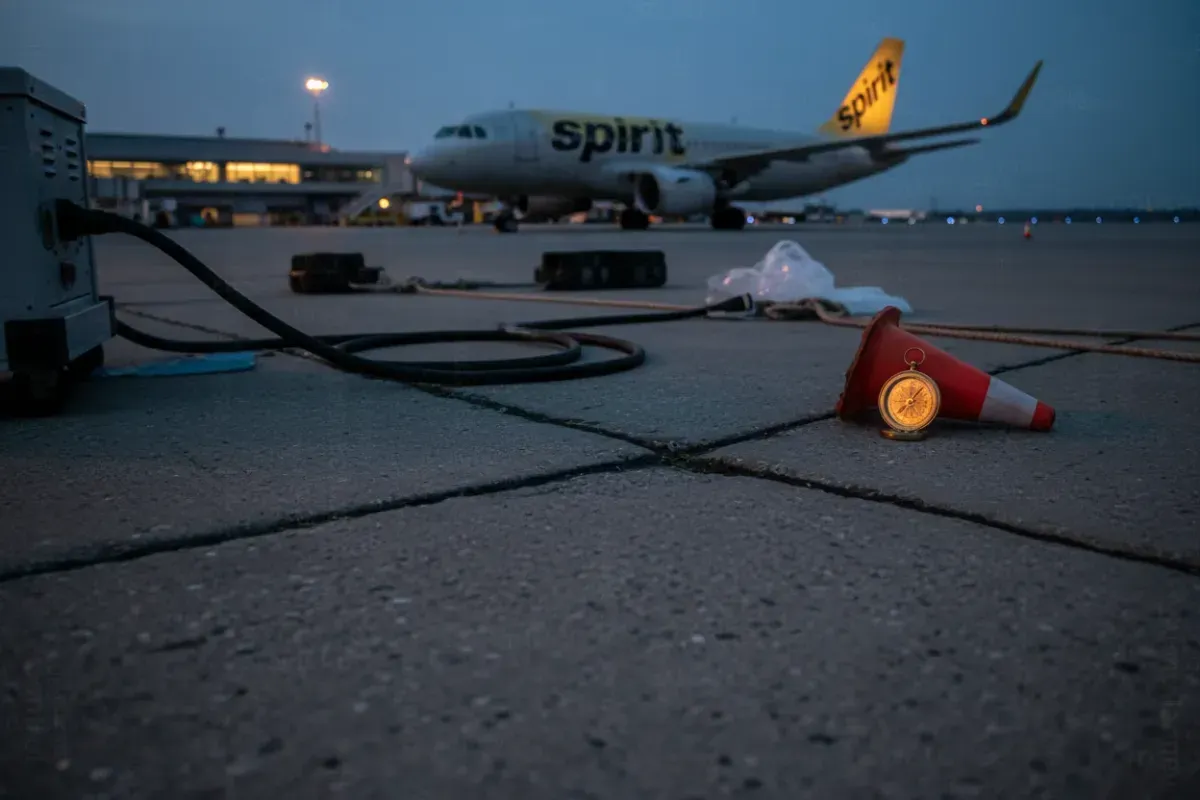
On April 16, 2026, a Spirit Airlines attorney told the bankruptcy court that a surge in jet fuel prices had left the carrier with "no remaining way out" of Chapter 11 protection. The airline that once reshaped low-cost travel across the United States now faces the concrete possibility of permanent grounding. FlySafe analysis shows the operational disruption risk for passengers on Spirit routes has reached levels that warrant close monitoring by travelers and industry stakeholders alike.
The question is no longer whether Spirit can return to profitability. The question is whether Spirit can survive the summer.
A Timeline of Two Bankruptcies
Spirit Airlines first filed for Chapter 11 bankruptcy protection on November 18, 2024. The filing came after years of mounting losses — net losses of $390 million in 2022 and $475 million in 2023, with long-term debt ballooning to over $3.3 billion by mid-2024. A proposed $3.8 billion acquisition by JetBlue, which would have provided a financial lifeline, was blocked by a federal court in January 2024 on antitrust grounds.
The first bankruptcy was structured as a prepackaged Chapter 11. Spirit received $300 million in debtor-in-possession financing from existing bondholders alongside a $350 million equity investment commitment. The airline equitized approximately $795 million of funded debt and emerged from Chapter 11 on March 12, 2025 — just 114 days after filing.
That reprieve proved short-lived. According to the Palm Beach Post, Spirit filed for bankruptcy a second time in August 2025, having struggled to turn a profit at any point since the onset of the COVID-19 pandemic in 2020. A restructuring agreement was announced in late February 2026, and on March 13, 2026, Spirit filed its Restructuring Support Agreement and Plan of Reorganization — internally designated "Project Soar" — targeting a summer 2026 exit from Chapter 11.
The plan was ambitious. Total debt and aircraft lease commitments would fall from approximately $7.4 billion before the filing to around $2.1 billion after emergence, a reduction of more than $5 billion. The airline would shrink to roughly 76 aircraft by mid-August 2026, reduce off-peak flying, adjust for seasonal demand, and target nearly $1 billion in cost reductions alongside revenue gains from premium seating and pricing adjustments.
On paper, Project Soar represented a credible path forward. Then jet fuel prices moved against every assumption in the plan.
The Fuel Cost Crisis
Spirit's restructuring projections assumed jet fuel prices of $2.24 per gallon in 2026 and $2.14 per gallon in 2027. As of mid-April 2026, according to Fortune, jet fuel was trading at $4.32 per gallon — nearly double the plan's baseline.
The financial impact is severe. J.P. Morgan estimated that if fuel remained at $4.60 per gallon, Spirit's projected 2026 operating margin would deteriorate from the 0.5 percent margin assumed in the restructuring plan to approximately negative 20 percent. The incremental cost burden: roughly $360 million — a figure that, as Fox Business reported, exceeds the $337 million in cash Spirit reported at the end of 2025.
Spirit's low-cost structure, once its competitive advantage, has become its greatest vulnerability. Ultra-low-cost carriers operate on razor-thin margins and depend on high load factors and minimal per-seat costs. When fuel costs surge, these carriers lack the pricing power of full-service airlines to pass increases through to passengers. As creditors behind Spirit's revolving credit facility argued in a court filing, the restructuring plan "may not be viable if fuel prices remain elevated."
Commodity market volatility, driven by regional security situations in key petroleum-producing areas, has created what creditors described as "an entirely new and unbudgeted strain" on the airline's projections. IATA's Global Outlook for Air Transport projects fuel to account for 25.7 percent of total airline operating expenses in 2026, with industry-wide fuel spend reaching $252 billion. For a carrier already in Chapter 11, this macro environment offers no margin for error.
Operational Status and Passenger Exposure
As of early May 2026, Spirit continues to operate flights. However, the carrier has been actively downsizing. The fleet target of 76 aircraft by mid-August 2026 represents a significant contraction from peak levels, and route reductions have already affected frequency and coverage across Spirit's network.
Spirit remains the dominant carrier at Fort Lauderdale-Hollywood International Airport (FLL), accounting for approximately one quarter of all passenger traffic. In 2025, a little over 9.1 million Spirit passengers flew through FLL — though this represented an 18 percent decline from 2024 levels, according to the Palm Beach Post.
Airspace status: Spirit's operational footprint, while diminished, still covers a substantial portion of the US domestic network and select Caribbean and Latin American routes. Passengers holding bookings on Spirit flights face elevated disruption risk, particularly for travel scheduled beyond mid-summer 2026.
Affected routes: Fort Lauderdale (FLL), Orlando (MCO), Las Vegas (LAS), and other high-density Spirit stations are most exposed to schedule reductions or potential cessation of service. Travelers with connections through Spirit-dominant airports should monitor schedule changes closely.
Recommendation: Based on publicly available NOTAMs and airline operational data, passengers with Spirit bookings for late summer and fall 2026 should consider contingency plans, including understanding their rights under DOT regulations regarding refunds in the event of carrier-initiated cancellations.
The Liquidation Scenario
The language from Spirit's own legal counsel — "no remaining way out" — signals a level of distress that goes beyond restructuring challenges. The airline has been seeking court approval to pay $10.7 million in retention bonuses to employees who remain during a potential wind-down, averaging $76,000 per participant.
Simultaneously, Spirit has reportedly asked the current administration for hundreds of millions of dollars in emergency government funding, according to Simple Flying. Whether such a bailout materializes remains uncertain. If neither rescue financing nor a workable bankruptcy exit emerges, the result could be a deeper breakup, with competitors acquiring pieces of the network — or full liquidation.
The broader consequences for the US aviation market would be material. As one industry analyst cited by The Points Guy noted, "losing Spirit would be a gut punch to cheaper travel." Spirit's competitive pressure on legacy carriers has historically kept domestic fares lower on overlapping routes. Without that pressure, travelers should anticipate fare increases, particularly on leisure-heavy routes where Spirit maintained significant market share.
Industry Context: Fuel Mitigation Strategies
The fuel cost challenge is not unique to Spirit, though Spirit is uniquely vulnerable to it. According to OpenAirlines, airlines across the industry have historically responded to fuel surges through a combination of hedging programs, schedule reductions, fuel surcharges, fleet optimization — parking older aircraft in favor of newer, more fuel-efficient models — and fuel optimization software that can generate savings of millions of dollars annually.
Carriers with hedging programs in place enjoy a distinct commercial advantage during price spikes, as they can maintain lower operating costs and attract passengers through more competitive pricing. Spirit, constrained by its bankruptcy status and limited cash reserves, lacks access to these conventional mitigation tools. The airline's inability to hedge, invest in fleet modernization, or absorb short-term losses makes it acutely sensitive to fuel market conditions in a way that financially healthier competitors are not.
IATA projects total airline industry costs to reach $981 billion in 2026, a 4.2 percent year-over-year increase, with the expiration of higher-cost hedges from 2025 expected to allow some carriers to realize lower average fuel prices closer to market levels. This dynamic benefits solvent airlines but offers no relief to a carrier already operating under court supervision with depleted reserves.
What Travelers and Operators Should Monitor
FlySafe analysis indicates several developments that warrant continued monitoring:
- Bankruptcy court proceedings: The court is expected to rule on whether Spirit has provided sufficient information for its restructuring plan to proceed. This ruling may determine whether Spirit continues operating or is forced into liquidation.
- Government funding decision: The outcome of Spirit's request for emergency government assistance will significantly influence the carrier's trajectory.
- Fuel price trajectory: Any sustained movement in jet fuel prices back toward the $2.50 range would materially improve Spirit's viability. Conversely, prices remaining above $4.00 per gallon make the restructuring arithmetic increasingly difficult.
- Route and schedule changes: Passengers should monitor Spirit's schedule filings for further frequency reductions or station closures, particularly at secondary airports where Spirit may be the sole or primary low-cost option.
Airlines have rerouted capacity planning in response to market conditions throughout aviation history. The difference in Spirit's case is the speed and severity of the external shock relative to the carrier's financial position. A $360 million incremental cost burden on a carrier with $337 million in total cash is not a scenario that permits gradual adjustment.
Analysis based on publicly available data only. FlySafe continues to track Spirit Airlines' operational status and will update risk assessments as court proceedings and market conditions evolve.
Frequently Asked Questions
What happens to my Spirit Airlines ticket if the airline files for bankruptcy?
During Chapter 11 bankruptcy, airlines typically continue to honor existing tickets and operate scheduled flights. However, if Spirit enters liquidation and ceases operations entirely, tickets would likely become worthless. The DOT requires airlines to provide refunds for flights they cancel, but recovery during liquidation proceedings is often limited. Credit card chargebacks may offer a faster path to reimbursement than bankruptcy claims.
Will other US airlines rebook me for free if my Spirit flight is canceled?
There is no regulatory requirement for competing airlines to rebook passengers from a failed carrier at no cost. Historically, some airlines have offered discounted "rescue fares" following a competitor's shutdown, but these are voluntary and not guaranteed. Travel insurance that includes carrier insolvency coverage is the most reliable protection.
How much did rising jet fuel costs impact Spirit's collapse?
The impact has been substantial and quantifiable. Spirit's restructuring plan assumed fuel at $2.24 per gallon, while actual prices reached $4.32 — nearly double. J.P. Morgan estimated this discrepancy could add approximately $360 million to Spirit's annual expenses, a figure exceeding the airline's entire reported cash balance. Commodity market volatility has been described by creditors as "an entirely new and unbudgeted strain" on the restructuring plan.
Does Spirit own or lease most of its aircraft fleet?
Spirit operates primarily with leased aircraft. The airline's pre-bankruptcy debt and lease obligations totaled approximately $7.4 billion, with the restructuring plan targeting a reduction to $2.1 billion. The fleet is being reduced to approximately 76 aircraft by mid-August 2026 as part of the downsizing strategy, with surplus aircraft returned to lessors.
- Spirit filed for bankruptcy twice in under a year — emerging from Chapter 11 in just 114 days in March 2025, then refiling in August 2025 — proving the first restructuring only restructured debt without solving the airline's fundamental inability to turn a profit at any point since 2020.
- Project Soar's plan to slash total obligations from $7.4B to $2.1B was rendered moot by a single input: jet fuel prices exceeded the $2.24/gal assumption baked into the restructuring model, which a Spirit attorney told the court left the carrier with "no remaining way out" of Chapter 11.
Powered by B1KEY
Live tools behind the analysis.
The signals FlySafe writes about are also published live — continuously verified by the Sentinel pipeline.
Information is accurate as of the publication date. FlySafe uses exclusively publicly available data.