By: FlySafe Research
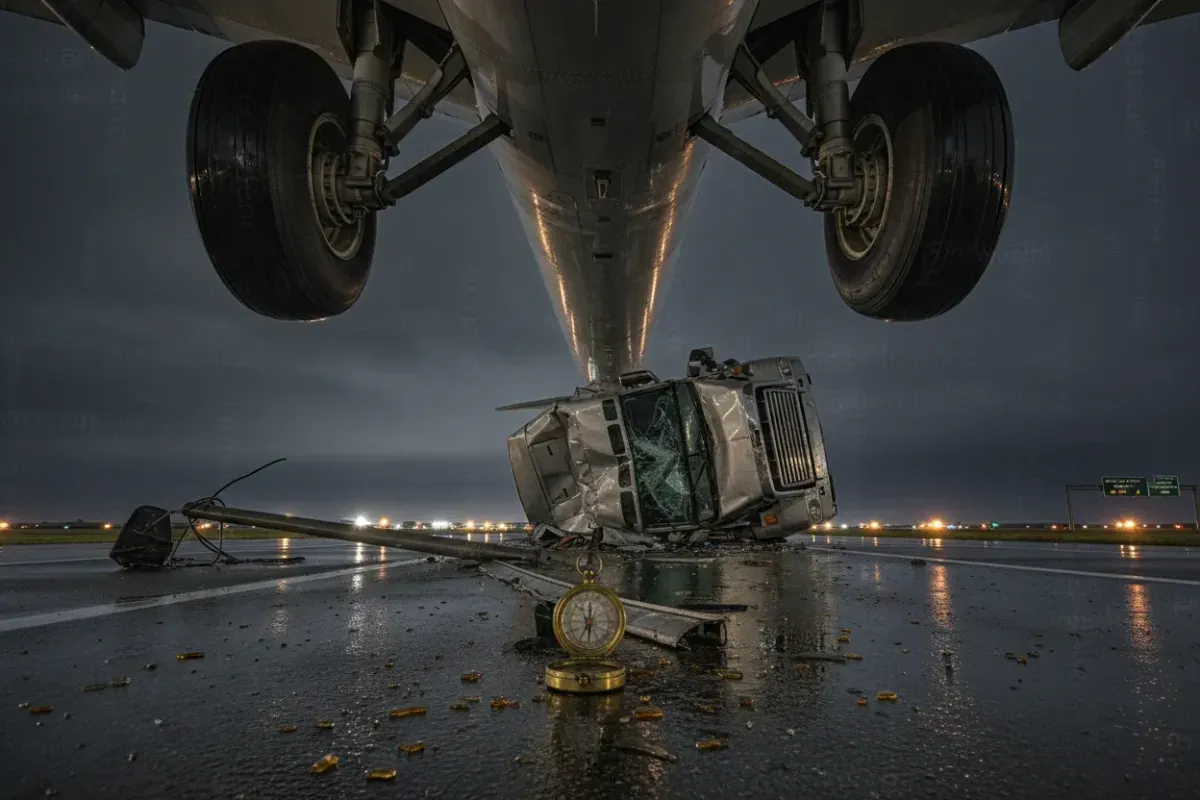
On May 4, 2026, a United Airlines Boeing 767-400ER operating as Flight 169 from Venice, Italy, made contact with a highway light pole and a tractor-trailer on the New Jersey Turnpike during final approach to Newark Liberty International Airport. The aircraft, carrying 221 passengers and 10 crew members, subsequently landed on Runway 29 and taxied to the gate under its own power. FlySafe analysis, based on publicly available data from the FAA and NTSB, examines the operational factors and safety implications of this occurrence.
Sequence of Events
According to CNN, a preliminary investigation determined that a tire from the aircraft's landing gear and the underside of the fuselage collided with a pole and a tractor-trailer on the New Jersey Turnpike. The dislodged pole then struck a third vehicle — a Jeep — on the highway. The Federal Aviation Administration confirmed that the aircraft was on a circling visual approach to Runway 29 when it crossed the Turnpike approximately 720 feet before the runway threshold, as reported by Aerotime.
The truck driver, Warren Boardley, was en route from Baltimore delivering bread for H&S Bakery to a depot at Newark Airport when the aircraft made contact with his vehicle. As noted by KETV, one of the aircraft's tires appears to have gone through the truck's windows and windscreen. Boardley sustained non-life-threatening injuries — cuts from broken glass to his arm and hand — and was transported to a local hospital, where he was treated and released. No passengers or crew members aboard the aircraft reported injuries.
A detail of particular concern, as captured in air traffic control recordings reviewed by CNN, is that neither the flight crew nor air traffic control appeared to be immediately aware that the aircraft had struck the light pole during landing.
Aircraft and Flight Details
The aircraft involved is a 23-year-old Boeing 767-424ER, registration N77066, as identified in reporting by Paddle Your Own Kanoo. The 767-400ER is the stretched variant of the 767 family, operated by United Airlines primarily on transatlantic routes. Flight UA169 is a regularly scheduled service between Venice Marco Polo Airport (VCE) and Newark (EWR), with an approximate flight time of nine to ten hours.
United Airlines released a statement confirming: "Upon its final approach into Newark International Airport, United flight 169 came into contact with a light pole. The aircraft landed safely, taxied to the gate normally and no passengers or crew were injured," as reported by AirLive. The airline further stated that its maintenance team would evaluate damage to the aircraft and that "a rigorous flight safety investigation" would be conducted, with the crew removed from service as part of that process.
The aircraft remains grounded at Newark pending the completion of structural assessment and the regulatory investigation.
NTSB and FAA Investigation
The National Transportation Safety Board classified the occurrence as an accident — not an incident — specifically "because of the extent of damage to the airplane," according to Aerotime. This classification carries significant procedural implications: it triggers a full NTSB investigation with a dedicated investigator-in-charge, mandatory preservation of evidence, and a comprehensive final report.
The NTSB dispatched an investigator to Newark and directed United Airlines to obtain and preserve the cockpit voice recorder (CVR) and flight data recorder (FDR). As reported by Paddle Your Own Kanoo, the investigation "will examine multiple factors, including flight operations, meteorological conditions, human performance, crew resource management, aircraft performance and air traffic control." The NTSB indicated that a preliminary report is expected within 30 days.
The FAA has also launched its own parallel investigation into why the aircraft was at an altitude low enough to make contact with objects on the Turnpike during the final phase of approach, as confirmed by Simple Flying.
The Circling Visual Approach: Operational Context
The fact that the crew was executing a circling visual approach to Runway 29 is a critical element of this occurrence. Circling approaches are among the most demanding procedures in commercial aviation. They require the flight crew to maintain visual contact with the runway environment while maneuvering the aircraft at low altitude, often in configurations not aligned with the final approach course.
At Newark, Runway 29 is not served by a precision instrument approach. Circling to this runway from another approach course demands precise altitude management, particularly given the surrounding terrain and infrastructure — including the New Jersey Turnpike (Interstate 95/New Jersey Turnpike), which passes in close proximity to the runway threshold. The 720-foot distance before the threshold where the aircraft crossed the Turnpike suggests the aircraft's vertical profile was below the expected glide path during the final seconds of approach.
Airspace status: Newark Liberty International Airport operates within some of the most complex and congested airspace in the United States. The New York Terminal Radar Approach Control (TRACON) manages arrivals and departures across Newark, JFK, and LaGuardia, with traffic density that frequently requires non-standard approach procedures and runway configurations. Circling approaches at EWR, while operationally necessary under certain wind conditions, introduce additional risk factors that are well-documented in aviation safety literature.
Implications for Airport Infrastructure and Approach Procedures
The proximity of the New Jersey Turnpike to Newark's Runway 29 threshold has been a recognized factor in airport operations for decades. The Turnpike carries tens of thousands of vehicles daily directly beneath the approach and departure corridors. While obstacle clearance surfaces are defined by FAA Order 8260.3 and ICAO Annex 14, these standards account for fixed obstacles — light poles, signage, and other permanent structures. Vehicles on the Turnpike, particularly tractor-trailers with heights exceeding 13 feet, represent transient obstacles that are managed through minimum descent altitudes rather than physical barriers.
This incident raises questions about the adequacy of current obstacle clearance margins for circling approaches at airports with highway infrastructure in the immediate vicinity of runway thresholds. FlySafe analysis shows that several major airports worldwide share similar configurations — London Heathrow's Runway 27L passes over the A30, and Chicago Midway's approaches traverse residential areas at low altitude — but the combination of a circling approach and highway proximity at Newark presents a distinct risk profile.
Affected routes: All operations to and from Runway 29 at EWR may be subject to revised procedures or enhanced scrutiny pending the outcome of the NTSB investigation. Airlines operating into Newark should monitor NOTAMs for any temporary amendments to circling approach minima or procedural changes.
What the Flight Data Will Reveal
The CVR and FDR are expected to provide definitive answers about the aircraft's altitude, speed, configuration, and flight path in the final minutes before touchdown. Key data points that investigators will examine include:
- Vertical profile: Whether the aircraft was on, above, or below the prescribed minimum descent altitude for the circling approach, and at what point the descent below safe clearance occurred.
- Airspeed management: Whether the aircraft's approach speed was within normal parameters for its weight and configuration.
- Crew communications: What callouts were made (or omitted) during the approach, and whether standard operating procedures for circling approaches were followed.
- ATC instructions: What clearances and altitude assignments were issued, and whether any advisories or alerts were triggered.
- Weather conditions: Visibility, wind speed and direction, and any factors that may have affected the crew's ability to maintain visual contact with the runway environment.
- Enhanced Ground Proximity Warning System (EGPWS): Whether any terrain or obstacle warnings were generated prior to the contact event.
The fact that neither the crew nor ATC initially detected the contact, as indicated by LiveATC recordings reviewed by CNN, suggests the physical impact may have been relatively subtle from the cockpit perspective — consistent with a tire strike rather than a full undercarriage impact. However, the NTSB's classification of this event as an accident based on aircraft damage severity indicates that the structural consequences were more significant than initial impressions may have suggested.
Historical Precedent
Low approach incidents, while rare in modern commercial aviation, are not without precedent. The aviation safety record includes several notable cases where aircraft have come into dangerously close proximity with obstacles during final approach phases. Each such event has historically led to revisions in approach procedures, obstacle assessment criteria, or crew training requirements.
Recommendation: Operators conducting circling approaches at airports with highway infrastructure near runway thresholds should review their standard operating procedures and crew training curricula related to minimum descent altitude adherence and visual segment management. Based on publicly available NOTAMs and FAA guidance, any procedural changes resulting from the NTSB investigation will likely be communicated through Safety Alerts for Operators (SAFOs) or Airworthiness Directives as appropriate.
Key Takeaways
This occurrence underscores several enduring themes in aviation safety: the inherent complexity of circling visual approaches, the challenges of operating in congested airport environments with ground-level infrastructure, and the critical importance of precise altitude management during the final phase of flight. The NTSB investigation will determine the specific causal and contributing factors, but the broader safety community should treat this event as a prompt to re-examine procedures and training related to circling approaches at airports with similar configurations.
FlySafe will continue to monitor the NTSB investigation and update its risk assessment for Newark operations as new information becomes available. The preliminary NTSB report, expected within 30 days, will provide the first substantive data-driven account of the causal chain.
Analysis based on publicly available data only. FlySafe Research does not possess or utilize classified information. All sources cited are independently verifiable through public records, regulatory filings, and published reporting.
Frequently Asked Questions
Why was the Boeing 767-400 descending low enough to strike objects on the New Jersey Turnpike during final approach?
The aircraft was executing a circling visual approach to Runway 29, a procedure that requires the crew to maneuver at low altitude while maintaining visual contact with the runway. The NTSB investigation will determine whether the aircraft descended below the prescribed minimum descent altitude and, if so, what factors contributed to that deviation. The aircraft crossed the Turnpike approximately 720 feet before the runway threshold.
What prevents vehicles on Interstate 95 from entering the direct flight path of planes landing at Newark?
There are no physical barriers separating highway traffic from approach corridors at Newark or similar airports. Safety is maintained through prescribed minimum descent altitudes and obstacle clearance surfaces defined by the FAA and ICAO. Vehicles, including tractor-trailers, are transient obstacles accounted for in approach design through vertical separation margins rather than ground-level restrictions.
What systemic failures allowed an aircraft to descend below safe clearance over a major public highway?
It is premature to characterize the event as a systemic failure before the NTSB completes its investigation. The Board will examine flight operations, human performance, crew resource management, meteorological conditions, aircraft performance, and air traffic control procedures. The CVR and FDR data will be essential in determining whether existing safeguards — including EGPWS alerts and ATC monitoring — functioned as designed.
- A United Airlines Boeing 767 on final approach to Newark struck a highway light pole and a tractor-trailer on the New Jersey Turnpike, with the aircraft crossing the Turnpike just 720 feet before the runway threshold — an extraordinarily tight margin that raises serious questions about the approach geometry.
- Neither the flight crew nor air traffic control were immediately aware the aircraft had struck the light pole, revealing a critical gap in real-time situational awareness during low-altitude approach phases.
Powered by B1KEY
Live tools behind the analysis.
The signals FlySafe writes about are also published live — continuously verified by the Sentinel pipeline.
Information is accurate as of the publication date. FlySafe uses exclusively publicly available data.