By: FlySafe Research
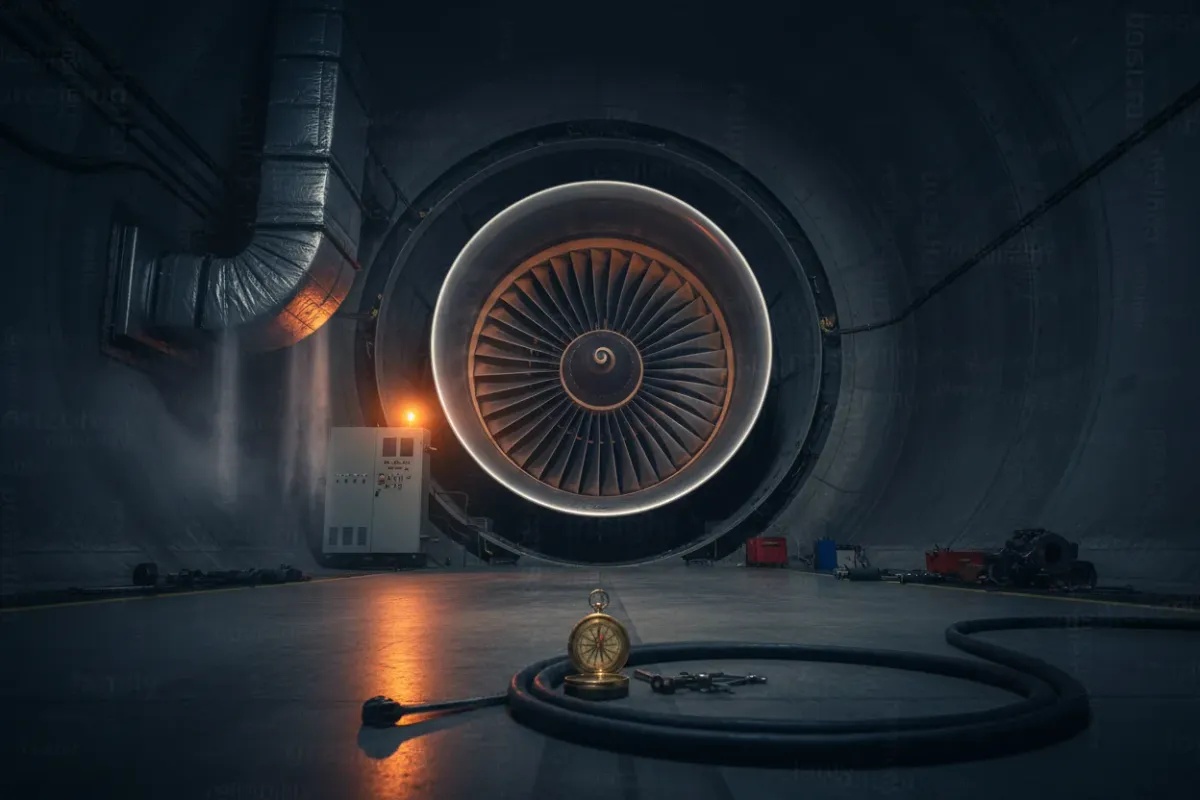
A gas turbine engine running entirely on hydrogen has achieved full take-off power during ground testing — a development that moves hydrogen-fueled commercial aviation from theoretical modeling into hardware validation. FlySafe analysis shows that while the path from ground-test success to certified airborne powerplants remains long, the engineering milestones now being recorded carry direct implications for future airspace planning, route economics, and airport infrastructure across global aviation networks.
From Laboratory Concept to Ground-Test Reality
The idea of burning hydrogen in an aircraft engine is not new. According to the FAA's Hydrogen-Fueled Aircraft Safety and Certification Roadmap, hydrogen-fueled aircraft were demonstrated in both the United States and the Soviet Union — Project Suntan in the 1950s and the TU-155 in the 1980s — but efforts were halted due to shifting priorities and onboard fuel storage challenges. The concept has been studied since as early as 1918, as noted in ICAS research on turbofan thermodynamic potential.
What distinguishes the current generation of ground tests is the convergence of modern materials science, advanced combustor design, and a regulatory environment that now actively supports certification pathways for alternative-fuel powerplants. The FAA roadmap confirms that conventional gas turbine designs could likely be modified to use hydrogen instead of — or even concurrent with — jet fuel or sustainable aviation fuel (SAF). That assessment underpins the current wave of hardware programs.
Rolls-Royce, working in partnership with easyJet, has conducted a series of ground tests aimed at developing hydrogen combustion engine capabilities for aircraft, including those in the narrow-body market segment. The collaboration combines Rolls-Royce's expertise in engine development and combustion systems with easyJet's operational knowledge and experience, and directly supports commitments to achieving net-zero carbon emissions by 2050.
Engineering Challenges at the Combustor Level
Reaching full take-off power on hydrogen is a more complex engineering task than the milestone might initially suggest. Hydrogen behaves fundamentally differently from kerosene inside a gas turbine. According to the FAA roadmap, hydrogen produces a combustor exhaust with water content exceeding 20 percent by volume — compared to less than 8 percent with kerosene. That elevated moisture level places new thermal and material demands on turbine blades, exhaust nozzles, and downstream components.
Furthermore, the FAA notes that pressures and temperatures prior to hydrogen injection are too high to prevent flashback, flame stabilization in the injector, and autoignition immediately upon injection. These are not theoretical concerns. They are active engineering constraints that ground tests are designed to characterize, measure, and ultimately resolve.
Hydrogen also exhibits an order of magnitude higher diffusivity in the gas phase compared to kerosene. This means leaks propagate faster, mixing behavior in the combustor differs substantially, and the entire fuel delivery architecture must be re-evaluated from first principles. Research at the USC Viterbi School of Engineering, supported by the U.S. Department of Energy, has focused on designing supersonic spraying techniques as part of an additive manufacturing process to coat turbine interiors with a thermal barrier layer — protecting engine structures from the higher combustion temperatures that hydrogen produces.
The variables under investigation include nozzle distance from the engine wall, injection speed, temperature levels, and the physical properties of the protective spray. These spray particles solidify to form a thermal barrier on the combustion turbine surface — a critical enabling technology for engines that must sustain hydrogen combustion at full power over extended duty cycles.
The Cryogenic Storage Problem
No discussion of hydrogen aviation is complete without addressing the storage challenge. Liquid hydrogen (LH2) must be maintained at approximately minus 253 degrees Celsius in pressurized, heavily insulated tanks. As reported by Scientific American, this requirement adds weight that directly reduces range, cargo capacity, and passenger load.
A 2022 McKinsey study, cited by the same source, concluded that with current aircraft designs, hydrogen aircraft could be range-limited to approximately 2,500 kilometers — roughly the distance between London and Istanbul. While that range covers a significant share of short- and medium-haul routes, it falls well short of the intercontinental missions that dominate airline economics.
Rolls-Royce has addressed part of this challenge through a recently patented hydrogen fuel system designed specifically for gas turbine engines. As detailed by Fuel Cells Works and Simple Flying, the system incorporates a main fuel conduit with a specialized pump that delivers pressurized fuel to the engine's core combustor, along with an auxiliary combustor that burns a small portion of the hydrogen to pre-heat the remaining fuel. This approach tackles one of the most persistent problems in cryogenic fuel delivery: managing the extreme temperature differential between stored LH2 and the conditions required for stable combustion.
The volume penalty remains significant. Hydrogen requires substantially more storage space than traditional jet fuel, posing design constraints for airframes and airport infrastructure alike. Francisco José Lucas, head of sustainable aviation at Repsol, was quoted by Scientific American as stating that the full potential of hydrogen in aviation is not yet known, and significant challenges remain on the road to making it technically and economically feasible.
Implications for Airport and Airspace Infrastructure
The transition from ground testing to flight testing — and eventually to commercial service — will require infrastructure changes that extend far beyond the aircraft itself. Airports will need LH2 storage, transfer, and fueling systems capable of handling cryogenic fluids at scale. Safety perimeters, fire suppression protocols, and ground handling procedures will all require revision.
From an airspace operations perspective, hydrogen-fueled aircraft are expected to operate within existing air traffic management structures. However, the range limitations identified in current studies suggest that early hydrogen routes will concentrate on high-density short-haul corridors — precisely the segments where airspace congestion is already most acute. FlySafe analysis indicates that airspace planners and route designers should begin incorporating hydrogen-range assumptions into long-term capacity models, particularly for European and intra-Asian networks where sub-2,500-kilometer sectors dominate.
Additionally, as noted in a comprehensive review published in the International Journal of Hydrogen Energy, the lack of refueling infrastructure, high production costs, and the entrenched market position of carbon-based fuels have collectively impeded hydrogen commercialization in aviation. New engine modules have been designed to accommodate hydrogen fuel cells economically, but the supporting ecosystem remains in early development.
The green hydrogen supply question also warrants attention. Val Miftakhov, CEO of ZeroAvia, noted that most hydrogen currently produced for transportation is not zero-emission — it is not green hydrogen. For the environmental premise of hydrogen aviation to hold, the fuel itself must be produced via electrolysis powered by renewable energy sources. Without that supply chain, the airborne emissions benefit is partially offset by upstream carbon intensity.
Military and Research Heritage Informing Civil Applications
The U.S. Department of Defense has explored hydrogen fuel operation for gas turbine engines in research documented by the Defense Technical Information Center (DTIC). That work included modifications to the C30, a 30-kilowatt electrical generating gas turbine, for hydrogen operation. The JetCat engine studied in the same program was originally designed for initial combustion with propane followed by continued operation on kerosene — its hydrogen operation characteristics were unknown because the engine was designed to burn liquid fuel.
Computational fluid dynamics (CFD) simulations were used to identify areas within the combustion chamber requiring modification for safe hydrogen operation. Recommendations from that research included improvements to the hydrogen fuel supply line and exploration of hydrogen capturing systems to create fuel cells capable of running and refueling the turbine within a single integrated system. These findings from defense-funded research continue to inform the civil aviation programs now reaching ground-test maturity.
What Full Take-Off Power Means for the Certification Timeline
Achieving full take-off power on the ground is a necessary but not sufficient step toward certification. It demonstrates that the thermodynamic cycle, combustor stability, fuel delivery, and turbine thermal protection can function together at the most demanding operating point an engine faces. Take-off power represents the peak thermal and mechanical stress condition for any gas turbine — validating it on hydrogen confirms that the fundamental engineering is sound.
The steps that follow are extensive: altitude testing, endurance testing, bird ingestion and containment testing, icing certification, and the full spectrum of type certification requirements under EASA CS-E or FAA 14 CFR Part 33 regulations. Each of these must be completed with hydrogen-specific failure modes and safety margins fully characterized.
The ICAS thermodynamic analysis underscores that the influence and potential of hydrogen on engine performance is still being quantified, particularly given the complexities introduced by storing fuel at 20 Kelvin and burning it at far higher temperatures and pressures. Ground-test data now being collected will feed directly into the certification evidence packages that regulators will evaluate.
Key Takeaway
The achievement of full take-off power from a hydrogen-fueled gas turbine engine during ground testing represents a meaningful engineering milestone — not a commercial-readiness announcement. Significant work remains on cryogenic storage, airport infrastructure, green hydrogen supply chains, and regulatory certification before hydrogen-fueled aircraft enter revenue service. However, the gap between concept and hardware demonstration has now been closed for the most demanding engine operating condition. FlySafe continues to monitor developments in alternative propulsion and their implications for airspace operations, route planning, and aviation safety standards. Operators, airports, and airspace authorities are advised to track hydrogen aviation developments as part of long-term strategic planning.
Analysis based on publicly available data only.
Frequently Asked Questions
Why is cryogenic liquid hydrogen required for aircraft instead of gaseous hydrogen?
Gaseous hydrogen at ambient conditions occupies far too much volume to be practical for aviation. Liquid hydrogen, stored at approximately minus 253 degrees Celsius, offers a dramatically higher energy density per unit volume — though it still requires roughly four times the tank volume of kerosene for equivalent energy content. The cryogenic requirement introduces insulation weight and boil-off management challenges, but remains the only viable storage approach for airborne applications given current technology.
Can hydrogen engines throttle fast enough to meet aviation safety requirements?
Aviation regulators require engines to accelerate from idle to full power within seconds to support go-around and emergency climb scenarios. Ground tests at full take-off power are a critical step in validating that hydrogen combustion dynamics — including flame stability, fuel metering, and thermal response — can meet these transient performance requirements. The higher reactivity and diffusivity of hydrogen compared to kerosene introduces unique control challenges that must be fully characterized before flight certification.
How is excess heat from hydrogen combustion managed in engine design?
Hydrogen combustion produces higher flame temperatures and significantly more water vapor than kerosene combustion. Thermal management strategies under development include advanced thermal barrier coatings applied to turbine surfaces via supersonic spray techniques, as well as active cooling using the cryogenic hydrogen fuel itself as a heat sink before it enters the combustor. These dual-use thermal management approaches are central to current ground-test programs.
- Achieving full take-off power on hydrogen during a ground test marks a genuine shift from theoretical modeling to hardware validation — but the article is explicit that the path to a certified airborne powerplant remains long, so the milestone should not be read as near-term readiness.
- Hydrogen produces combustor exhaust with over 20% water content by volume versus less than 8% for kerosene, imposing fundamentally different thermal and material demands on turbine blades and downstream components — making the engineering challenge deeper than simply swapping fuel.
- What distinguishes today's programs from the failed 1950s–80s attempts (Project Suntan, TU-155) is not just better materials and combustor design, but an FAA regulatory environment that now actively defines certification pathways for hydrogen powerplants — removing a structural barrier that previously killed prior efforts.
Powered by B1KEY
Live tools behind the analysis.
The signals FlySafe writes about are also published live — continuously verified by the Sentinel pipeline.
Information is accurate as of the publication date. FlySafe uses exclusively publicly available data.