FlySafe was not operational during these events. This analysis reconstructs publicly available signals and operational patterns — to demonstrate the monitoring capabilities our system now provides.
UAE Precautionary Closures
March 2026
Not one event — a pattern. Four separate precautionary airspace closures at Dubai International in 24 days. Each one brief. Each one cascading into days of global disruption. Together, they exposed a systemic vulnerability: what happens when the world's busiest hub has no early warning system.
Context
Following the February 28 regional closures, UAE reopened its airspace under ESCAT (Emergency Security Control of Air Traffic) restrictions. Emirates resumed at reduced capacity. Etihad operated at roughly 15%.
But the crisis was far from over. Between March 7 and March 30, four separate incidents forced DXB to halt operations — each time with zero advance warning to airlines, and each time creating cascading disruption far beyond the closure itself.
for international passengers
per year (2025)
by Emirates alone
The Four Incidents
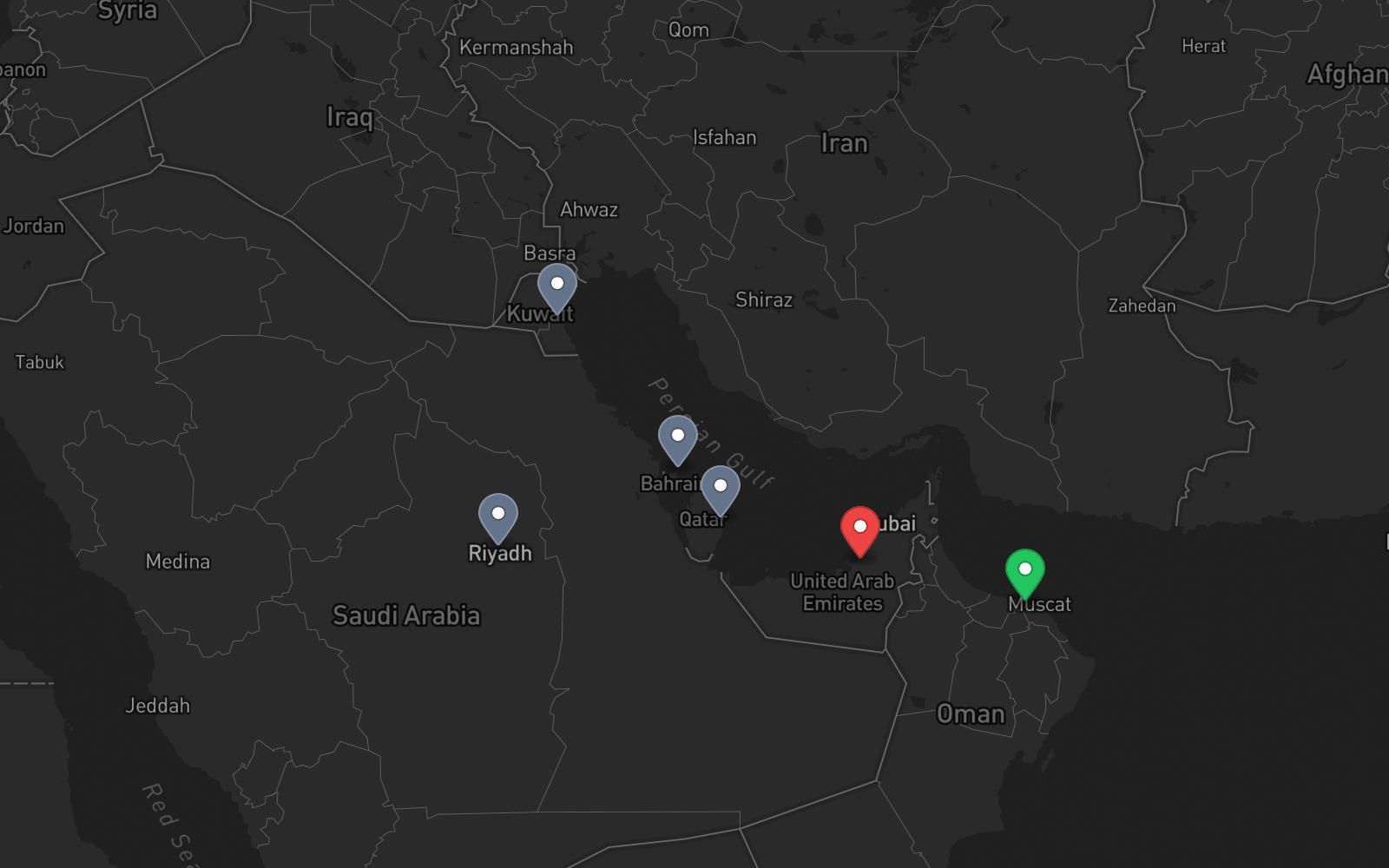
Each incident followed the same pattern: sudden closure, zero airline pre-warning, diversions to airports already under stress, days of cascading rebooking chaos.
Drone incident near DXB Terminal 3. Brief operational halt, flights held on ground. Operations resumed within hours. First signal that the February pattern would continue.
Drone strike on fuel storage infrastructure near DXB. Airport operations suspended for 7 hours. 65+ flights diverted to Muscat, Riyadh, and Kuwait City. 300+ movements disrupted.
Overnight: GCAA declared full OMAE airspace closure as an "exceptional precautionary measure" — approximately 2 hours of complete shutdown.
Drone debris struck Terminal 3 arrivals roof. Brief shutdown. 11 flights diverted to Al Maktoum (DWC), Muscat, and Doha.
Drone-related fire near DXB at 6:30 AM. Operations suspended. Multiple Emirates flights diverted to Al Maktoum. Fourth disruption in 24 days.
Signals That Were Available
While individual drone incidents were unpredictable, the elevated risk environment was clearly visible across multiple public data sources throughout March:
CZIB 2026-03 active throughout March, revised R3→R4→R5. R4 issued March 18: "avoid all altitudes and flight levels" for OMAE. Updated every 2–10 days as situation evolved.
Emergency Security Control of Air Traffic active since February 28. Extended to March 16 (then further). Overflights restricted to single LUDID waypoint — a clear indicator of sustained threat.
After March 7 and March 16, the pattern was established: drone incidents at 7–10 day intervals. March 26 and 30 followed the same pattern.
Emirates at ~60% capacity by March 12. Etihad at ~15%. European carriers fully suspended under EASA CZIB. 4.4 million seats cut across GCC. These are not normal operations.
Ongoing cross-border drone and missile exchanges documented throughout March. Each incident correlating with subsequent airspace disruption.
UAE advisory elevated from "exercise increased caution" to "reconsider travel" in early March. A rare escalation for a major business destination.
Timeline
Initial OMAE closure as part of regional shutdown. ESCAT activated. All DXB/DWC operations suspended.
ESCAT extended to March 16. Emirates resumes limited operations. Overflights restricted to single waypoint (LUDID). European carriers remain grounded under EASA CZIB.
First post-reopening incident. Drone near DXB Terminal 3. Brief halt. Signal that threat is not diminishing.
Gradual capacity recovery. Emirates reaches ~60%, Etihad ~15%. EASA CZIB remains active. NOC (No Objection Certificate) required for each corridor entry.
Drone strikes fuel storage near DXB. 7-hour suspension. 65+ flights diverted to MCT, RUH, KWI. Overnight: full OMAE closure, ~2 hours. 300+ movements disrupted.
EASA issues CZIB R4 (March 18). Recovery restarts. Airlines rebuild schedules — again.
Drone debris hits Terminal 3 arrivals roof. 11 flights diverted. Third incident in 20 days.
Drone fire near DXB at 06:30. Operations suspended. Emirates flights divert to DWC. Fourth incident. EASA extends CZIB R5 to April 10.
The Cascade Effect
A 2-hour closure at DXB does not cause 2 hours of disruption. It causes days. Here's why:
With incidents every 7–10 days, DXB never fully recovered before the next closure. Each cascade compounded the previous one. Airlines operated in a permanent state of disruption for the entire month.
Aviation Impact
Cumulative cancellations since February 28 across the Gulf region. DXB bore the largest share as the dominant hub.
Capacity removed from GCC routes in the disruption period. Asia-Europe overflights rerouted, adding 90–120 minutes per flight.
Oxford Economics estimate for 2026 regional tourism spending loss. 23–38 million fewer visitors expected across affected countries.
While Emirates operated at ~60%, Etihad struggled at ~15%. European carriers fully suspended under EASA prohibition. Air India and IndiGo reported losses.
Takeaway
The individual incidents were hard to predict. The elevated risk environment was not. EASA bulletins, ESCAT restrictions, prior incident patterns, reduced airline capacity, and escalated travel advisories all pointed to the same conclusion: DXB was operating in a high-risk environment where further disruption was probable.
Airlines that maintained contingency routing and pre-positioned alternates weathered each incident better. Those that treated each recovery as "back to normal" were caught off guard — repeatedly.
Had a system like FlySafe been operational, the sustained CRITICAL risk level for OMAE may have been visible — not buried across separate EASA revisions, NOTAMs, and news reports. Operators could have seen a single, persistent warning: this FIR is not safe to treat as normal.
Sources
- EASA — Conflict Zone Information Bulletin 2026-03, revisions R3–R5 (March–April 2026)
- UAE GCAA — ESCAT activations and NOTAM publications for OMAE FIR
- OpsGroup — Middle East Airspace: Current Operational Picture (continuous updates)
- Dubai Airports — Operational status updates (media.dubaiairports.ae)
- Oxford Economics — Regional tourism impact assessment, $34–56B estimate
- Gulf News — 23,000+ flight cancellations across GCC, airline capacity reporting
- CNBC, Al Jazeera, The National — Incident reporting and airline response coverage
- Safe Airspace — Conflict zone risk database (safeairspace.net)
All data sourced from publicly available records, aviation authority publications, and open news reporting.
This is a retrospective analysis of publicly documented events. FlySafe's prediction system was not operational during these events. Signal categories described are based on data sources that were available at the time and are now part of FlySafe's monitoring pipeline. All information is sourced from public records, EASA publications, and open data.