Edmonton (YEG) Traffic Down 62% on Sunday 1 November 2026 — a Day of Freezing Fog, Not a Gap in Our Data
- The −62% on 1 November is a reading from our own feed, and on this occasion the cross-checks say it reflects fewer flights, not lost coverage. A second receiver network saw a similar fall, and flights that normally land at Edmonton landed at Calgary far more often than usual.
- It coincided with a day of freezing fog: visibility at or below half a mile for about 23 hours from 08:04 UTC on 1 November. Calgary had clear weather and a normal day, and no closure signal registered in the Edmonton FIR (CZEG).
- The fog had lifted by 08:51 UTC on 2 November; whether traffic recovered is not yet readable in our data. Observed counts are a floor, not a total — for a specific flight, check your airline or the airport.
Advisory timeline — how active is this episode
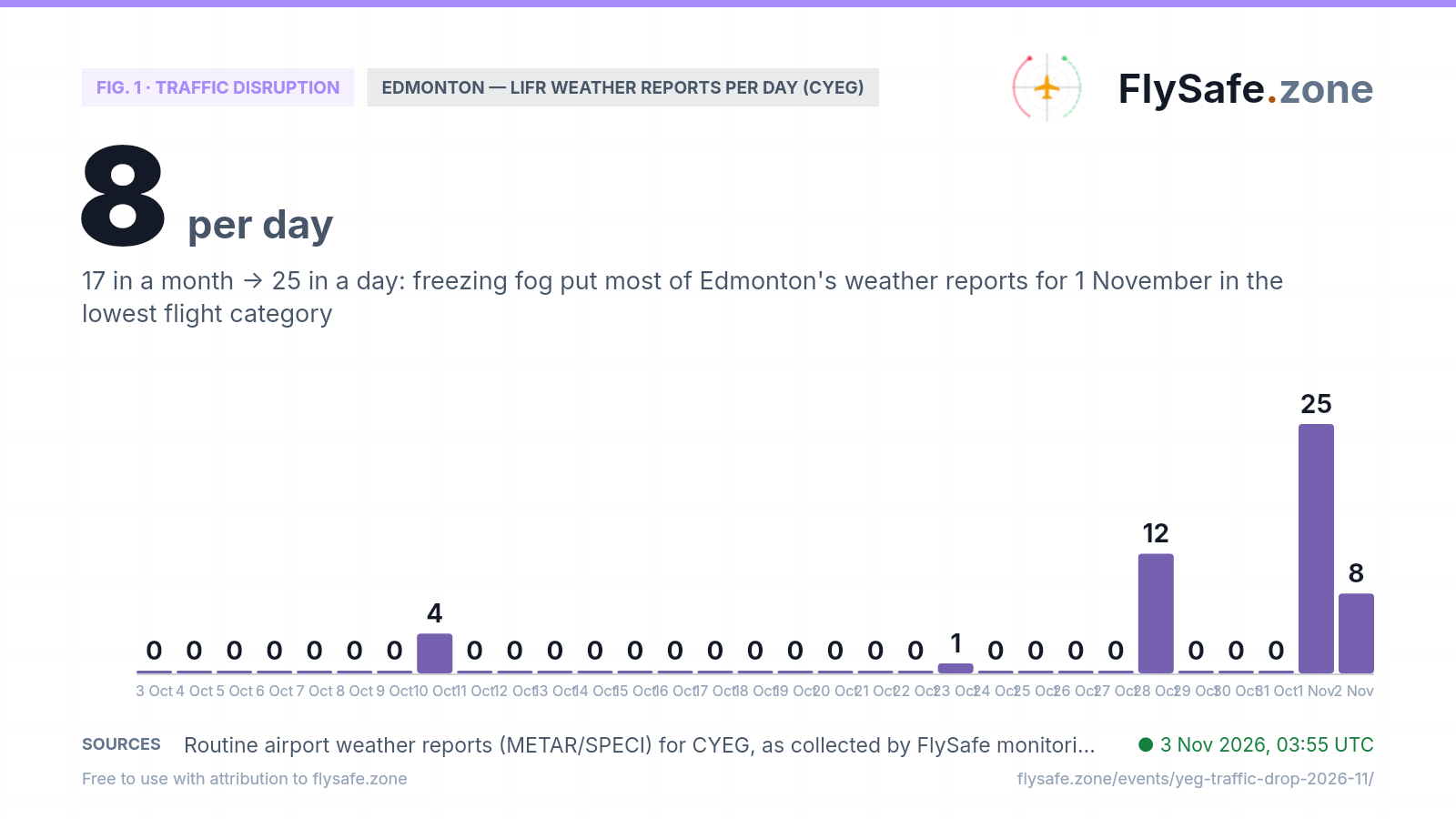
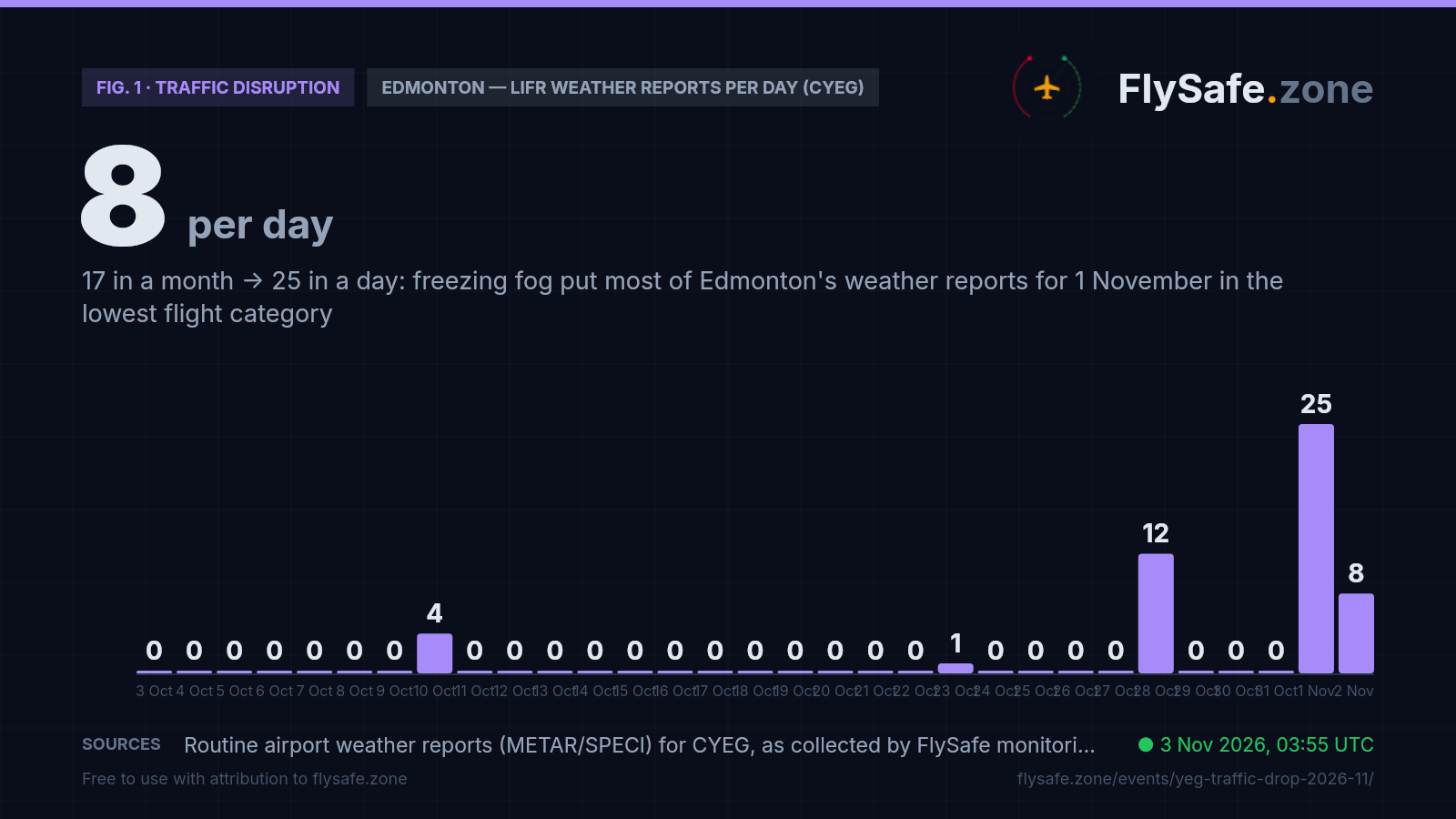
This chart does not count flights — it counts how many of Edmonton's routine weather reports each day fell into LIFR, the lowest flight category (cloud ceiling below 500 ft or visibility below one mile). Across 3–31 October that happened 17 times in 791 reports, on three days: 4 on 10 October, 1 on 23 October, 12 on 28 October. On 1 November it was 25 of 38. Freezing fog set in at 08:04 UTC; from then until 07:00 UTC on 2 November, 32 of 33 reports put visibility at or below half a mile — down to 1/8 mile for long stretches, with vertical visibility of 100–400 ft and runway visual range on runway 02 mostly between 700 and 2,600 ft (briefly higher around 14:30 UTC; lowest at 17:00 and 18:11 UTC). Eight more LIFR reports followed on 2 November before visibility lifted to 2¼ miles at 07:55 UTC and to VFR at 08:51 UTC. For contrast: the 12 LIFR reports of 28 October came on a day when traffic held at 307 movements, level with the 312 and 319 of the two Wednesdays before — what set 1 November apart is how long and how deep the fog sat:
Fig. 1 — Routine weather reports at Edmonton International (CYEG) in the LIFR category, per UTC day, 3 Oct – 2 Nov 2026 · Data as of 3 Nov 2026, 03:55 UTC · Source: Routine airport weather reports (METAR/SPECI) for CYEG, as collected by FlySafe monitoring.
Airports in the exposure zone
| Airport | Size | Observed signal | FIR |
|---|---|---|---|
| Edmonton International Airport (YEG) | large | — · 1 Nov: 93 observed movements (58 dep / 35 arr), −62% vs ~243 on prior Sundays; freezing fog, LIFR in 25 of 38 reports; second network 119 (−51%) | CZEG |
| Calgary International Airport (YYC) | large | 246 km · 415 movements on 1 Nov vs 430 on 25 Oct; VFR all day; second network 445 vs 445; Edmonton-bound callsigns landed here 39 times vs 7 | CZEG |
| Saskatoon John G. Diefenbaker International Airport (YXE) | large | 480 km · Also in fog — LIFR in 28 of 39 reports on 1 Nov; 30 departures vs 39 on 25 Oct (provisional) | CZWG |
| Vancouver International Airport (YVR) | large | — · 568 movements on 1 Nov vs 682 on 25 Oct — departures −14% like-for-like, in line with the feed-wide softness that day | CZVR |
| Winnipeg / James Armstrong Richardson International Airport (YWG) | large | — · 199 movements on 1 Nov vs 210 on 25 Oct — departures 120 vs 116 like-for-like | CZWG |
Distance alone does not determine impact — wind direction and the flight levels the ash reaches decide which airports and routes are affected on a given day. FIR = Flight Information Region.
What our monitoring shows: a real thinning at Edmonton, concentrated in the fog hours
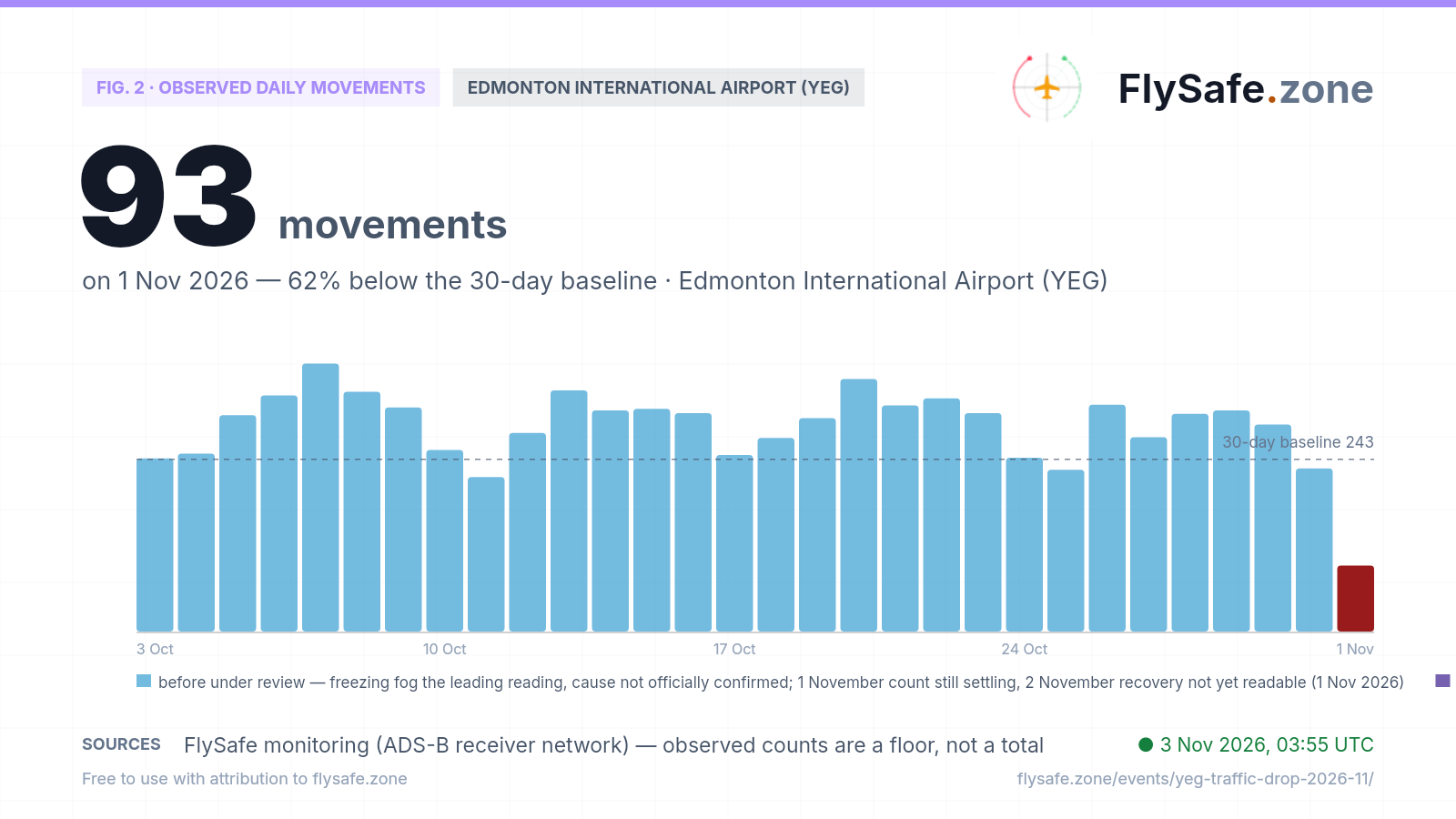
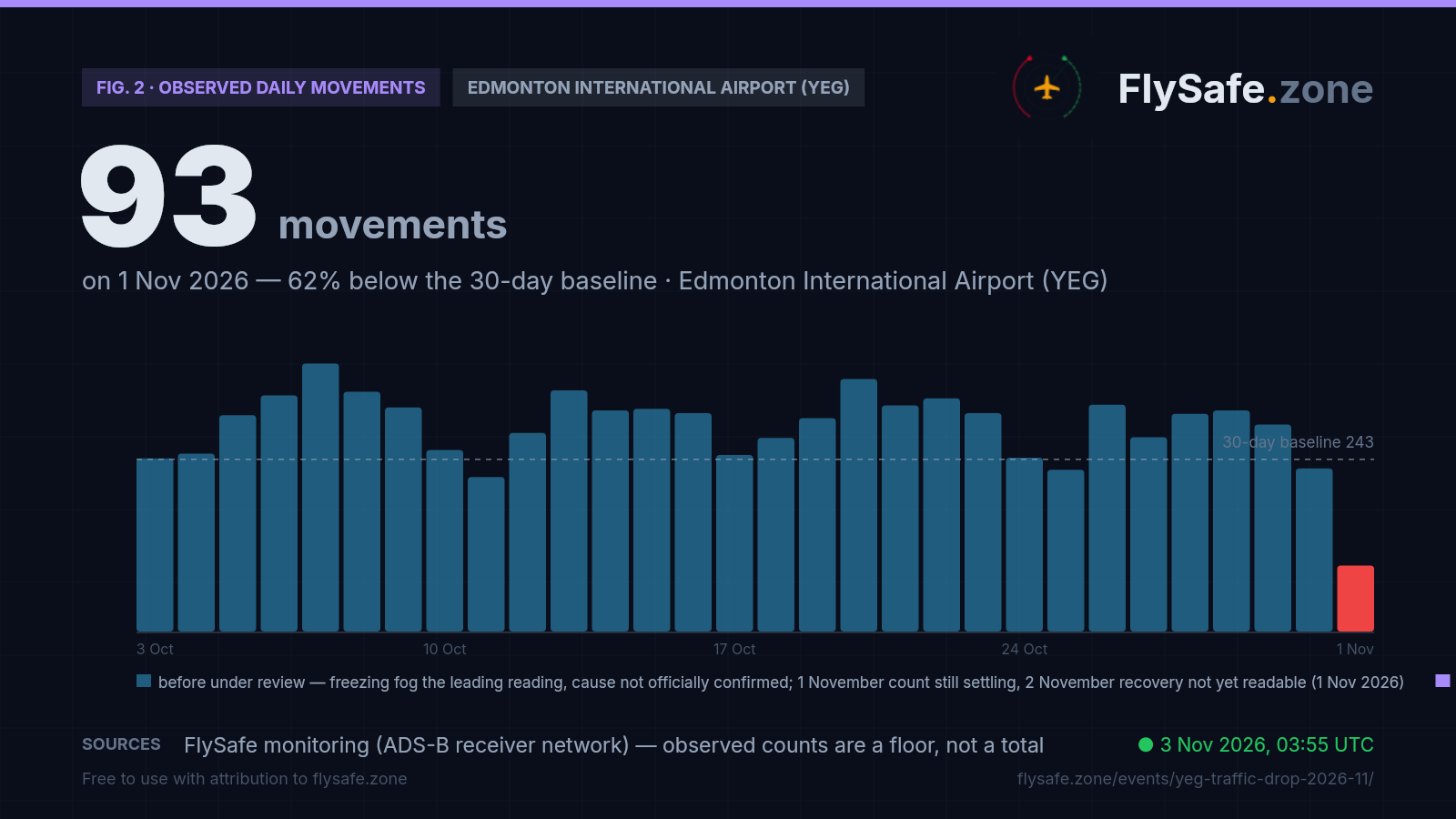
FlySafe tracks observed departures and arrivals at 493 airports from crowdsourced ADS-B receiver data. Observed counts are a floor, not a total — receiver coverage varies — but an airport measured against its own baseline is a reliable shape. Edmonton International Airport's last 30 days:
Fig. 2 — Observed daily movements at YEG, 3 Oct – 1 Nov (latest complete UTC day). Data as of 3 Nov 2026, 03:55 UTC · Source: FlySafe monitoring (ADS-B receiver network).
- Baseline = the four Sundays before: 251, 218, 273 and 228 observed movements (4–25 Oct), ~243 a day. Sunday 1 Nov came in at 93 — −62% against that baseline (58 departures, 35 arrivals). Detection fired at −64% against a seven-day rolling average of ~256 that already included the 1st itself and a partly loaded 31 October.
- The loss sits in the fog hours. From 08:00 to 23:59 UTC our feed recorded 36 departures and 9 arrivals at Edmonton, against 98 and 69 in the same UTC hours on 25 October; from 17:00 UTC (10:00 local) to midnight UTC, 4 departures and 6 arrivals against 47 and 59. Before 08:00 UTC — the evening of 31 October local time, before the fog — the counts were close to normal: 22 departures and 26 arrivals against 32 and 29. Hours are UTC; clocks in Alberta went back an hour on 1 November, so local banks shift by one hour against 25 October.
- Every operator thinned. The airport's largest operator by our count flew 22 departures against 30 on 25 October; the second-largest flew 4 against 25.
- Not a collection-gap day — but the feed was softer everywhere. Network-wide, 1 November holds 114,337 takeoff records, 76% of the 14-day median (~149,650) and above our 60% gap rule. At the same point of ingestion, though, it sits 13% below 25 October, and Calgary (−9% departures like-for-like), Vancouver (−14%) and Toronto (−8%) read lower by about that much. Edmonton's like-for-like departures are −50% (58 vs 117) — well outside that feed-wide softness.
- Provisional days, flagged: 1 November is two days old. On 18–29 October, 90–97% of a day's Edmonton departures were in our records by this point, so a few more movements are likely, not enough to change the picture; the day settles on the nightly refresh of 5 November. 31 October is plotted from a recount of the raw flight records, 230 (129 departures, 101 arrivals) — the stored 195 was clipped by a routine refresh — and settles on 4 November. 3 October is read from the daily rollup (244). 2 November is barely begun in the movement layer and is not read here.
Observed counts are a floor, not a total — they measure what our receivers heard, and they are meaningful only while coverage holds. Live view: YEG airport brief.
What it means for flights
What fired, and what we checked. Our detection layer flagged YEG when Sunday 1 November came in at 93 observed movements against a rolling seven-day average of ~256 — a −64% traffic anomaly at the airport. Against the four Sundays before it (~243 a day) the reading is −62%. A drop that size can be an operational event or a failure of the instrument, so automated multi-signal analysis checks it against every other layer we track before anything is claimed: the hour-by-hour shape of the count, the flights behind it, a second receiver network, neighbouring airports, weather, closure signals and GNSS interference. Here, unlike the Alicante coverage anomaly in October, the layers line up on a real thinning of traffic — and on one candidate cause.
A day of freezing fog. Edmonton's routine weather reports were VFR through the evening of 31 October local time. At 08:04 UTC on 1 November they turned to freezing fog — visibility half a mile, vertical visibility 200 ft — and then worsened: 1/8 mile for much of the day, a report of zero visibility with fog estimated at about 300 ft at 17:00 UTC, runway visual range on runway 02 mostly between 700 and 2,600 ft. In all, 32 of 33 reports from 08:04 UTC on 1 November to 07:00 UTC on 2 November put visibility at or below half a mile; 25 of the 38 reports on 1 November were LIFR, against 17 in the 791 reports of 3–31 October. Winds stayed near calm, which is what lets radiation fog sit. Saskatoon, 480 km east, logged LIFR in 28 of its 39 reports the same day; Calgary, 246 km south, logged 24 VFR reports with visibility of at least 12 miles. As interpretation rather than measurement: in visibility this low, whether an arrival can land depends on the runway's approach equipment and on each aircraft's and crew's low-visibility approval, and departures thin out later in the day when the aircraft that would fly them did not arrive. That fits the shape we measured — a morning bank of 32 departures against 47, then 4 departures and 6 arrivals after 17:00 UTC against 47 and 59.
The flights did not fly from here — they did not vanish from our view. The test that separates a real drop from lost coverage is continuity. We took every callsign that departed Edmonton in our records on 11–31 October and counted their flights on each day, from any airport. On 1 November they flew 221 times, against 303 on 25 October; 54 departed Edmonton (129 the Sunday before), 122 departed somewhere else (134), and 45 could not be tied to any departure airport (40). The untagged share did not move — the signature of a receiver outage, as at Alicante, is that it jumps. The inbound side shows where some flights went: callsigns that had landed at Edmonton earlier in the month flew 229 times on 1 November against 303, landed at Edmonton 31 times against 98 — and landed at Calgary 39 times, against 7 on 25 October. We label the method honestly: a callsign is a flight number, not a specific aircraft or rotation, and this is a continuity indicator, not a diversion log. It is consistent with flights diverting to Calgary or not operating, and not consistent with flights operating normally out of our sight.
A second network saw it too; Calgary did not. We cross-check against a second crowdsourced ADS-B aggregate built on different volunteer receivers. It recorded 119 movements at Edmonton on 1 November (68 departures, 51 arrivals), against 234 and 252 on the two Sundays before — −51% — and 445 at Calgary, exactly its count of 25 October. In our own feed Calgary read 415 against 430. Our feed was softer network-wide on 1 November — 13% below 25 October at the same point of ingestion, with Vancouver and Toronto down by about that much — but that is a fraction of Edmonton's fall, and the second network does not share it at Calgary. Saskatoon, also in fog, recorded 30 departures in our feed against 39 on 25 October; at a smaller airport that difference is within normal noise, and we do not read it as an event.
No closure, no interference — and one blind spot. No closure event registered in the Edmonton FIR (CZEG) in our records this autumn — a FIR-level statement about airspace signals, not a claim about operations at Edmonton, which belong to the airport, the airlines and Canadian aviation authorities. Next door, the Winnipeg FIR (CZWG) carries a low-confidence (0.18) flag of unknown cause spanning 29 October to 1 November, built on two weak signals; nothing in the movement counts corroborates it, and we do not link it to Edmonton. GNSS interference across CZEG sat at 0.03% of aircraft on 1 November (5 of 18,381), in line with 0–0.07% on 26–31 October, and the airport's own seven-day interference ratio is zero. The blind spot we name: our NOTAM set carries no records for the Edmonton FIR at all, so we cannot say whether a notice was issued for YEG on 1 November.
What would change this page. Three things decide it. The settling count: 1 November settles on the nightly refresh of 5 November; we expect a few more movements, not ~150. The next day: visibility at Edmonton was back to VFR by 08:51 UTC on 2 November; if Monday 2 November reads near the ~300 movements of recent Mondays (280, 301 and 320 on 12, 19 and 26 October), this closes as a one-day weather event; if traffic stays low with the weather clear, the page stays open and the fog reading weakens. An official signal: a closure, a NOTAM or an operational notice for YEG appearing in any layer would sharpen or change the framing. Until then we publish measured signals and their timing, not conclusions about why individual flights did not operate.
Passenger questions, answered from the data
No closure signal registered in the Edmonton FIR (CZEG) in the layers we track, and flights did continue at a reduced rate — our feed recorded 93 movements that day against ~243 on recent Sundays. The drop coincided with freezing fog that held visibility at or below half a mile for about 23 hours from 08:04 UTC. Our NOTAM set carries no records for the Edmonton FIR, so we cannot confirm or rule out a formal notice. For official status, check the airport or your airline.
We publish what we measured, not airline decisions. What we measured: Edmonton's weather reports showed freezing fog from 08:04 UTC, with 25 of the day's 38 reports in the lowest flight category; most of the lost traffic fell in those hours; a second receiver network saw a similar −51% fall; and flight callsigns that normally land at Edmonton landed at Calgary 39 times, against 7 the Sunday before. That pattern is consistent with fog-related diversions and cancellations, but the reasons for individual flights belong to the airlines and the airport.
The observed count did — 93 movements on 1 November 2026 against ~243 on the four Sundays before. Observed counts are a floor, not a total, and the day is still settling, though on recent days 90–97% of departures were already in our records at the same point. Two checks say the drop is real rather than lost coverage: a second receiver network recorded −51%, and the share of flights our feed could not tie to any airport did not rise. Our feed was about 13% softer network-wide that day, which accounts for a small part of the figure.
We publish measured signals, not safety verdicts — operating decisions belong to airlines, the airport and Canadian aviation authorities, who work from complete operational data rather than crowdsourced tracking. What we can say: Edmonton's weather reports were back to VFR by 08:51 UTC on 2 November and have stayed there through our latest data; whether traffic recovered on 2 November is not yet readable in our records. For any specific flight, check your airline on the day of travel.
For media — the full kit
Everything on this page — charts, CSV, quotes — is published under CC BY 4.0: free to reuse with attribution to FlySafe.zone. Charts come in dark (social/web) and light (print/light layouts) versions; attribution and license are embedded in every file.
“Observed traffic at Edmonton International Airport fell 62% below its recent Sunday average on 1 November, to 93 recorded movements, on a day when freezing fog held visibility at the airport at or below half a mile for about 23 hours; a second receiver network recorded a similar fall, flight callsigns that normally land at Edmonton landed at Calgary 39 times against 7 the Sunday before, and Calgary itself ran a normal day under clear skies — a pattern consistent with fog-related diversions and cancellations, though the cause has not been officially confirmed, according to flight-monitoring service FlySafe.zone.”
Boilerplate — about the source (for your article footer)
FlySafe.zone monitors airspace risk and observed airport activity worldwide: 334 flight-information regions scored daily, GPS-interference signals, volcanic-ash exposure and daily observed movements at 493 airports from the crowdsourced ADS-B receiver network. Methodology: flysafe.zone/methodology.
Need a different cut of the data, a comment, or numbers for another airport? Leave an email — we answer fast during active events.