By: FlySafe Research

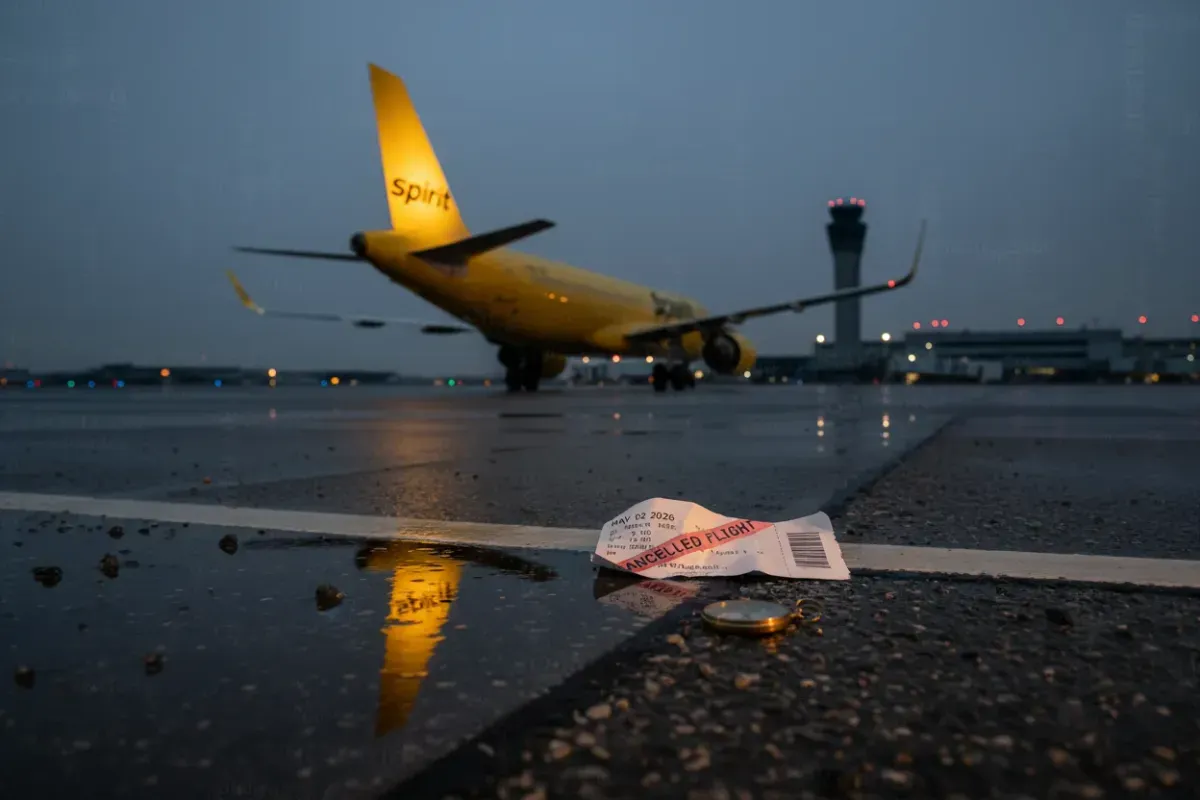
On a Saturday morning, approximately 17,000 employees of Spirit Airlines received the notification that their airline — after 34 years of continuous service — would cease all operations effective immediately. What began as a structured series of furloughs during Chapter 11 bankruptcy proceedings had, within months, become one of the largest airline workforce dislocations in recent U.S. aviation history. FlySafe analysis shows the progression from targeted crew reductions to full operational shutdown followed a pattern that merits close examination by aviation professionals, workforce planners, and policymakers alike.
From Restructuring Furloughs to Operational Collapse
Spirit Airlines entered bankruptcy protection with a plan to emerge as a smaller but viable carrier. The restructuring involved significant workforce reductions designed to align staffing with a reduced fleet of approximately 94 Airbus A320-family aircraft, according to AeroMorning.
The initial round of furloughs affected well over 2,000 workers directly. As reported by Metaintro, approximately 1,800 flight attendants — roughly one-third of the cabin crew — were furloughed. An additional 150 corporate and operational positions were eliminated, and maintenance stations in Baltimore and Chicago were closed. The airline also planned to furlough 365 pilots, though those specific cuts were later canceled because pilots were voluntarily departing at a rate faster than projected.
Between September 1, 2024, and November 1, 2025, approximately 500 pilots were involuntarily furloughed as Spirit reduced flying and attempted to match crew levels to its diminished schedule. Additional indirect job losses were recorded at airports where the airline suspended service entirely.
The March 2026 Recall: A Brief Reversal
In early March 2026, Spirit Airlines appeared to be stabilizing. On March 9, the airline sent recall notices to nearly all 500 furloughed pilots, as CNBC reported. A company memo reviewed by CNBC attributed the decision to "higher-than-expected attrition" that had strained operations beyond what planners had modeled.
"Pilot attrition has been higher than forecast, making precise alignment between staffing and the reduced schedule more challenging," the airline stated in the internal communication. Spirit similarly announced recalls for furloughed flight attendants around the same period.
The recall suggested a pathway toward the carrier's stated goal of exiting Chapter 11 later in 2026. Management and bondholders had articulated a restructuring plan intended to produce a fully viable airline moving forward. For a brief window, the trajectory appeared to be one of recovery.
Commodity Market Disruption and the Final Phase
That trajectory reversed sharply. As outlined in a letter from the Association of Flight Attendants-CWA, Spirit CEO Dave Davis cited "global geopolitical tensions" that had "driven a sharp and sustained increase in fuel prices" as having "materially impacted" the airline's financial position and the viability of its restructuring plan.
Commodity market volatility — a significant predictive factor in airline operational continuity — proved to be the decisive blow. Sustained elevated fuel costs eroded the financial assumptions underlying the bankruptcy exit plan. The restructuring that had been positioned as a bridge to long-term viability was no longer tenable under the revised cost structure.
Spirit Airlines ceased all operations, canceling every remaining flight. The shutdown was effective immediately, with no wind-down period for passengers or crew. Based on publicly available data, approximately 17,000 employees were impacted by the closure, as documented across multiple reports including Business Insider.
Workforce Impact by Region
The geographic footprint of the workforce dislocation has been substantial, concentrated in Spirit's key hub states.
Florida
Nearly 5,000 employees in Florida were affected by the shutdown. According to AOL News, the state established a dedicated helpline (1-800-385-3920) for displaced Spirit workers. Regional workforce boards including CareerSource South Florida and CareerSource Broward activated free job placement services, resume assistance, and training program access. A spokeswoman for the Florida Department of Commerce confirmed that the state's unemployment trust fund balance was sufficient to absorb the surge in claims.
Georgia
The Georgia Department of Labor reported approximately 650 employees impacted in the state, with layoffs effective May 3. Atlanta had served as one of the airline's primary hubs, making the local aviation labor market impact particularly concentrated.
Michigan
Former Spirit ticket and gate agents reported filing for unemployment benefits at Michigan Works facilities, as documented by WXYZ Detroit. Employees noted that official notification from the airline arrived only hours after the news had already broken publicly — in some cases not until nearly noon on Saturday, despite the 3 a.m. announcement. Workers with decades of seniority at Spirit face the prospect of starting at entry-level positions at other carriers.
Government and Union Response
The U.S. Department of Labor designated the Spirit closure as a qualifying mass-dislocation event. The DOL's dedicated Spirit Airlines page confirmed that Rapid Response Services were activated and that National Dislocated Worker Grant funding may be made available to reconnect affected workers with in-demand employment. The department also directed workers to COBRA information for temporary continuation of employer-provided health insurance.
The Association of Flight Attendants-CWA, representing nearly 5,500 flight attendants at Spirit, formally urged the Bankruptcy Court for the Southern District of New York to prioritize the full and timely payment of workers' earned compensation. The union's request specifically referenced accrued vacation, earned wages, and per diem owed under the AFA–Spirit Collective Bargaining Agreement. Reports from affected employees indicated they had been told they would "only receive pay for time worked," with accrued paid time off in question.
Implications for the U.S. Aviation Labor Market
The Spirit Airlines closure removes an ultra-low-cost carrier that had operated for more than three decades, displacing a workforce of approximately 17,000 across pilots, flight attendants, gate agents, maintenance technicians, and corporate staff. Several operational and workforce factors warrant attention from the broader aviation community.
Airspace status: Routes previously served exclusively or primarily by Spirit now have reduced or eliminated service. Airports where Spirit was a significant carrier — particularly in Florida, Georgia, and the upper Midwest — face capacity adjustments.
Affected routes: The full scope of discontinued routes spans Spirit's former domestic and international network across the Americas. Passengers and travel management companies should verify alternative carrier availability on former Spirit routes.
Recommendation: Aviation workforce professionals, airport authorities, and regional economic development agencies in Spirit hub cities should anticipate sustained demand for reemployment services. The specialized nature of aviation credentials — type ratings, recency requirements, security clearances — means that displaced workers face time-sensitive windows for transitioning to equivalent positions at other carriers.
The pilot recall in March, followed by full shutdown weeks later, illustrates the volatility that commodity market disruption can introduce into airline restructuring proceedings. FlySafe analysis shows that fuel cost sensitivity remains a critical variable in the operational viability of carriers operating under financial restructuring, particularly those with limited cash reserves and narrow route economics.
Key Takeaway
The Spirit Airlines furlough-to-shutdown sequence represents a case study in how workforce reductions during airline bankruptcy can transition from managed restructuring to complete cessation when external cost variables shift unfavorably. Over 17,000 workers were affected, federal and state rapid response mechanisms were activated, and the U.S. ultra-low-cost carrier segment lost a legacy operator.
FlySafe continues to monitor the operational and route-level implications of the Spirit Airlines closure for aviation professionals and stakeholders. Further analysis will be published as workforce transition data and route reallocation patterns become available.
Analysis based on publicly available data only. FlySafe Research does not possess, access, or utilize any classified or non-public information. All sources referenced are independently verifiable.
- Spirit's furloughs were initially a deliberate restructuring tool aimed at a smaller but viable airline — not a prelude to collapse — making the eventual full shutdown a failure of the restructuring plan itself, not its starting condition.
- Voluntary pilot attrition during bankruptcy significantly outpaced forecasts, forcing recall notices for nearly all 500 furloughed pilots just weeks before shutdown — a concrete warning that workforce models underestimate departures during prolonged uncertainty.
Powered by B1KEY
Live tools behind the analysis.
The signals FlySafe writes about are also published live — continuously verified by the Sentinel pipeline.
Information is accurate as of the publication date. FlySafe uses exclusively publicly available data.