By: FlySafe Research
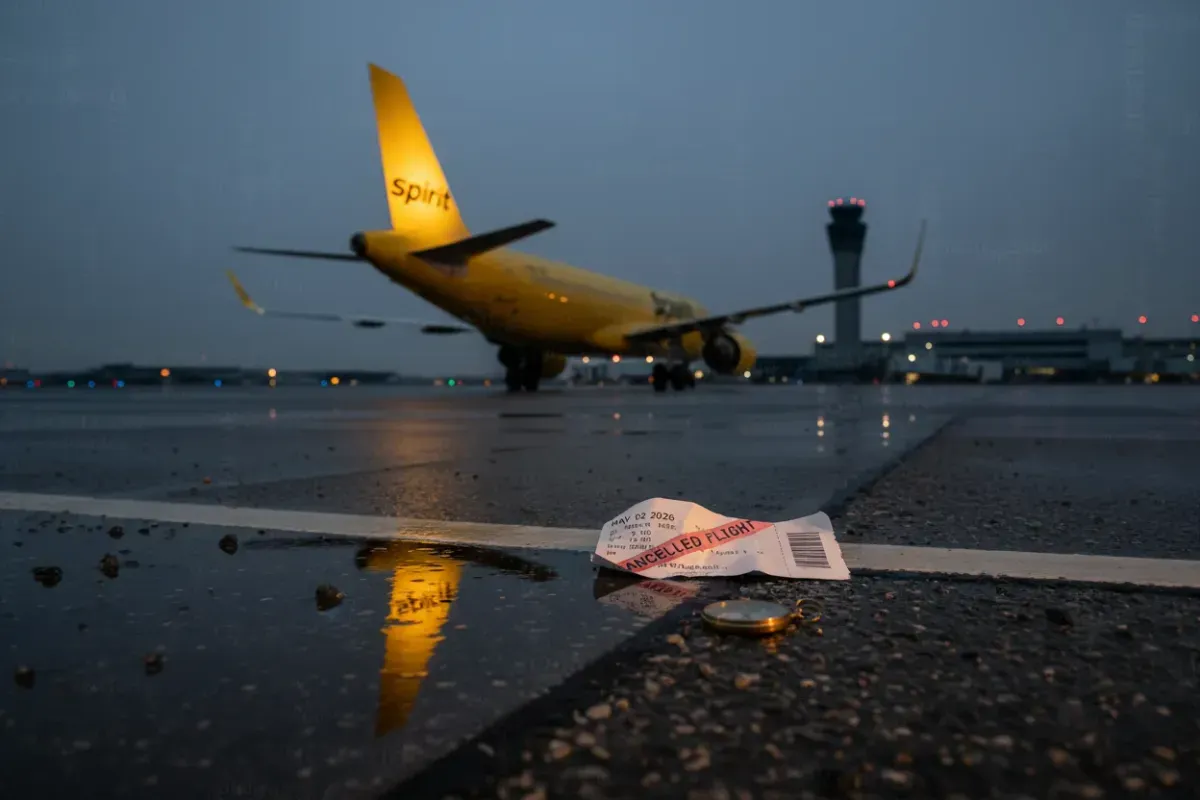
On May 2, 2026, Spirit Airlines ceased all operations — permanently. After 34 years as one of the largest ultra-low-cost carriers in the United States, the airline cancelled all flights with immediate effect and confirmed that customer service is no longer available. FlySafe analysis shows the sudden removal of a carrier that transported approximately 1.7 million domestic passengers in February 2026 alone has created significant disruption across dozens of domestic and international routes, particularly in the southeastern United States and Caribbean markets.
This bulletin examines the operational impact, available passenger remedies, and the route-level consequences of this shutdown based on publicly available data only.
The Final Flight and Wind-Down Timeline
According to NBC Chicago, Spirit Airlines' final revenue flight landed at Dallas Fort Worth International Airport, arriving from Detroit Metropolitan Airport. The orderly wind-down was structured so that all aircraft completing their final routes were safely on the ground and their respective crews accounted for before the cessation took effect.
As reported by The Independent, legal representatives filed court motions in a New York bankruptcy court to begin a rapid wind-down strategy focused on liquidating all available assets — including aircraft, engines, and spare parts — while simultaneously reducing expenses such as payroll and leasing obligations.
The airline's trajectory toward this outcome had been visible for some time. Spirit first filed for Chapter 11 bankruptcy protection in November 2024, and according to CBS News, the carrier had lost more than $2.5 billion since the start of 2020 by that point. A second bankruptcy filing followed in August 2025, when court documents revealed $8.1 billion in debts against $8.6 billion in assets, as noted by NBC Chicago.
The company cited rising fuel costs driven by commodity market volatility, along with persistent operational and financial pressures, as the factors that ultimately proved insurmountable. An effort to secure $500 million in federal funding did not result in an agreement, and with no additional funding sources available, the wind-down became the only remaining option, as NPR reported.
Affected Routes and Operational Footprint
Airspace status: Spirit Airlines has vacated all of its route network with immediate effect. The carrier's largest base was Fort Lauderdale International Airport (FLL), which served as the hub for a substantial portion of its domestic and Caribbean operations.
Affected routes: In 2025 alone, Spirit had already cut approximately 200 underperforming routes along with nearly 4,000 jobs, ending the year with roughly 7,500 employees, including 2,000 pilots and 3,000 flight attendants, according to CBS News. The full shutdown now removes all remaining routes from the market.
The closure is expected to directly impact approximately 17,000 employees, as reported by WCNC. FlySafe analysis shows that Spirit's removal disproportionately affects price-sensitive leisure routes between mid-size U.S. cities and Florida, as well as connections to Caribbean and Latin American destinations where Spirit maintained consistent service.
Markets most likely to experience reduced capacity include Fort Lauderdale, Orlando, Las Vegas, Detroit, and Atlantic City — cities where Spirit held meaningful market share and where alternative low-cost service is not always abundant.
Passenger Impact: Tickets, Refunds, and Rebooking
Recommendation: Passengers holding Spirit Airlines tickets should understand that a full liquidation proceeding is underway. Based on publicly available NOTAMs and airline communications, the following applies:
Ticket Status
All Spirit Airlines flights have been cancelled. The airline has confirmed that tickets will not be transferred to other carriers. Travelers are responsible for securing their own replacement flights. Customer service is no longer operational through Spirit's channels.
Refund Process
Passengers who purchased tickets with credit cards should contact their card issuer to initiate a chargeback or dispute. Those who booked through third-party travel agencies should contact the agency directly. Under the liquidation process, passengers become unsecured creditors, which historically means limited recovery through bankruptcy proceedings. The credit card dispute route is generally the most effective path for individual consumers.
Travel Insurance
Travelers who purchased trip protection or travel insurance policies should file claims promptly. Most comprehensive travel insurance policies cover airline bankruptcy or cessation of operations, though coverage terms vary by provider. Documentation of the original booking and the cancellation should be retained.
Rescue Fares and Alternative Carrier Response
Several major carriers have responded to the disruption by introducing special fare programs for displaced Spirit passengers. This response is noteworthy for its breadth and speed.
Southwest Airlines
Southwest Airlines has made special fares available at airport ticket counters through May 6, 2026. Domestic fares are tiered by distance, ranging from $200 to $400 one-way, as reported by WCNC. Passengers should note that these fares are available only at physical ticket counters, not online.
American Airlines
American Airlines has introduced "rescue fares" on routes where its network overlaps with Spirit's former service. The carrier has stated it is evaluating additional capacity measures, including deploying larger aircraft and scheduling supplemental flights on affected routes. According to The Points Guy, American Airlines stated it is "prepared to do all it can to support Spirit Airlines customers and team members."
United Airlines
United Airlines is offering capped fares for Spirit customers whose tickets were scheduled between May 2 and May 16, 2026, limiting prices on most one-way flights along routes previously served by Spirit, per WCNC. United has also indicated it is preparing to support displaced Spirit workers.
Frontier Airlines
Frontier Airlines, Spirit's closest competitor in the ultra-low-cost segment, has publicly committed to offering low-fare options for displaced travelers, as noted by The Points Guy.
Budget Carrier Alternatives for Former Spirit Routes
Airlines have rerouted or will likely expand service into markets vacated by Spirit. For travelers accustomed to Spirit's pricing model, several carriers operate with comparable fare structures.
Frontier Airlines remains the most direct substitute as an ultra-low-cost carrier with a similar route network and pricing philosophy. Frontier covers many of the same domestic leisure routes that Spirit served.
Breeze Airways offers domestic service with some international routes to Mexico and the Caribbean, according to Alternative Airlines. The carrier focuses on underserved city pairs, which may partially overlap with Spirit's former niche markets.
JetBlue Airways operates as a low-cost carrier with somewhat higher base fares than Spirit's, but includes additional amenities such as greater baggage allowances and more seating space. JetBlue has significant presence in the northeastern U.S. and Caribbean markets where Spirit was active.
Allegiant Air specializes in leisure routes connecting smaller U.S. cities to vacation destinations, particularly in Florida and the western United States.
Avelo Airlines is a domestic-focused carrier that prioritizes non-hub routes, flying to locations in the United States that major carriers tend to bypass, as noted by Alternative Airlines. Its network may absorb some demand from Spirit's smaller-market routes.
Industry and Market Implications
The removal of Spirit Airlines from the U.S. aviation market represents the loss of a significant competitive force in domestic pricing. With 1.7 million passengers carried in a single month as recently as February 2026, the carrier's absence will be felt most acutely on routes where it was the primary or sole low-cost option.
FlySafe analysis shows that the concentration of Spirit's operations in Florida, the Caribbean corridor, and secondary U.S. markets means that fare increases are most probable in these segments. Historical precedent from prior airline shutdowns suggests that competing carriers typically absorb the displaced demand within 60 to 90 days, though fares on affected routes tend to remain elevated during the transition period.
The redistribution of Spirit's approximately 2,000 pilots and 3,000 flight attendants into the broader aviation labor market may provide some relief to carriers currently experiencing staffing constraints, particularly among regional operators and expanding low-cost carriers.
Spirit's fleet of aircraft, engines, and parts entering the secondary market through the liquidation process may also create acquisition opportunities for carriers seeking to expand capacity. The bankruptcy court proceedings in New York will determine the timeline and structure of these asset sales.
Key Takeaway
Spirit Airlines' 34-year run as a pioneer of ultra-low-cost air travel in the United States ended on May 2, 2026, with immediate and widespread consequences for millions of budget-conscious travelers. The combination of more than $2.5 billion in accumulated losses, rising fuel costs linked to commodity market volatility, and the inability to secure additional funding created conditions from which recovery was not possible.
For passengers with existing Spirit bookings, the priority actions are clear: pursue credit card chargebacks for ticket refunds, check travel insurance coverage, and take advantage of the time-limited rescue fares offered by Southwest, American, United, and Frontier.
FlySafe continues to monitor route-level capacity changes across all affected markets. As competing carriers adjust their networks to absorb former Spirit routes, updated analysis will be published to help travelers and aviation professionals assess where service gaps persist and where adequate alternatives have emerged.
Analysis based on publicly available data only.
Frequently Asked Questions
Which airlines are offering rescue fares for stranded Spirit passengers?
Southwest Airlines is offering tiered domestic fares ($200–$400) at airport ticket counters through May 6. American Airlines has introduced rescue fares on overlapping routes. United Airlines has capped fares on Spirit-served routes for tickets dated May 2–16, 2026. Frontier Airlines has also committed to low-fare options for displaced travelers.
What happens to existing Spirit Airlines ticket bookings after the shutdown?
All flights have been cancelled and tickets will not be transferred to other airlines. Passengers should contact their credit card issuer to initiate a chargeback or dispute the charge. Those who booked through third-party agencies should contact the booking platform directly.
How do stranded Spirit Airlines passengers get refunds for cancelled flights?
The most effective path is a credit card chargeback through the issuing bank. Under the liquidation proceeding, ticket holders become unsecured creditors with limited prospects for recovery through the bankruptcy process. Passengers with travel insurance should file claims with their policy provider as soon as possible.
Which airline will fill the gap left by Spirit Airlines on its former routes?
Frontier Airlines is the most direct substitute given its similar ultra-low-cost model and overlapping route network. Breeze Airways, JetBlue, Allegiant Air, and Avelo Airlines also cover portions of Spirit's former service areas. Major carriers like American and United have indicated they are evaluating capacity increases on affected routes.
How can former Spirit Airlines employees find jobs at competing airlines?
Several carriers, including American Airlines and United Airlines, have publicly stated they are preparing to support displaced Spirit workers. The current aviation labor environment, particularly the demand for experienced pilots and flight attendants, suggests that many former Spirit employees will find opportunities at competing carriers during the industry's ongoing staffing expansion.
- Spirit Airlines permanently ceased all operations on May 2, 2026, grounding approximately 1.7 million monthly passengers after accumulating over $2.5 billion in losses since 2020 and failing to secure a $500 million federal rescue — making its collapse the result of years of financial deterioration, not a sudden event.
- The shutdown leaves roughly 200 routes immediately vacant, with the heaviest disruption concentrated in southeastern U.S. and Caribbean markets where Spirit was often the sole ultra-low-cost option.
Powered by B1KEY
Live tools behind the analysis.
The signals FlySafe writes about are also published live — continuously verified by the Sentinel pipeline.
Information is accurate as of the publication date. FlySafe uses exclusively publicly available data.