By: FlySafe Research

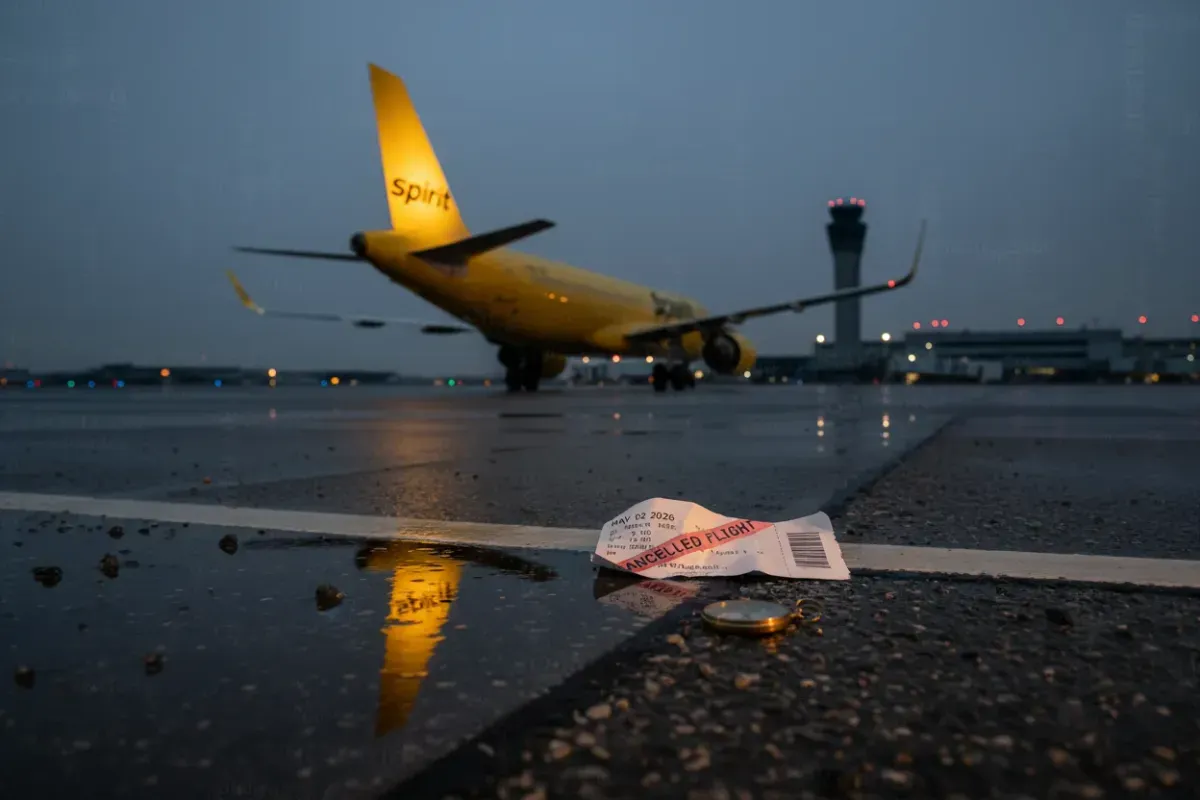
On May 3, 2026, Spirit Airlines ceased all flight operations effective immediately — ending 34 years of ultra-low-cost service across the United States. The shutdown, which followed two bankruptcy filings since late 2024 and a failed attempt to secure $500 million in federal funding, removed a carrier that held a 3.9% share of U.S. domestic passengers as recently as February 2026. FlySafe analysis shows this represents one of the most significant U.S. carrier shutdowns in recent memory, with direct implications for route availability, fare dynamics, and passenger protections across dozens of domestic and international markets.
This bulletin examines the operational impact, affected routes, and concrete steps passengers should take to secure refunds or rebooking on alternative carriers.
Airspace Status: Full Cessation of Spirit Operations
According to Spirit Airlines' restructuring portal, all Spirit flights have been cancelled effective immediately. The airline's wind-down announcement was made overnight to ensure, as Yahoo Finance reported, that all aircraft were safely on the ground and crews accounted for — a "tightly choreographed" process reflecting standard industry practice for orderly shutdowns.
Spirit CEO Dave Davis cited the sustained rise in fuel prices as the final determining factor, stating that the company had "no alternative but to pursue an orderly wind-down," as reported by the Miami Herald. The airline had previously warned during its 2025 restructuring proceedings that it faced existential risk within a year even after emerging from its first bankruptcy.
The carrier's parent company had filed for bankruptcy protection in August 2025, following an initial filing in November 2024. As noted by the Washington Post, the shutdown came "after two recent bankruptcies, countless punch lines and untold number of cheap flights."
Spirit is unable to assist passengers in rebooking onto other airlines. The carrier confirmed this directly on its restructuring website. All future asset liquidation — including aircraft, engines, spare parts, gates, and landing slots — will be handled through the bankruptcy court process.
Affected Routes: Domestic and International Impact
Spirit operated across a significant portion of the U.S. domestic network, with particular concentration in leisure-oriented markets. The airline's February 2026 market share stood at 3.9% of U.S. passengers, down from 5.1% in the same period one year prior, according to NPR's reporting. That share was projected to decline further to 1.8% by May — indicating the airline had already been reducing its footprint substantially before the final shutdown.
Key markets affected include Fort Lauderdale-Hollywood International Airport (FLL), which served as Spirit's primary hub, along with significant operations at Orlando (MCO), Las Vegas (LAS), Detroit (DTW), Atlantic City (ACY), and numerous Caribbean and Latin American destinations. Passengers holding bookings on any Spirit route should treat those reservations as cancelled and take immediate steps toward alternative arrangements.
The removal of Spirit's capacity from these markets is expected to affect fare competition. As consumer advocate William McGee observed in comments reported by NPR: "You do not have to fly a small carrier in order to benefit from its presence, because they will bring down the big guys' fares." The implication is clear — markets previously served by Spirit may experience upward fare pressure in the near term, particularly on routes where Spirit was among a limited number of competitors.
Frontier Airlines acknowledged the significance of the event. Bobby Schroeter, Frontier's chief commercial officer, stated that "Spirit Airlines played an important role in expanding access to affordable travel and bringing more low fares to more people," as reported by PBS NewsHour.
Recommendation: Passenger Refund and Rebooking Procedures
Passengers affected by Spirit's shutdown should pursue the following steps based on how their tickets were purchased. The situation varies significantly depending on payment method and booking channel.
Credit or Debit Card Purchases Made Directly Through Spirit
Spirit has stated it will automatically process refunds for flights purchased through Spirit.com or Spirit's direct booking channels with a credit or debit card, returning funds to the original form of payment. According to Spirit's support page, approved refunds will be issued within seven business days to the original payment method.
However, as John Breyault, vice president of public policy at the National Consumers League, cautioned in PBS NewsHour's coverage: "Not all Spirit customers should assume a refund will automatically appear. When an airline shuts down this suddenly, it's up to travelers to take proactive steps to have the best chance of getting their money back."
Passengers who do not receive automatic refunds within seven business days should contact their credit card issuer and request a chargeback under the Fair Credit Billing Act, citing services not rendered. The U.S. Department of Transportation has specifically recommended this course of action.
Third-Party Bookings (Travel Agents, OTAs)
Passengers who booked through a travel agent or online travel agency should contact that intermediary directly to request a refund. Spirit has indicated it cannot process refunds for bookings made through third parties. The refund terms will depend on the specific policies of the travel agent or platform used.
Vouchers, Credits, and Free Spirit Points
This category carries the greatest uncertainty. Spirit has confirmed that compensation for passengers who booked using vouchers, travel credits, or Free Spirit loyalty points will be determined at a later date through the bankruptcy court process. This means these claims will be treated as unsecured creditor claims in the bankruptcy proceedings — a process that historically yields partial recovery at best and can take months or years to resolve.
Rebooking on Other Carriers
According to Fox Business, major U.S. airlines have responded by capping rebooking fares for displaced Spirit passengers. Affected customers may be eligible for one-way tickets priced at approximately $200, provided they can verify their original Spirit booking. Transportation Secretary Sean Duffy recommended that affected travelers "try to book with these airlines as soon as possible," given that discounted rebooking availability is likely to be limited in duration.
Financial Context: The Collapse Sequence
The trajectory that led to Spirit's cessation followed a well-documented pattern of financial distress. The airline entered its first bankruptcy in November 2024. After attempting to restructure, the parent company filed again in August 2025. A previously considered acquisition by another carrier was not approved by regulators — a decision that Transportation Secretary Duffy publicly criticized, as noted by NBC Chicago.
The final months saw the airline's financial position deteriorate further amid rising fuel costs and commodity market volatility. An industry analyst identified by the BBC as "Syth" stated that "if it wasn't for the fuel scenario, they would have been okay through the summer." The Trump administration reportedly considered a $500 million government bailout, but as reported by the BBC, a deal was not reached.
Spirit's own leadership acknowledged the inevitability. According to the Miami Herald, Spirit executives had issued a prescient warning in 2025 predicting the company's potential collapse within a year, even after emerging from restructuring.
The bankruptcy court hearing attracted significant attention, with more than 100 people tuning in virtually, as reported by Yahoo Finance. The liquidation plan centers on selling every possible asset — aircraft, engines, spare parts, airport gates, and landing slots — to satisfy creditor claims.
Implications for the U.S. Domestic Market
The loss of Spirit removes the largest independent ultra-low-cost carrier from the U.S. market. While Frontier Airlines and other budget carriers continue to operate, Spirit's absence reduces competitive pressure on legacy carriers across dozens of domestic routes.
Based on publicly available NOTAMs and airline schedule data, the most immediate impact will be felt at airports where Spirit represented a significant share of departures. Fort Lauderdale, in particular, loses its largest carrier by flight count. Secondary airports that Spirit served as one of few carriers — such as Atlantic City — may see reduced service levels that are not easily replaced.
Airlines have rerouted capacity in response to competitor shutdowns historically, but the timeline for such adjustments varies. Passengers planning travel on routes previously served by Spirit should expect reduced availability and potentially higher fares in the short term, particularly for last-minute bookings.
FlySafe analysis shows that the broader pattern of ultra-low-cost carrier consolidation — with Spirit's exit following years of industry pressure on the ULCC model — represents a structural shift in U.S. domestic aviation. Commodity market volatility, which correlates with operational disruptions, proved to be the final factor in Spirit's case, but the underlying financial fragility had been apparent for over a year.
Key Takeaways for Travelers
- All Spirit flights are cancelled. There is no partial service or wind-down schedule. The cessation was immediate.
- Credit/debit card refunds should process automatically, but passengers should monitor their accounts and be prepared to file chargebacks if refunds do not appear within seven business days.
- Vouchers and loyalty points are at risk. Recovery, if any, will come through the bankruptcy court — a lengthy and uncertain process.
- Rebooking caps are available from major carriers at approximately $200 one-way, but these are limited and time-sensitive.
- Travel insurance may cover some losses depending on the policy; affected passengers should review their coverage terms.
Travelers with upcoming bookings on routes previously dominated by Spirit should compare alternative carriers promptly. FlySafe continues to monitor U.S. domestic route availability and fare conditions as the market adjusts to Spirit's exit.
Analysis based on publicly available data only.
Frequently Asked Questions
What happens to my Free Spirit points or miles balance?
Spirit has confirmed that compensation for bookings made with Free Spirit points will be determined through the bankruptcy court process. Points balances effectively become unsecured claims against the estate. Full recovery is unlikely based on historical precedent with airline bankruptcies, and the timeline for any resolution may extend several months or longer.
Can I transfer my points to another airline or loyalty program?
No. Spirit's Free Spirit program has ceased operations along with the airline. There is no transfer arrangement with any other carrier's loyalty program. Points cannot be redeemed, transferred, or converted.
If I have an unused Spirit voucher, can I receive a cash refund?
Unused vouchers fall under the same bankruptcy process as loyalty points. Spirit has stated that compensation for voucher holders will be determined at a later date by the bankruptcy court. Voucher holders should retain all documentation of the voucher's value and issuance for potential filing as a creditor claim.
Can Spirit help me switch my flight to another airline?
No. Spirit has explicitly stated on its restructuring website that it is unable to help rebook passengers on another airline. Travelers must arrange alternative transportation independently, though several major U.S. carriers have offered capped fares for displaced Spirit customers.
Will Spirit reimburse additional expenses like emergency hotels or replacement flights?
Spirit has not indicated any program for reimbursing incidental expenses caused by the shutdown. Such costs would likely need to be pursued through travel insurance claims, credit card travel protections, or as unsecured claims in the bankruptcy proceeding. The U.S. Department of Transportation recommends contacting your credit card issuer about protections under the Fair Credit Billing Act for the original ticket cost.
- Spirit Airlines permanently ceased all flight operations on May 3, 2026, following two bankruptcies since late 2024 and a failed bid for $500 million in federal funding — ending 34 years of ultra-low-cost service.
- Spirit cannot rebook passengers onto other airlines; travelers must independently seek refunds or alternative flights through the bankruptcy restructuring portal.
- Spirit held a 3.9% share of U.S. domestic passengers as recently as February 2026, making this one of the most consequential U.S. carrier collapses in recent memory with real impact on route availability and fares.
Powered by B1KEY
Live tools behind the analysis.
The signals FlySafe writes about are also published live — continuously verified by the Sentinel pipeline.
Information is accurate as of the publication date. FlySafe uses exclusively publicly available data.