Budapest (BUD) Observed Traffic −67% on 17 November 2026 — Morning Fog, a Short Day in Our Worldwide Feed, and a Thin Afternoon
- Our count at Budapest fell from about 394 movements a day to 130 on Tuesday 17 November — on a day when our worldwide feed was also short, mostly before 12:00 UTC, and Budapest reported fog until about 09:30 UTC.
- Vienna, Prague, Warsaw and Bucharest read low in our feed the same day. Budapest's afternoon came back to about half its usual departures, and we cannot yet say how much of that is the feed.
- 17 November is provisional and the second network we cross-check against has not published it yet. Check your airline and the airport for the status of any flight.
Advisory timeline — how active is this episode
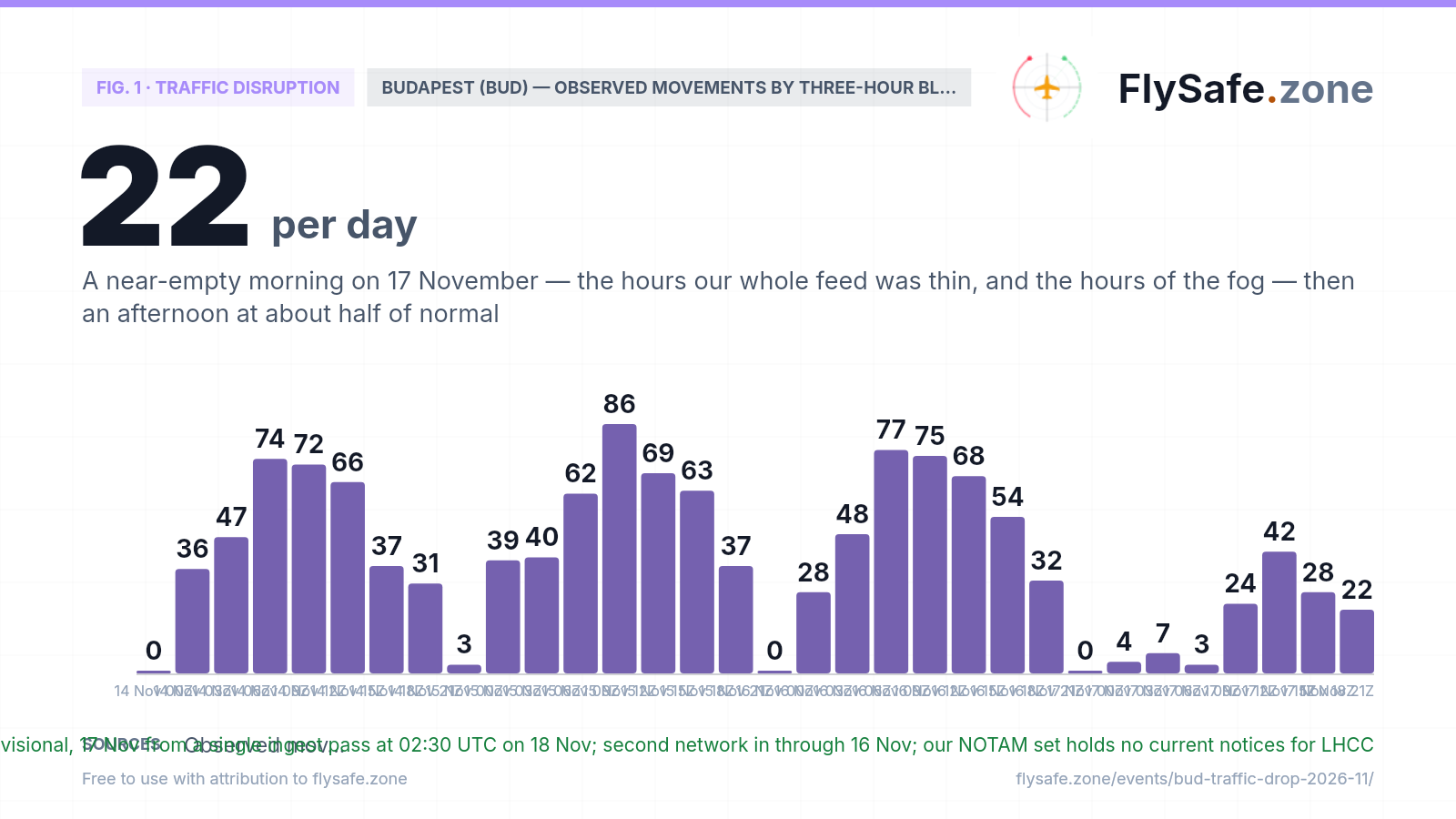
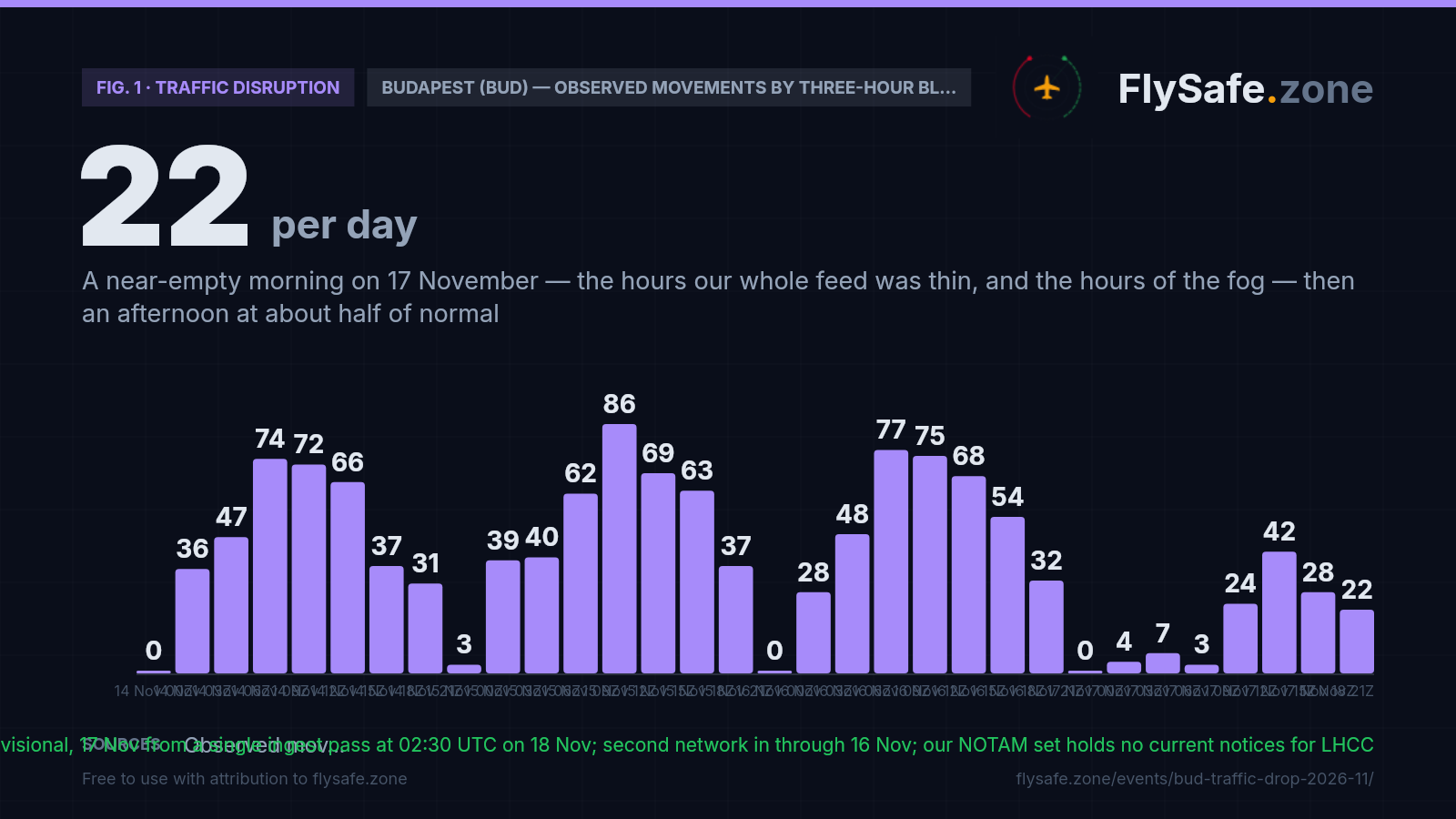
Across 14–16 November Budapest's day totals read 363–399, with the busiest blocks between 09:00 and 15:00 UTC at 62–86 movements each. On Tuesday 17 November the four blocks from 00:00 to 12:00 UTC read 0–7 each — the same hours in which our worldwide feed held about a sixth of its usual records, and the hours in which Budapest reported fog. From 12:00 UTC the blocks read 22–42, against 31–86 in the same blocks of the three days before: the afternoon came back, but not to its usual level. Three-hour blocks, 14–17 November:
Fig. 1 — Observed departures + arrivals at Budapest (BUD) in each three-hour UTC block, 14–17 November 2026 (Budapest time = UTC+1); recounted from the underlying flight records; 16–17 November provisional · Data as of 18 Nov 2026, 06:55 UTC · BUD series settled through 14 Nov; 15 Nov plotted as a recount (stored row 356); 16 Nov and 17 Nov provisional, 17 Nov from a single ingest pass at 02:30 UTC on 18 Nov; second network in through 16 Nov; our NOTAM set holds no current notices for LHCC · Source: Observed movement records for LHBP from a crowdsourced ADS-B receiver network, as collected by FlySafe monitoring.
Airports in the exposure zone
| Airport | Size | Observed signal | FIR |
|---|---|---|---|
| Budapest Liszt Ferenc International Airport (BUD) | large | — · 17 Nov: 130 observed movements (68 dep / 62 arr), provisional, −67% vs a 394 median; departures before 12:00 UTC 10 vs 86–95, from 15:00 UTC 34 vs 56–72; fog 00–09:30 UTC, visibility down to 200 m; low-altitude position reports 104 vs 63–145 a day on 8–16 Nov; no closure event in LHCC | LHCC |
| Vienna International Airport (VIE) | large | 215 km · Same shape next door: 235 on 17 Nov vs 526–664 a day on 12–16 Nov; departures before 12:00 UTC 14 vs 132–153, from 15:00 UTC 76 vs 92–120 | LOVV |
| Václav Havel Airport Prague (PRG) | large | 472 km · Also low: 150 on 17 Nov vs 330–437 a day on 12–16 Nov; departures before 12:00 UTC 12 vs 88–97, from 15:00 UTC 37 vs 47–81 | LKAA |
| Warsaw Chopin Airport (WAW) | large | 541 km · Also low: 209 on 17 Nov vs 428–504 a day on 12–16 Nov; departures before 12:00 UTC 14 vs 102–110, from 15:00 UTC 72 vs 58–92 — afternoon in range | EPWW |
| Bucharest Henri Coandă International Airport (OTP) | large | 616 km · Also low: 105 on 17 Nov vs 266–335 a day on 12–16 Nov | LRBB |
Distance alone does not determine impact — wind direction and the flight levels the ash reaches decide which airports and routes are affected on a given day. FIR = Flight Information Region.
What our monitoring shows: a low Tuesday at Budapest inside a short day for the whole feed
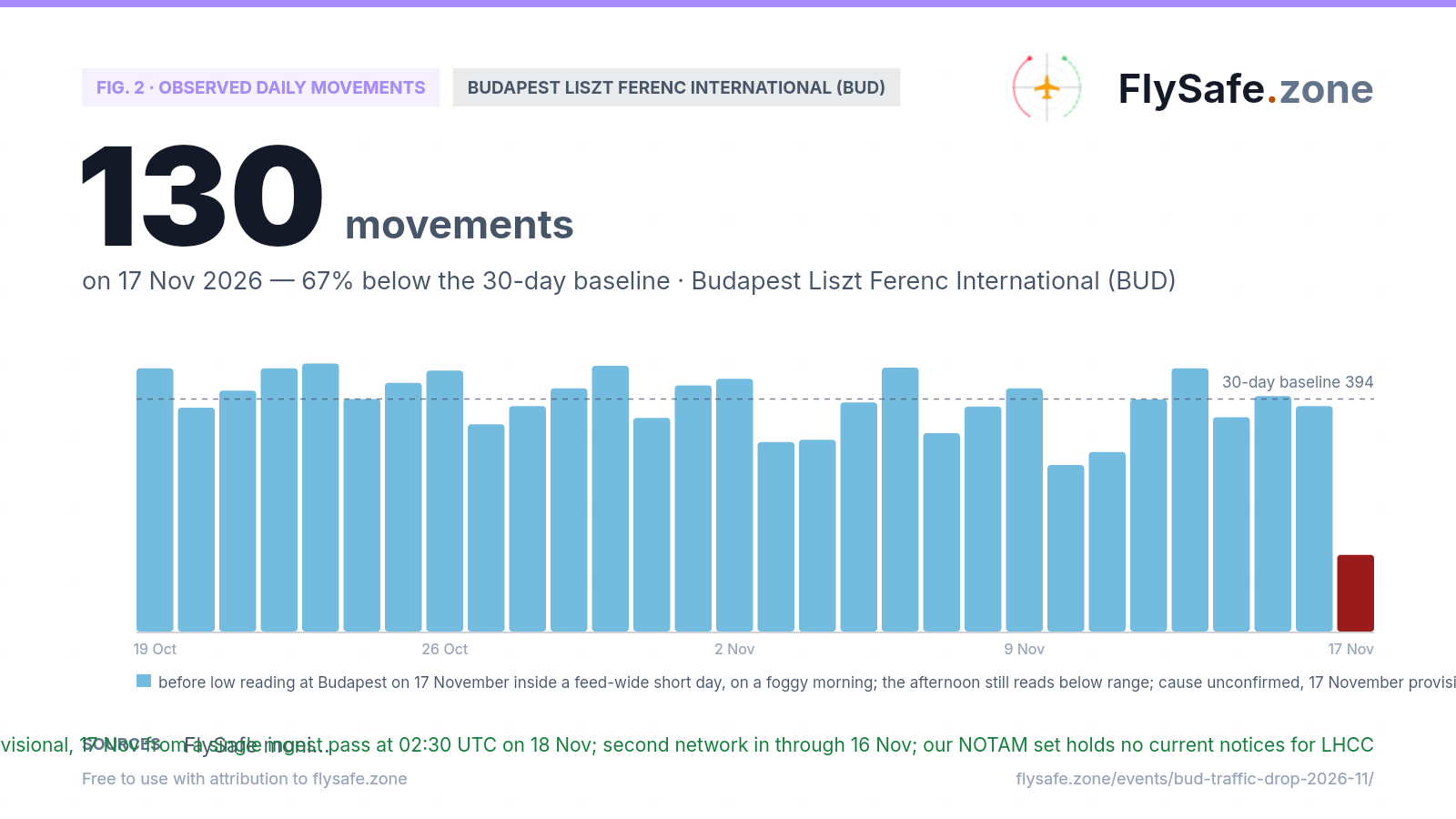
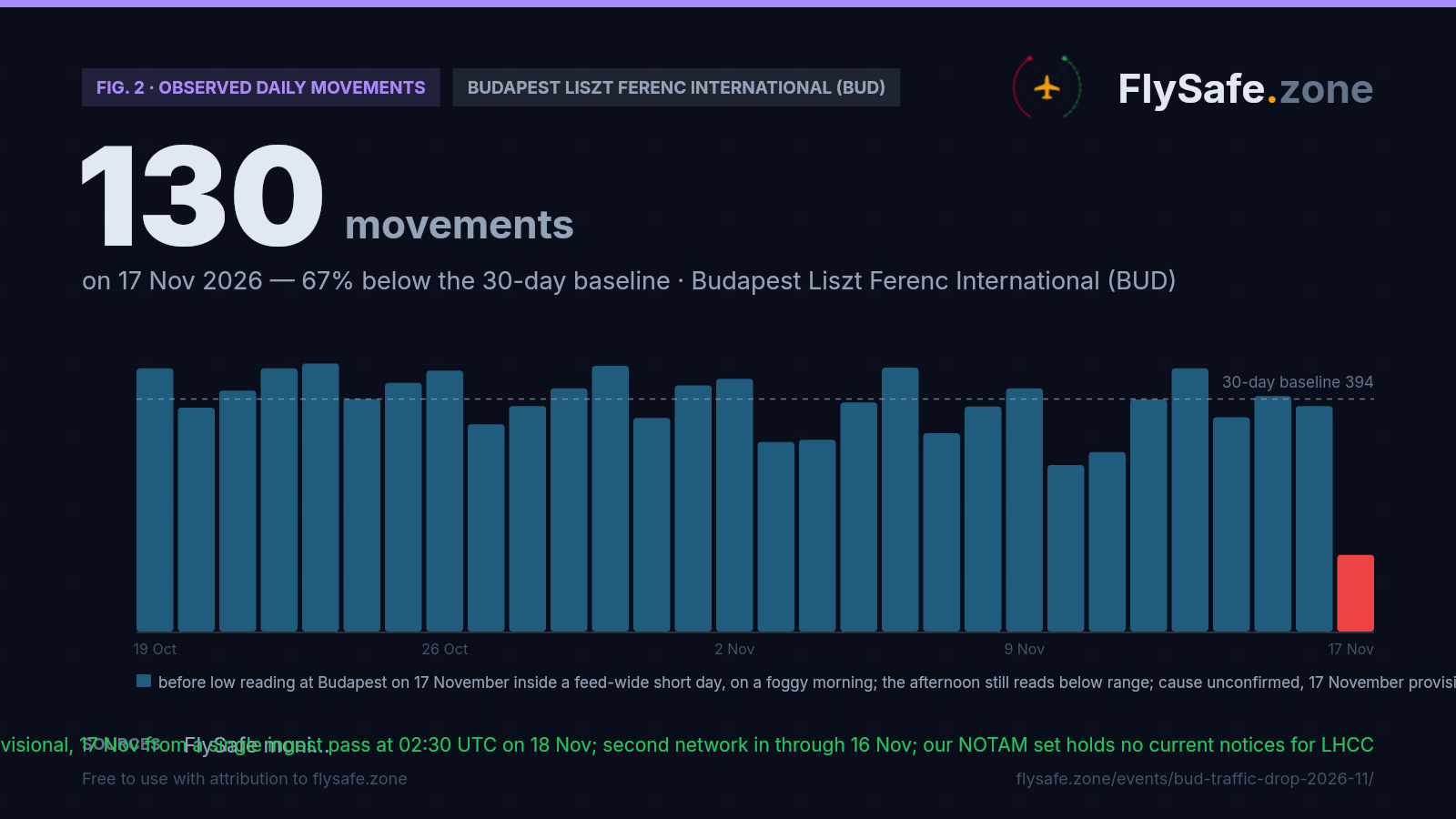
FlySafe tracks observed departures and arrivals at 493 airports from crowdsourced ADS-B receiver data. Observed counts are a floor, not a total — receiver coverage varies — but an airport measured against its own baseline is a reliable shape. Budapest Liszt Ferenc International's last 30 days:
Fig. 2 — Observed daily movements at BUD, 19 Oct – 17 Nov (latest complete UTC day). Data as of 18 Nov 2026, 06:55 UTC · BUD series settled through 14 Nov; 15 Nov plotted as a recount (stored row 356); 16 Nov and 17 Nov provisional, 17 Nov from a single ingest pass at 02:30 UTC on 18 Nov; second network in through 16 Nov; our NOTAM set holds no current notices for LHCC · Source: FlySafe monitoring (ADS-B receiver network).
- Baseline in our own feed: 394 observed movements/day (median of 19 Oct – 16 Nov), range 282–454. Tuesdays run below that: the four previous Tuesdays read 379, 351, 325 and 282. The low 10–11 November (282, 304) shows in the second network too (276, 293).
- Tue 17 Nov: 130 — 68 departures, 62 arrivals — 67% below the median; the detection layer fired at −62% against a 7-day average of 345. Provisional: the day's records arrived in a single ingest pass at 02:30 UTC on 18 November and can still rise.
- The whole feed is short on 17 November. Our worldwide table holds 81,931 flight records for the day against 121,560–141,851 for 13–16 November. Records with a take-off between 00:00 and 12:00 UTC number 8,024 against 46,217 on 16 November. Departures from European airports show the same: 1,396 before 12:00 UTC against 10,902–12,852 on 14–16 November.
- Budapest follows that split in the morning — 10 departures before 12:00 UTC against 86–95 — but stays low afterwards: 34 departures from 15:00 UTC against 56–72. European departures in our feed from 15:00 to 22:00 UTC read 5,788 against 6,554–8,300, so part of the afternoon gap is the feed as well.
- Mon 16 Nov: 382 (188 / 194), provisional. Sun 15 Nov: 399 on recount from the underlying flight records (the stored row, cut short by a routine partial refresh, holds 356).
Observed counts are a floor, not a total. Live view: BUD airport brief.
What it means for flights
A crowdsourced count can fall without any traffic falling. Observed movements are reconstructed from ADS-B receivers run by volunteers, then aggregated on our side and loaded in nightly batches. When a batch arrives short, every airport in it reads low at once, while flights keep operating. That is why we publish observed counts as a floor, not a total, and why a −67% reading opens an investigation rather than a headline. A real local disruption — weather, a restriction, a runway or system problem — would also lower the count, so we test for both rather than pick one.
The worldwide test: the whole feed was short on 17 November. Our worldwide table holds 81,931 flight records for 17 November against 121,560–141,851 for each of 13–16 November, and it arrived in a single pass at 02:30 UTC on 18 November. The shortfall sits in the first half of the day: 8,024 records with a take-off between 00:00 and 12:00 UTC against 46,217 the day before, while 15:00–22:00 UTC holds 56,154 against 50,244. Across European airports the morning is at about an eighth of normal (1,396 departures before 12:00 UTC against 10,902–12,852), and the afternoon is softer than worldwide (5,788 against 6,554–8,300). Vienna, Prague, Warsaw and Bucharest all read less than half their usual day. A reading that moves with the entire feed is first of all a feed reading.
The Budapest test: fog in the morning, a thin afternoon. Budapest's routine weather reports for 17 November put every observation from 00:00 to 10:00 UTC in the lowest flight category: fog with visibility of 200–1,200 m, vertical visibility or overcast at 200 ft and runway visual range down to 450 m until a special report at 09:24 UTC lifted visibility to 4 km in mist. From about 11:30 UTC the reports were mostly visual. Low cloud alone has not cut our count before: on 12 November every report was in the lowest category, with visibility of 1.8 km or more, and Budapest read 393. The morning on 17 November cannot be read apart from the feed, which was short in the same hours. The afternoon can be compared: from 15:00 UTC our feed attached 34 departures to Budapest against 72, 64 and 56 in the same hours of 15, 16 and 14 November, while Vienna read 76 against 92–120 and Warsaw 72 against 58–92. The raw position sample, which reaches us by a different collection path, held up: 104 reports below 2,500 m around the airport on 17 November from 73 aircraft, against 63–145 reports a day on 8–16 November; distinct aircraft over Hungary and its borders read 1,535 against 1,693–1,984.
Notices and closure signals. Our NOTAM set currently holds no notices for the Budapest FIR (LHCC), so we cannot check runway or aerodrome notices for this episode from our own data and make no claim either way. Our detection layer registered no closure event in LHCC, and no FIR-level traffic anomaly in LHCC since 3 November. These are FIR-level observations, not statements about the airport.
Why we cannot settle it yet — and what would. We cross-check drops like this against a second crowdsourced ADS-B network. At Budapest it tracks our count closely: 334–422 movements a day on 12–16 November, 397 on 16 November. Its 17 November figure is not in yet. Two things would close this episode in our data: our 17 November total rising on the next nightly refetch, as provisional days usually do once the missing records arrive, and the second network's 17 November figure — which would show whether the morning and the afternoon were short at Budapest itself. If both arrive and Budapest still reads low, we will say so here. This automated multi-signal analysis surfaces anomalies like this one early and publishes what can and cannot be measured; the operating picture on any given day belongs to the airport, the airlines and the relevant authorities.
Passenger questions, answered from the data
Our data cannot confirm that. Our observed count at Budapest fell to 130 movements on 17 November against a 394/day median, but our whole worldwide feed was short that day — 81,931 flight records against 121,560–141,851 on 13–16 November — and Vienna, Prague, Warsaw and Bucharest read low by the same pattern. Budapest's afternoon departures stayed below their usual range, which the feed explains only in part. For a specific flight, check the airline and the BUD brief, which updates nightly.
Yes, according to the airport's routine weather reports in our set: fog from midnight to about 09:30 UTC (01:00–10:30 Budapest time), with visibility of 200–1,200 m and runway visual range down to 450 m, then mist and low cloud lifting to mostly visual conditions from about 11:30 UTC. How the airport and airlines operated in it is for them to say; our feed was short in the same morning hours, so our count cannot measure it.
Our detection layer registered no closure event in the Budapest FIR (LHCC). Our notice set holds no current notices for LHCC, so we cannot check aerodrome or runway notices from our own data. The airport and the Hungarian air navigation service are the authoritative sources.
We do not make that call — we publish what our monitoring can and cannot measure. Here most of the reading coincides with a short day in our own feed, so it is not by itself evidence of a disruption. Your airline and the airport are the authoritative sources for any flight.
For media — the full kit
Everything on this page — charts, CSV, quotes — is published under CC BY 4.0: free to reuse with attribution to FlySafe.zone. Charts come in dark (social/web) and light (print/light layouts) versions; attribution and license are embedded in every file.
“Observed traffic at Budapest Liszt Ferenc International fell to 130 movements on 17 November 2026 in FlySafe's own crowdsourced ADS-B feed — 67% below its 394-a-day median — on a foggy morning and on a day when the whole worldwide feed held 81,931 flight records against 121,560–141,851 on the four days before; Budapest's afternoon departures stayed below their usual range, and the cause of the low reading remains unconfirmed, according to flight-monitoring service FlySafe.zone.”
Boilerplate — about the source (for your article footer)
FlySafe.zone monitors airspace risk and observed airport activity worldwide: 334 flight-information regions scored daily, GPS-interference signals, volcanic-ash exposure and daily observed movements at 493 airports from the crowdsourced ADS-B receiver network. Methodology: flysafe.zone/methodology.
Need a different cut of the data, a comment, or numbers for another airport? Leave an email — we answer fast during active events.