By: FlySafe Research

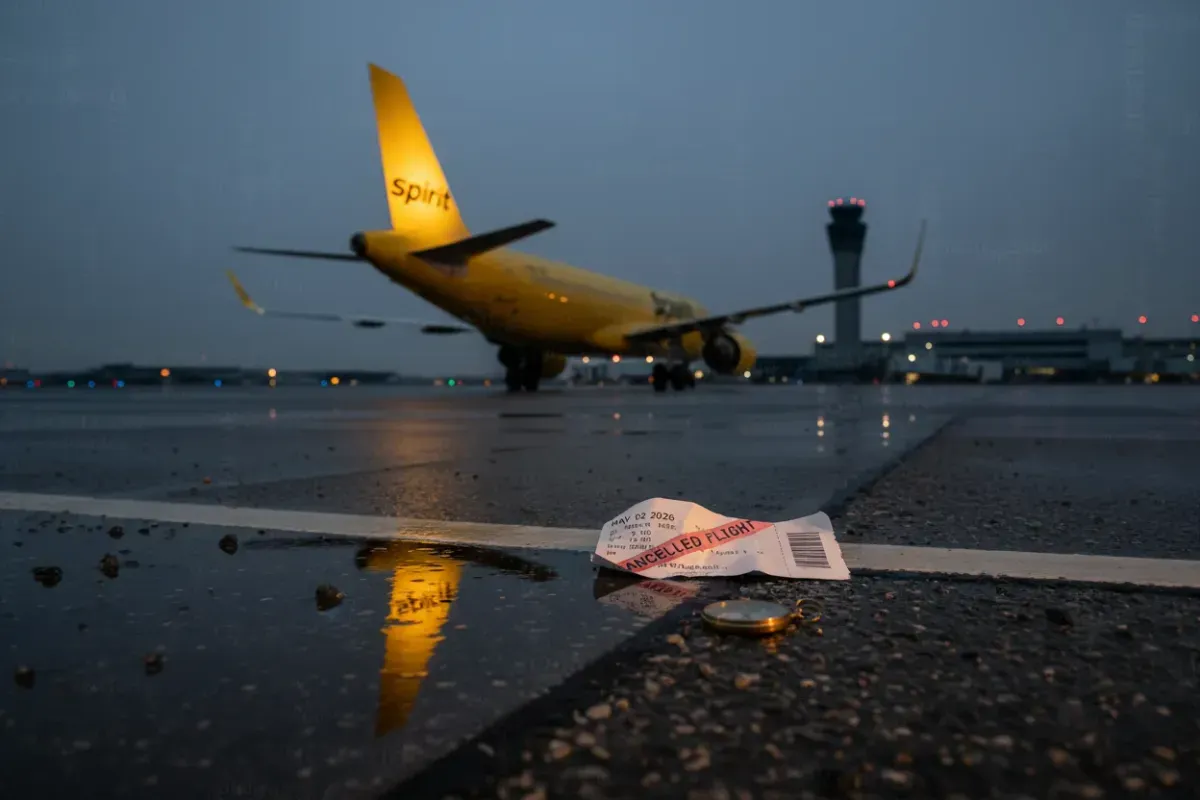
On May 2, 2026, Spirit Airlines announced the immediate cessation of all flight operations, marking the end of a 34-year presence in the U.S. aviation market. FlySafe analysis shows this represents the largest ultra-low-cost carrier (ULCC) shutdown in American aviation history, with significant implications for domestic route coverage, fare dynamics, and tens of thousands of affected passengers. This bulletin provides a comprehensive operational overview of the shutdown, its impact on affected routes, and actionable guidance for travelers and industry stakeholders.
Airspace Status: Full Operational Shutdown
Spirit Airlines has confirmed that all flights have been canceled effective immediately. According to NBC Chicago, the final Spirit flight landed at Dallas Fort Worth International Airport from Detroit Metropolitan Airport, concluding what the airline described as "an orderly wind-down of our operations."
The airline's official restructuring page at spiritrestructuring.com confirms that all flights have been cancelled, customer service is no longer available, and the carrier is unable to rebook passengers on alternative airlines. This is a complete cessation — not a temporary suspension. No resumption of service is anticipated.
At the time of shutdown, Spirit operated a fleet of 172 Airbus narrowbody aircraft: 59 A320s in active service with an additional 63 in storage, and 37 A321s in service with 13 in storage, as reported by CNBC citing aviation-data firm Cirium. More than three-quarters of this fleet was leased, a factor that accelerates the dismantling process as lessors move to reclaim their assets.
Financial Background: A Prolonged Decline
The shutdown did not occur in isolation. Spirit Airlines had been navigating severe financial headwinds for several years. As reported by CBS News, the carrier had lost more than $2.5 billion since the start of 2020 by the time of its first bankruptcy filing in November 2024.
The airline filed for Chapter 11 bankruptcy protection a second time in August 2025, at which point it reported $8.1 billion in debts against $8.6 billion in assets, according to NBC Chicago. During 2025, the company undertook significant restructuring efforts, cutting approximately 4,000 jobs and eliminating 200 underperforming routes, ending the year with roughly 7,500 employees, as noted by CBS News.
The immediate catalyst for the shutdown was a sharp increase in fuel costs driven by commodity market volatility, which added approximately $100 million in incremental costs during March and April 2026 alone, according to statements made by Spirit's legal counsel in bankruptcy court, as reported by CNBC. The airline had sought a $500 million federal financial package, but as NPR reported, those discussions failed to yield a deal. With no additional funding available, the carrier determined it had no viable path to continue operating.
Affected Routes: Domestic Network Impact
Spirit Airlines once operated hundreds of daily flights across the United States, the Caribbean, and Latin America. The elimination of this capacity represents a meaningful reduction in available seat miles on numerous domestic and international routes, particularly in markets where Spirit served as a primary low-fare competitor.
Based on publicly available NOTAMs and schedule data, the most significant route gaps are concentrated in the following areas:
Major Affected Hubs and Focus Cities
- Fort Lauderdale-Hollywood International Airport (FLL): Spirit's largest base of operations. Dozens of nonstop routes to Caribbean, Central American, and domestic destinations are now unserved or underserved by ULCC competitors.
- Orlando International Airport (MCO): A major Spirit focus city with extensive domestic connectivity now requiring reabsorption by other carriers.
- Detroit Metropolitan Airport (DTW): Spirit's historical home base, where it maintained a significant presence particularly on leisure routes.
- Dallas Fort Worth International Airport (DFW): Site of the airline's final arriving flight, with multiple former Spirit routes now dependent on legacy carrier capacity.
- Las Vegas Harry Reid International Airport (LAS): A high-volume Spirit market where leisure-oriented travelers will face reduced ULCC options.
- Atlantic City International Airport (ACY): Among the airports most disproportionately affected, given Spirit's dominant market share at certain smaller stations.
Caribbean and Latin American Routes
Spirit maintained extensive service to destinations across the Caribbean basin and Latin America, including routes to Colombia, Jamaica, the Dominican Republic, Honduras, Guatemala, Costa Rica, and several island destinations. Many of these routes were served with high frequency and low fares that competing carriers may not replicate in the near term. Travelers planning trips to these destinations should verify alternative carrier availability and anticipate potential fare increases in the interim.
Capacity Reabsorption
The redistribution of Spirit's former passenger demand across remaining carriers will take time. Airports and route networks most dependent on Spirit's capacity will experience the most pronounced disruption. FlySafe analysis indicates that travelers on routes where Spirit was the sole or dominant ULCC should plan for reduced frequency, higher average fares, and potential schedule gaps during the reabsorption period.
Recommendation: Passenger Refund and Rebooking Guide
For the approximately 17,000 employees and hundreds of thousands of passengers holding active bookings, the immediate priority is navigating refunds and alternative travel arrangements. The following guidance is based on publicly available information from Spirit Airlines, the U.S. Department of Transportation, and responding carriers.
Automatic Refunds (Credit/Debit Card Purchases)
According to Spirit's official restructuring portal at spiritrestructuring.com, the airline will automatically process refunds for any flights purchased directly through Spirit using a credit or debit card. These refunds will be returned to the original form of payment.
However, as PBS NewsHour reported, consumer advocates caution that not all Spirit customers should assume a refund will automatically appear. John Breyault, vice president of public policy at the National Consumers League, noted that "when an airline shuts down this suddenly, it's up to travelers to take proactive steps to have the best chance of getting their money back."
Credit Card Chargeback Rights
The U.S. Department of Transportation advises affected passengers to contact their credit card issuer and exercise rights under the Fair Credit Billing Act by requesting a chargeback for services not rendered, as noted by PBS. This is a critical backup mechanism, particularly if automatic refunds are delayed or incomplete. Passengers should file chargeback requests promptly, as card issuers typically impose time limits on such disputes.
Third-Party Bookings
Passengers who purchased tickets through travel agencies or third-party online platforms must direct refund requests to those providers, not to Spirit Airlines. As confirmed by both Fox Business and Spirit's own restructuring page, the airline is unable to process refunds for bookings made through external channels.
Vouchers, Credits, and Loyalty Points
Passengers who booked flights using Spirit vouchers, travel credits, or Free Spirit loyalty points face the greatest uncertainty. According to Spirit's restructuring page, compensation for these bookings will be determined at a later date through the bankruptcy court process. The airline has stated it is not able to offer cash refunds for unused vouchers at this time. Affected passengers should document their holdings and monitor bankruptcy court proceedings for updates.
Rescue Fares from Other Carriers
In a notable industry response, major U.S. airlines — including United, Delta, JetBlue, and Southwest — have introduced capped rebooking fares for affected Spirit customers. According to Fox Business, affected passengers may be eligible for one-way tickets priced at approximately $200, provided they can verify their original Spirit booking. These rescue fares are time-limited, and travelers are advised to act promptly.
As Frontier Airlines' chief commercial officer Bobby Schroeter stated, "Spirit Airlines played an important role in expanding access to affordable travel and bringing more low fares to more people." Frontier, as the remaining major ULCC in the U.S. market, may be positioned to absorb a significant share of displaced Spirit demand over time.
Industry Implications: The ULCC Model Under Pressure
Spirit's shutdown raises broader questions about the viability of the ultra-low-cost carrier model in the current operating environment. The combination of sustained financial losses exceeding $2.5 billion over six years, heavy debt loads, elevated fuel costs driven by commodity market volatility, and an inability to secure either a merger partner or emergency financing points to structural vulnerabilities in the business model as currently configured.
The concentration of ULCC capacity in the hands of fewer operators — primarily Frontier Airlines and, to a lesser extent, Allegiant Air and Avelo Airlines — may reduce competitive pressure on fare levels in markets previously served by Spirit. Travelers and industry observers should monitor fare trends in affected markets over the coming months.
For airports where Spirit held significant market share, the operational adjustment will be particularly acute. Airport authorities may need to actively court replacement service from existing or new carriers to maintain route connectivity and passenger throughput.
Key Takeaway
The cessation of Spirit Airlines operations represents a significant structural shift in the U.S. domestic aviation landscape. With 172 aircraft grounded, hundreds of routes eliminated, and approximately 17,000 jobs affected, the ripple effects will be felt across the industry for months.
FlySafe analysis shows that affected passengers should prioritize the following immediate actions: verify refund eligibility based on payment method, file credit card chargebacks where appropriate, explore rescue fares from participating carriers, and document any voucher or loyalty point holdings for the bankruptcy process. Travelers planning future trips on routes formerly served by Spirit should anticipate reduced frequency and potentially higher fares during the capacity reabsorption period.
This analysis is based on publicly available data only, including airline statements, court filings, and official DOT guidance. FlySafe will continue to monitor route-level impacts and fare dynamics as the market adjusts to Spirit's absence.
Frequently Asked Questions
Will I get a refund for my Spirit Airlines ticket?
If the ticket was purchased directly through Spirit using a credit or debit card, the airline has stated it will automatically process refunds to the original form of payment. However, consumer advocates warn that passengers should not rely solely on automatic processing and should take proactive steps, including filing a credit card chargeback if the refund does not appear in a reasonable timeframe.
Can I use a credit card chargeback to recover my ticket cost?
Yes. The U.S. Department of Transportation recommends contacting the credit card issuer and requesting a chargeback under the Fair Credit Billing Act for services not rendered. This is available regardless of whether Spirit processes an automatic refund and serves as an important consumer protection mechanism.
What are the rescue fares other airlines are offering stranded passengers?
United, Delta, JetBlue, and Southwest have introduced capped one-way fares of approximately $200 for verified Spirit ticket holders. These offers are time-limited and subject to availability. Affected passengers should book as soon as possible and have their original Spirit booking confirmation available for verification.
What happens to my Spirit miles, vouchers, or points after the bankruptcy?
Compensation for bookings made using vouchers, travel credits, or Free Spirit loyalty points will be determined through the bankruptcy court process at a later date. Spirit has confirmed it cannot offer cash refunds for unused vouchers at this time. Passengers should retain all documentation and monitor the airline's restructuring page for updates.
Can travel insurance cover the loss of my prepaid Spirit flight?
Coverage depends on the specific policy terms. Many comprehensive travel insurance policies include provisions for airline financial default or cessation of operations, though this coverage varies significantly between providers. Passengers holding travel insurance should file a claim promptly and review their policy language regarding carrier bankruptcy or shutdown scenarios.
- Spirit Airlines permanently ceased all operations on May 2, 2026 — not a temporary suspension — leaving passengers with no rebooking assistance and no path to refunds through the airline itself.
- The collapse was years in the making: Spirit lost over $2.5 billion since 2020, filed for bankruptcy twice, and shed 4,000 jobs before a final fuel-cost spike triggered the shutdown.
Powered by B1KEY
Live tools behind the analysis.
The signals FlySafe writes about are also published live — continuously verified by the Sentinel pipeline.
Information is accurate as of the publication date. FlySafe uses exclusively publicly available data.