Lima (LIM) Read Zero Flights on 17 November 2026 in Our Feed — the Flights Are There, Filed Under a Second Airport Identifier
- The zero at Lima on Tuesday 17 November is a labelling problem in our own data: the day's 266 records sit under the airport's other identifier.
- A second ADS-B network counts 507 Lima movements that day — its usual level. Our own count is low in the morning hours, when our whole worldwide feed was short, and ordinary from 15:00 UTC.
- From 18 November, notices schedule night-time runway works at Lima. 17 November is provisional in our feed. Check your airline and the airport for the status of any flight.
Advisory timeline — how active is this episode
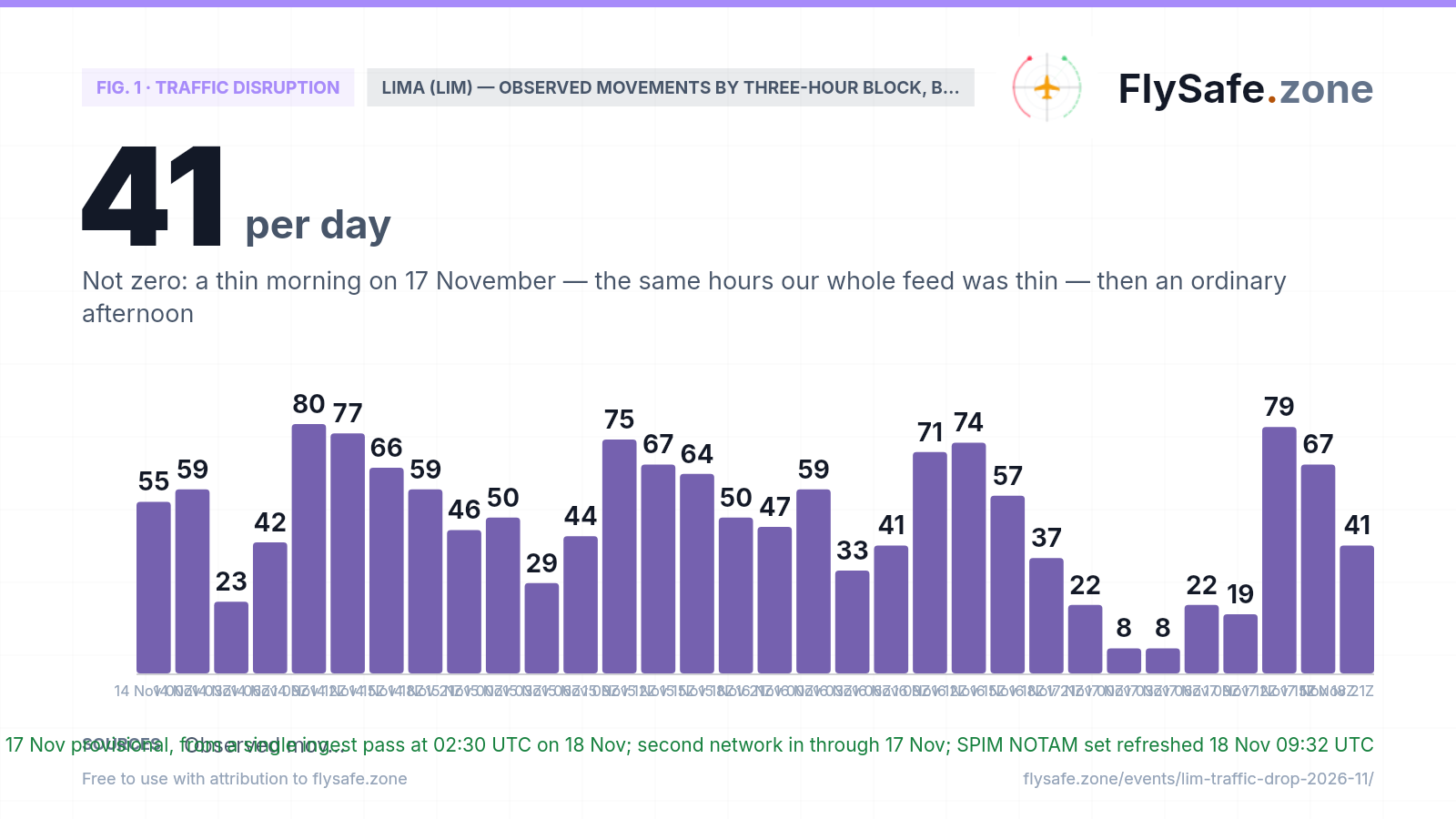
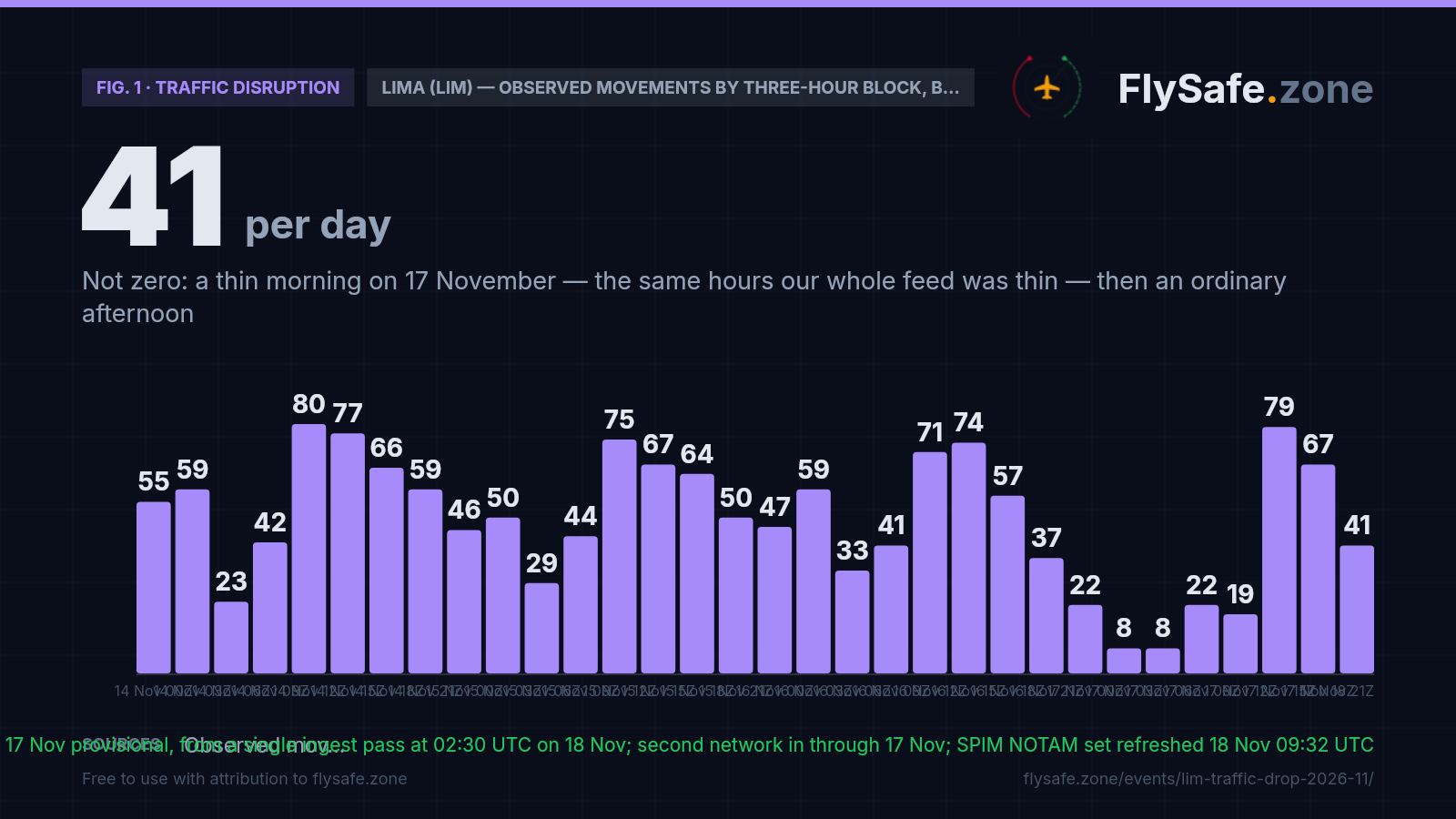
Lima reaches our feed under two identifiers: SPJC, the airport's own code, and SPIM, the code of the Lima FIR that some records carry for the airport. Our Lima brief tracks SPIM. On 17 November all 266 of the day's records arrived under SPJC and none under SPIM — that is the zero. Counted across both identifiers with duplicates removed, 14–16 November read 419–461 a day. On Tuesday 17 November the four blocks from 00:00 to 12:00 UTC read 8–22 each, 60 together against 169–180 on the three days before — the same hours our worldwide feed was short. From 15:00 UTC Lima's blocks read 41–79, 187 together, against 168–202 in the same hours of 14–16 November. Three-hour blocks, 14–17 November:
Fig. 1 — Observed departures + arrivals at Lima (LIM) in each three-hour UTC block, 14–17 November 2026 (Lima time = UTC−5), counted across both identifiers SPIM and SPJC with duplicate records removed; recounted from the underlying flight records; 17 November provisional · Data as of 18 Nov 2026, 09:55 UTC · LIM counted across both identifiers (SPIM + SPJC, duplicates removed) for 14–17 Nov; 17 Nov provisional, from a single ingest pass at 02:30 UTC on 18 Nov; second network in through 17 Nov; SPIM NOTAM set refreshed 18 Nov 09:32 UTC · Source: Observed movement records for SPIM and SPJC from a crowdsourced ADS-B receiver network, as collected by FlySafe monitoring.
Airports in the exposure zone
| Airport | Size | Observed signal | FIR |
|---|---|---|---|
| Jorge Chávez International Airport (LIM) | large | — · 17 Nov: 0 under SPIM, 266 under SPJC (149 dep / 117 arr), provisional; second network 507 vs a 507 median (7–16 Nov); own feed before 12:00 UTC 60 vs 169–180, from 15:00 UTC 187 vs 168–202; low-altitude position reports 185 vs 194–212 a day on 12–16 Nov; weather visual/marginal visual; no closure event in SPIM | SPIM |
| Comodoro Arturo Merino Benítez International Airport (SCL) | large | 2462 km · Same short day in our feed: 106 on 17 Nov vs 248–374 a day on 12–16 Nov; the second network read 201 departures, inside its 148–215 for 12–16 Nov | SCEZ |
| El Dorado International Airport (BOG) | large | 1888 km · Same short day in our feed: 667 on 17 Nov vs 915–1,473 a day on 12–16 Nov; the second network read 633, against 452–606 on 12–16 Nov | SKED |
| São Paulo/Guarulhos–Governor André Franco Montoro International Airport (GRU) | large | 3475 km · Same short day in our feed: 402 on 17 Nov vs 635–922 a day on 12–16 Nov; the second network read 834, against 759–843 on 12–16 Nov | SBCW |
Distance alone does not determine impact — wind direction and the flight levels the ash reaches decide which airports and routes are affected on a given day. FIR = Flight Information Region.
What the second network shows: an ordinary Tuesday at Lima
FlySafe tracks observed departures and arrivals at 493 airports from crowdsourced ADS-B receiver data. Observed counts are a floor, not a total — receiver coverage varies — but an airport measured against its own baseline is a reliable shape. Lima Jorge Chávez International's last 30 days:
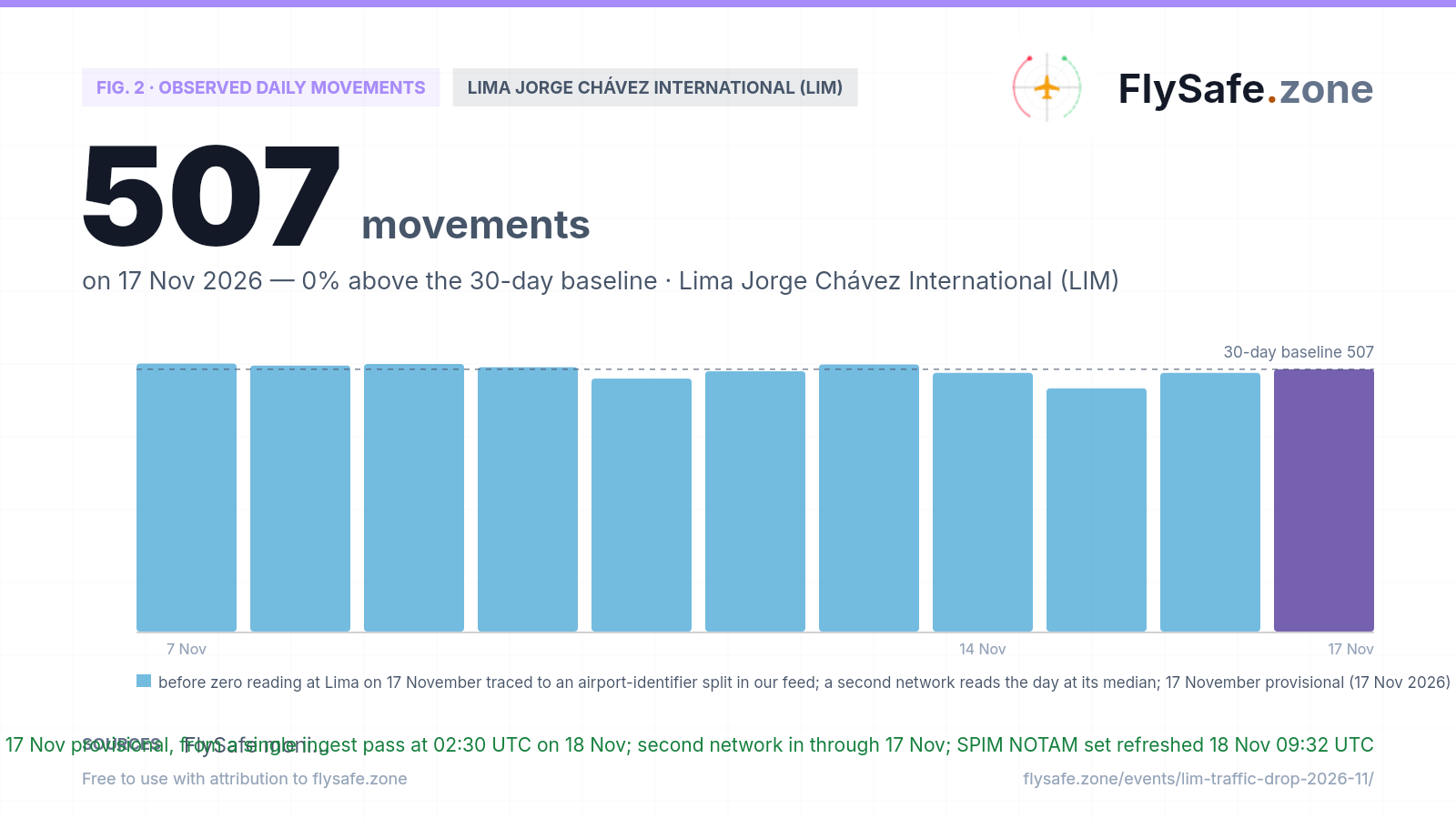
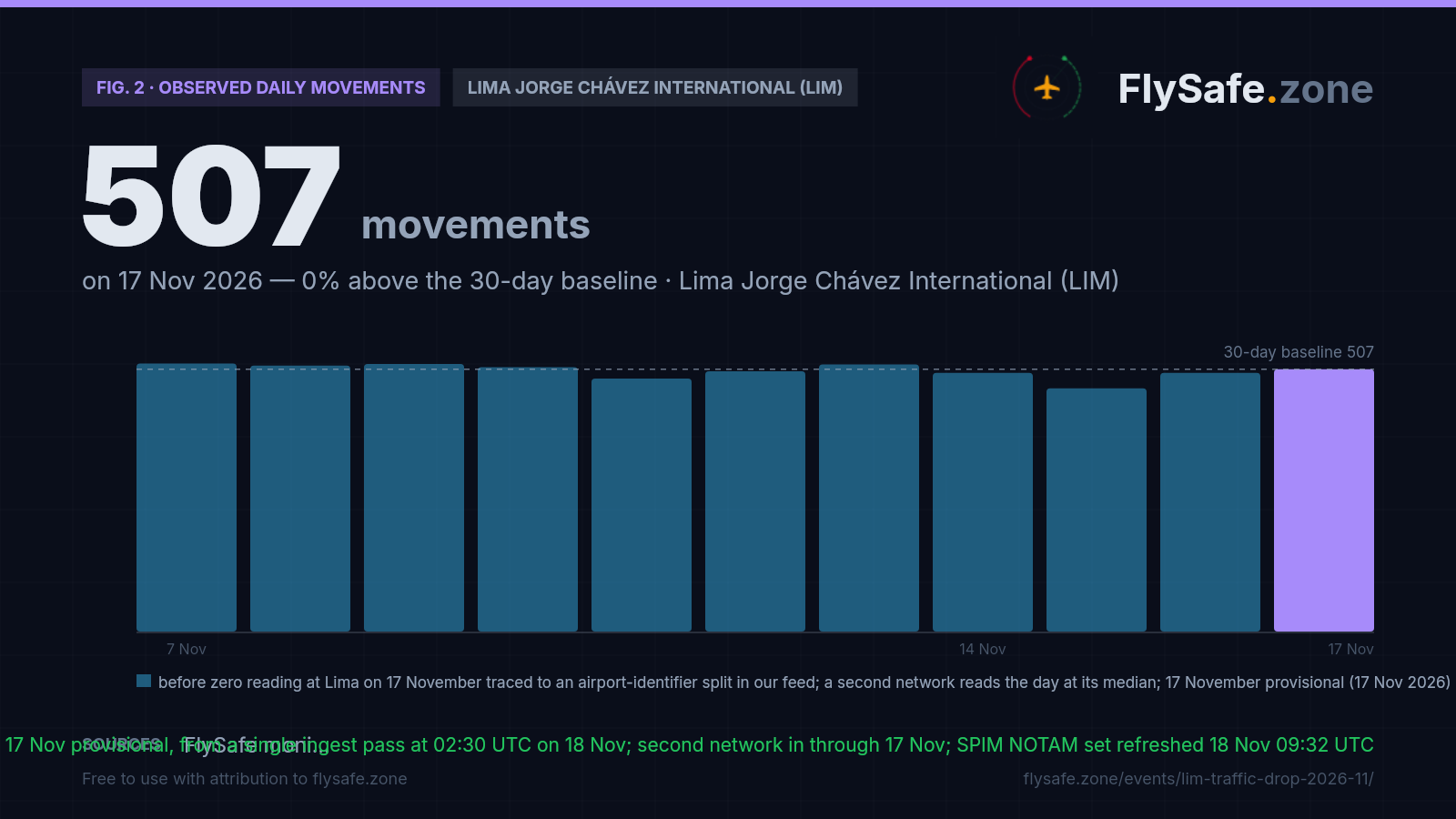
Fig. 2 — Observed daily movements at LIM, 7 Nov – 17 Nov (latest complete UTC day). Data as of 18 Nov 2026, 09:55 UTC · LIM counted across both identifiers (SPIM + SPJC, duplicates removed) for 14–17 Nov; 17 Nov provisional, from a single ingest pass at 02:30 UTC on 18 Nov; second network in through 17 Nov; SPIM NOTAM set refreshed 18 Nov 09:32 UTC · Source: FlySafe monitoring (ADS-B receiver network).
- The chart above is the second crowdsourced ADS-B network we cross-check against, not our primary feed. We plot it here because our own Lima series is split across two identifiers and has a coverage hole: under SPJC it read 538–639 movements a day from 15 September to 11 October, then thinned from mid-October and was near-empty under both identifiers on most days from 19 October to 10 November. The stored SPIM series our Lima brief shows — empty to 9 November, 131–441 on 11–16 November — was loaded by a catch-up batch at 03:00–03:15 UTC on 17 November.
- Second-network baseline: 507 movements/day (median of 7–16 November), range 470–518. Tue 17 Nov: 507 — 262 departures, 245 arrivals — at the median.
- Our primary feed, both identifiers, duplicates removed: 466, 478, 461, 425, 419 on 12–16 November; 266 (149 / 117) on 17 November, provisional and inside a short day for the whole feed. The detection layer fired at −100% against a 7-day average of 312, reading the SPIM identifier alone.
- On 11–15 November the same flights often sit in our feed twice, once under each identifier — 119–150 matched departures a day on 12–15 November — which is why we remove duplicates before counting.
Observed counts are a floor, not a total. Live view: LIM airport brief.
What it means for flights
A zero can be a label, not a count. Every flight record in our feed carries the identifier of the airport it left from or landed at, and that identifier comes from the upstream data. For Lima, two are in use: SPJC, the airport's own four-letter code, and SPIM, which is also the code of the Lima Flight Information Region. Our Lima brief and the detection layer read SPIM. On 17 November not one of the day's 266 Lima records carried SPIM — all carried SPJC — so the brief read zero while the aircraft were there in the data. On 11–15 November the opposite happened as well: many flights appear twice, once under each code. That is why every number on this page counts both identifiers and removes duplicates.
The second-network test: 17 November at its median. We cross-check drops like this against a second crowdsourced ADS-B network, which files Lima under a single identifier. It counts 507 movements on 17 November — 262 departures and 245 arrivals — against 470–518 a day on 7–16 November and a median of 507. Regional peers that read low in our feed on the same day read at or above their recent levels there: Santiago at 201 departures, Bogotá at 633 movements, São Paulo Guarulhos at 834.
Why our own count is still low: a short day for the whole feed. Counted across both identifiers, our feed holds 266 Lima movements on 17 November against 419–478 on 12–16 November. That gap moves with the entire feed: our worldwide table holds 81,931 flight records for 17 November against 121,560–141,851 for 13–16 November, all of them from a single ingest pass at 02:30 UTC on 18 November. Lima follows the shape — 60 movements between 00:00 and 12:00 UTC against 169–180, then 187 from 15:00 UTC against 168–202. The raw position sample, which reaches us by a different collection path, held steady: 185 reports below 2,500 m around the airport from 105 aircraft on 17 November, against 194–212 reports from 97–109 aircraft a day on 12–16 November.
Weather, notices and closure signals. Lima's weather reports in our set for 17 November were visual or marginal visual: 18 of 22 visual, 4 marginal visual with broken cloud at 3,000 ft between 08:00 and 12:00 UTC, visibility 10 km or more throughout and wind 9–14 kt. Our NOTAM set for the Lima FIR (SPIM) was refreshed at 09:32 UTC on 18 November and holds 42 notices, 25 of them for the airport. Standing notices keep runway 16L/34R unavailable 05:00–10:59 UTC daily to 20 November and split the two runways between landings and take-offs for the rest of the day. From 22:47 UTC on 17 November to the end of 18 November, two standard departure procedures are suspended because a navigation aid is out of service. From 18 November, runway 16R/34L is closed 06:30–09:30 UTC daily to 28 November for works, and runway 16L/34R is unavailable on 18, 19, 21 and 22 November at 17:30–19:30 and 21:00–22:30 UTC. Read together, the notices list neither runway as available between 06:30 and 09:30 UTC (01:30–04:30 Lima time) on 18–20 November; the set holds no notice closing the aerodrome as such, and how the airport and airlines plan around that window is for them to state. Our detection layer registered no closure event in SPIM on 16–17 November. Its FIR-level traffic signal for SPIM has fired 40 times since 1 November, each time on samples of 14 aircraft or fewer — routine noise at that size. These are FIR-level observations, not statements about the airport.
What happens next in our data. Two things would close this episode on our side: the 17 November total rising on the next nightly refetch, as provisional days usually do once the missing records arrive, and the two Lima identifiers being counted as one airport in the brief. The second network has already published 17 November at its usual level. If our refetched total stays low while the second network holds, we will say so here. This automated multi-signal analysis surfaces anomalies like this one early and publishes what can and cannot be measured; the operating picture on any given day belongs to the airport, the airlines and the relevant authorities.
Passenger questions, answered from the data
Our data does not show that. The zero our detection read on 17 November belongs to one of the two identifiers our feed uses for Lima; the day's 266 records arrived under the other one. A second ADS-B network counts 507 Lima movements that day, at its 507/day median for 7–16 November. For a specific flight, check the airline and the LIM brief, which updates nightly.
Notices in our set close runway 16R/34L 06:30–09:30 UTC daily from 18 to 28 November for works, while runway 16L/34R is unavailable 05:00–10:59 UTC daily to 20 November and at set evening hours on 18, 19, 21 and 22 November. Read together, they list neither runway as available 06:30–09:30 UTC (01:30–04:30 Lima time) on 18–20 November. These start after 17 November, so they do not bear on the reading on this page; how the airport and airlines plan around them is for them to say.
Not according to the airport's routine weather reports in our set: on 17 November every report was visual or marginal visual, with visibility of 10 km or more, the lowest cloud ceiling broken at 3,000 ft and wind of 9–14 kt.
We do not make that call — we publish what our monitoring can and cannot measure. Here the zero comes from how our own data labels the airport, and the second network reads 17 November at its usual level. Your airline and the airport are the authoritative sources for any flight.
For media — the full kit
Everything on this page — charts, CSV, quotes — is published under CC BY 4.0: free to reuse with attribution to FlySafe.zone. Charts come in dark (social/web) and light (print/light layouts) versions; attribution and license are embedded in every file.
“A zero reading for Lima's Jorge Chávez International on 17 November 2026 in FlySafe's own crowdsourced ADS-B feed traces to an airport-identifier split: the day's 266 records arrived under the airport code SPJC rather than SPIM, the identifier the detection read, and a second ADS-B network counts 507 Lima movements that day, at its 507-a-day median for 7–16 November, according to flight-monitoring service FlySafe.zone.”
Boilerplate — about the source (for your article footer)
FlySafe.zone monitors airspace risk and observed airport activity worldwide: 334 flight-information regions scored daily, GPS-interference signals, volcanic-ash exposure and daily observed movements at 493 airports from the crowdsourced ADS-B receiver network. Methodology: flysafe.zone/methodology.
Need a different cut of the data, a comment, or numbers for another airport? Leave an email — we answer fast during active events.