Campinas Viracopos (VCP) Observed Traffic −61% on 17 November 2026 — a Reading From a Thin Day in Our Feed; a Second Network Counts an Ordinary Tuesday
- Our count at Viracopos fell to 139 movements on Tuesday 17 November, against a 7-day average of 355 — on a day when our worldwide feed was also short, and São Paulo's other airports read low in it too.
- A second ADS-B network we cross-check against counts 333 movements at Viracopos that day, above its usual 297. The weather was visual all day.
- 17 November is provisional in our own feed and can still rise on the next nightly refetch. Check your airline and the airport for the status of any flight.
Advisory timeline — how active is this episode
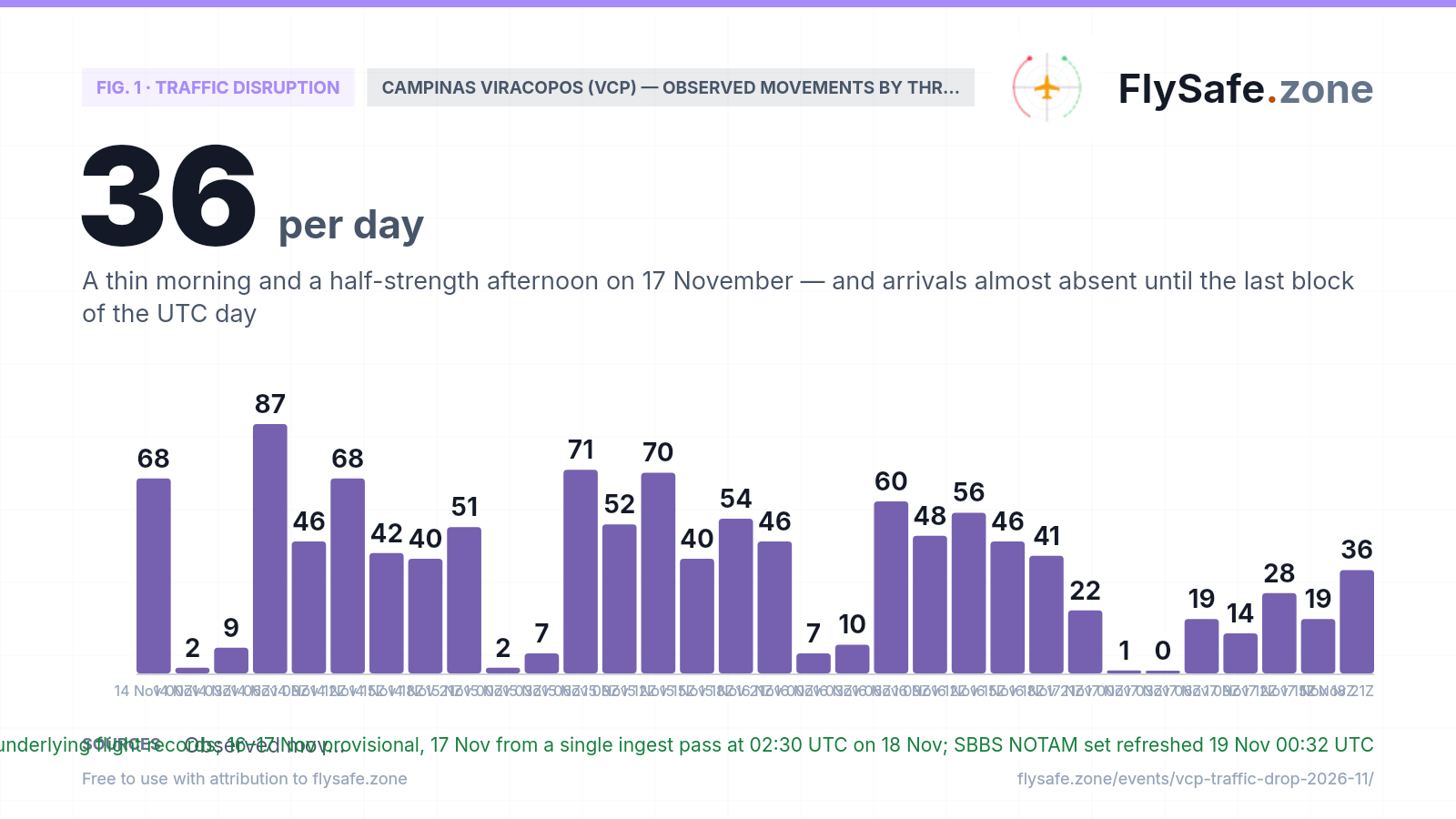
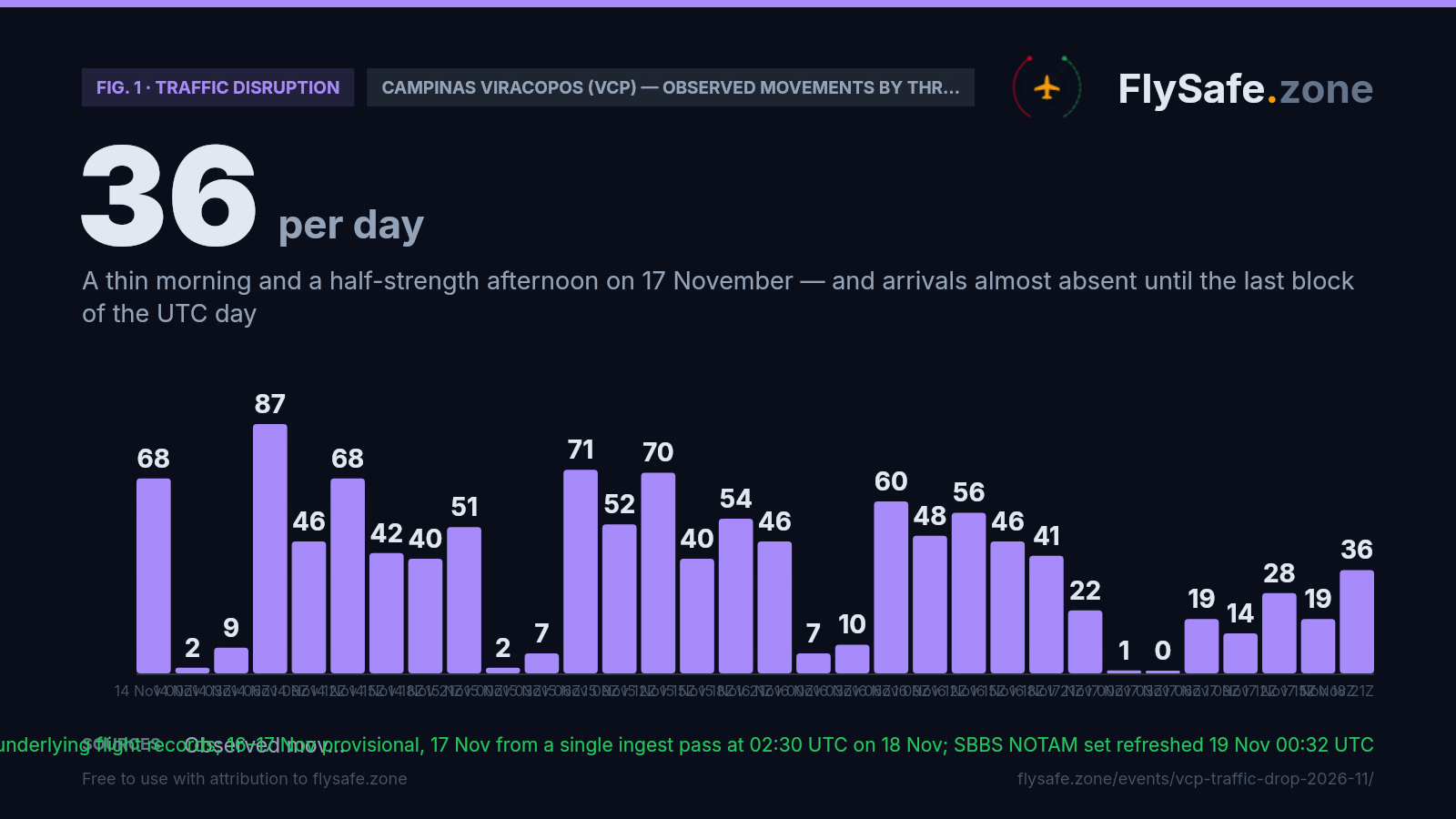
On 14–16 November the four blocks from 00:00 to 12:00 UTC — 21:00 to 09:00 Campinas time — held 166, 131 and 123 movements at Viracopos. On Tuesday 17 November the same blocks held 42 — the hours in which our worldwide feed held about a sixth of its usual records. The blocks from 12:00 UTC held 97 against 191–216, so the afternoon reads about half-strength as well. Arrivals are the sharper gap: 6 attached to VCP before 21:00 UTC, against 91–118 on 14–16 November; the 21:00–24:00 UTC block then held 24, inside the 24–33 of the three days before. Three-hour blocks, 14–17 November:
Fig. 1 — Observed movements (departures + arrivals) at Campinas Viracopos (VCP) in each three-hour UTC block, 14–17 November 2026 (Campinas time = UTC−3); recounted from the underlying flight records in our primary feed; 16–17 November provisional · Data as of 19 Nov 2026, 00:48 UTC · pulse = our primary feed (SBKP) 19 Oct – 17 Nov, 15 Nov plotted as a recount from the underlying flight records; second crowdsourced ADS-B network in through 17 Nov (no 6 Nov row) as cross-check; movements by three-hour block 14–17 Nov recounted from the underlying flight records; 16–17 Nov provisional, 17 Nov from a single ingest pass at 02:30 UTC on 18 Nov; SBBS NOTAM set refreshed 19 Nov 00:32 UTC · Source: Observed movement records for SBKP from a crowdsourced ADS-B receiver network, as collected by FlySafe monitoring.
Airports in the exposure zone
| Airport | Size | Observed signal | FIR |
|---|---|---|---|
| Viracopos International Airport (VCP) | large | — · 17 Nov: 139 observed movements (109 dep / 30 arr), provisional, −61% vs a 355 7-day average; 00–12 UTC 42 vs 123–166, from 12 UTC 97 vs 191–216; arrivals before 21 UTC 6 vs 91–118; second network 333 (168 / 165) vs a 297 median; weather visual; no notice names VCP | SBBS |
| São Paulo/Guarulhos International Airport (GRU) | large | 83 km · Same day, same direction in our feed: 402 on 17 Nov (213 dep / 189 arr) vs 691 on 16 Nov; departures after 12 UTC 133 vs 271–298 on 10–15 Nov; second network 834 (414 / 420) vs an 828 median | SBCW |
| São Paulo Congonhas Airport (CGH) | large | 84 km · Same day, same direction in our feed: 352 on 17 Nov (180 dep / 172 arr) vs 505 on 16 Nov; second network 530 (252 / 278) vs a 560 median for 7–16 Nov | SBCW |
Distance alone does not determine impact — wind direction and the flight levels the ash reaches decide which airports and routes are affected on a given day. FIR = Flight Information Region.
What our monitoring shows: a low Tuesday at Viracopos inside a short day for the whole feed
FlySafe tracks observed departures and arrivals at 493 airports from crowdsourced ADS-B receiver data. Observed counts are a floor, not a total — receiver coverage varies — but an airport measured against its own baseline is a reliable shape. Viracopos International Airport (Campinas)'s last 30 days:
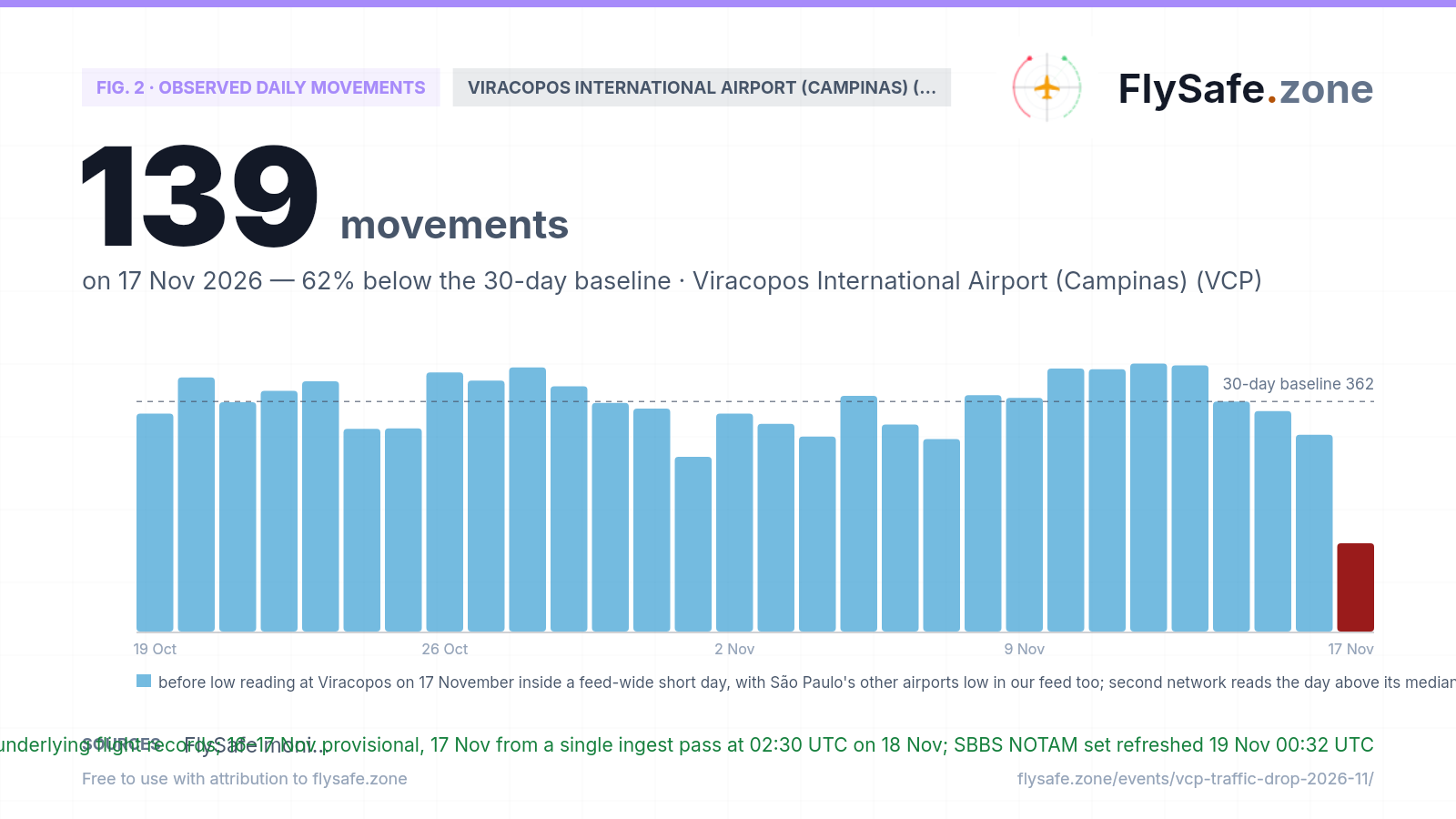
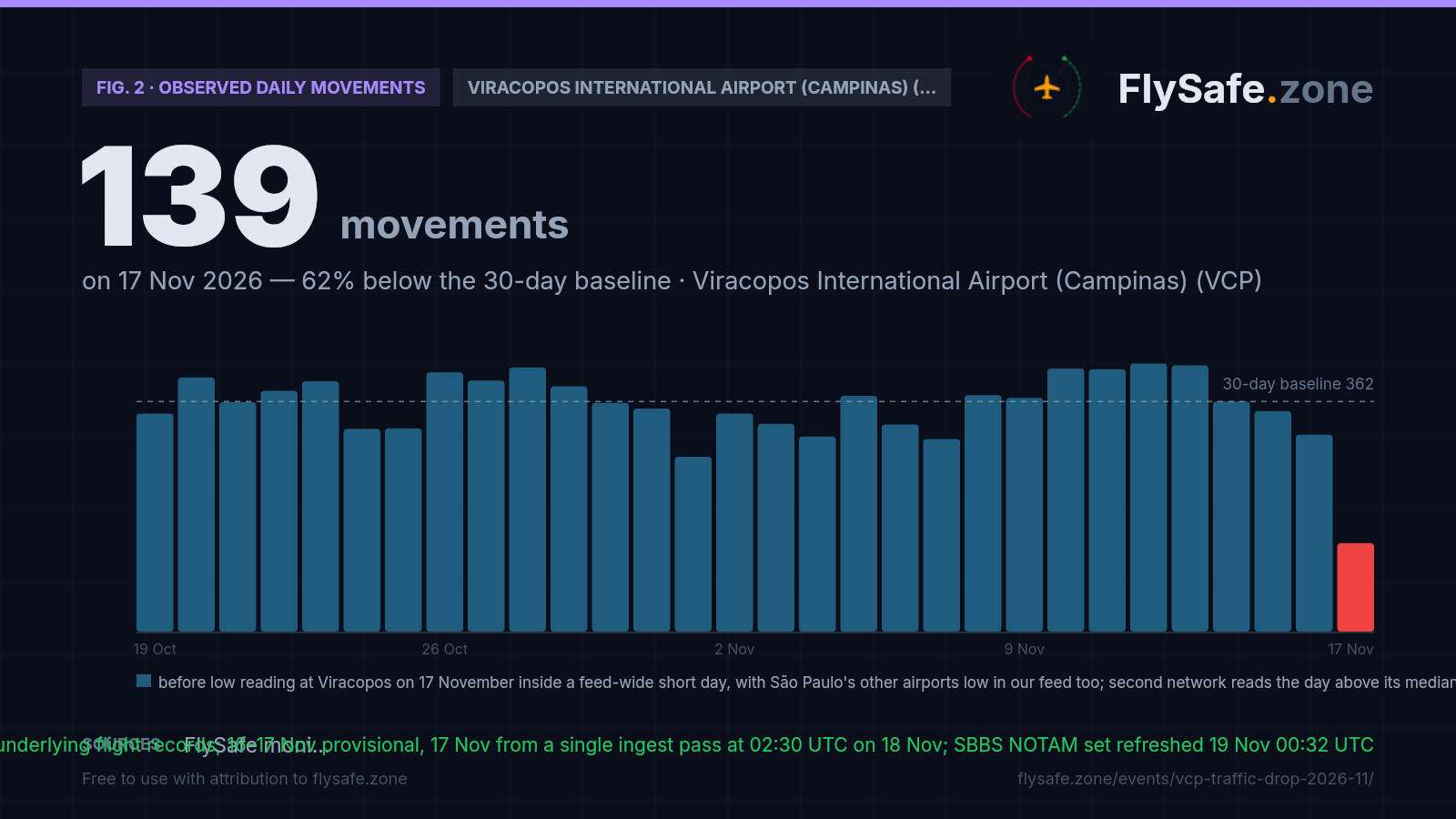
Fig. 2 — Observed daily movements at VCP, 19 Oct – 17 Nov (latest complete UTC day). Data as of 19 Nov 2026, 00:48 UTC · pulse = our primary feed (SBKP) 19 Oct – 17 Nov, 15 Nov plotted as a recount from the underlying flight records; second crowdsourced ADS-B network in through 17 Nov (no 6 Nov row) as cross-check; movements by three-hour block 14–17 Nov recounted from the underlying flight records; 16–17 Nov provisional, 17 Nov from a single ingest pass at 02:30 UTC on 18 Nov; SBBS NOTAM set refreshed 19 Nov 00:32 UTC · Source: FlySafe monitoring (ADS-B receiver network).
- Baseline in our own feed: 362 observed movements/day (median of 19 Oct – 16 Nov), range 275–422. The two previous Tuesdays read 414 and 327.
- Tue 17 Nov: 139 — 109 departures, 30 arrivals — 62% below the median; the detection layer fired at −61% against a 7-day average of 355. Provisional: the day's records arrived in a single ingest pass at 02:30 UTC on 18 November and can still rise.
- The whole feed is short on 17 November. Our worldwide table holds 81,931 flight records for the day against 121,560–146,699 for 10–16 November. Records with a take-off between 00:00 and 12:00 UTC number 8,024 against 46,217 on 16 November.
- São Paulo's other airports read low in our feed the same day: Guarulhos 213 departures against 534–565 on 10–15 November, Congonhas 180 against 312–448. Their departures after 12:00 UTC are low as well, so in our feed the thinning around São Paulo is not confined to the morning.
- Second crowdsourced ADS-B network, Viracopos, 17 Nov: 333 movements (168 / 165) against a 297/day median for 7–16 November (range 165–354). Guarulhos reads 834 there against a 828 median.
- Arrivals at VCP are routinely under-attributed in our feed — 60–166/day since 19 October, against a 147/day median in the second network — so departures carry most of our count. Sun 15 Nov is plotted as 347, a recount from the underlying flight records; the stored row, cut short by a routine partial refresh, holds 45. Mon 16 Nov: 310 (165 / 145), provisional.
Observed counts are a floor, not a total. Live view: VCP airport brief.
What it means for flights
A crowdsourced count can fall without any traffic falling. Observed movements are reconstructed from ADS-B receivers run by volunteers, then aggregated on our side and loaded in nightly batches. When a batch arrives short, every airport in it reads low at once, while flights keep operating. That is why we publish observed counts as a floor, not a total, and why a −61% reading opens an investigation rather than a headline. A real local disruption — a restriction, a runway or system problem — would also lower the count, so we test for both rather than pick one.
The worldwide test: the whole feed was short on 17 November — and thin around São Paulo all day. Our worldwide table holds 81,931 flight records for 17 November against 121,560–146,699 for each of 10–16 November, and it arrived in a single pass at 02:30 UTC on 18 November. Worldwide, the shortfall sits in the first half of the UTC day: 8,024 records with a take-off between 00:00 and 12:00 UTC against 46,217 the day before. Around São Paulo the thinning reaches into the afternoon too: after 12:00 UTC our feed holds 133 Guarulhos departures against 271–298 on 10–15 November, and 141 at Congonhas against 219–309. Both airports already read low in our feed on 16 November (Guarulhos 344 departures, Congonhas 250). A reading that moves with every large airport in the region at once is first of all a feed reading.
The Viracopos test: a second network reads the day above its median. The second crowdsourced ADS-B network we cross-check against counts 333 movements at Viracopos on 17 November — 168 departures and 165 arrivals — against a 297/day median for 7–16 November and 359 on Tuesday 3 November. The same network reads 834 at Guarulhos against an 828 median, and 530 at Congonhas against 560. In our own feed the largest gap is arrivals: 6 attached to VCP before 21:00 UTC, then 24 in the last block of the UTC day, inside the 24–33 of 14–16 November. Arrival attribution at Viracopos is chronically low in our feed — 60–166 a day since 19 October — so an arrival gap here is weaker evidence than it would be at an airport where arrivals attach cleanly. The second network had a low stretch of its own on 9–10 November (186 and 165) that our feed does not show; it is not explained here.
Weather, notices and closure signals. The 12 routine weather reports for Viracopos on 17 November in our set all read visual: CAVOK for most of the day, a broken layer at 4,000–4,800 ft around 15:00–16:00 UTC, winds of 4–14 kt and no gusts reported. Over the past 30 days 5% of Viracopos reports in our set were in instrument conditions. Our notice set for the Brasília FIR (SBBS), refreshed at 00:32 UTC on 19 November, holds 39 currently valid notices; none names Viracopos. Those that close runways do so at Guarulhos and Brasília on published maintenance schedules — one Guarulhos runway on Mondays and Tuesdays 05:00–07:59 UTC since 9 November, with the second runway open; the set holds currently valid notices, so one issued and withdrawn earlier would not appear. Our detection layer registered a low-confidence (0.18), unattributed FIR-level closure signal for SBBS on 18 November and none for 17 November; its small-count night-time traffic signals for the FIR recur almost daily this month. These are FIR-level observations, not statements about the airport.
What would close this episode — and what would reopen it. Two things would close this episode in our data: our 17 November total rising on the next nightly refetch, as provisional days usually do once the missing records arrive, and the second network's 333 holding as published. If our refetched count still reads low and the second network revises down, we will say so here. This automated multi-signal analysis surfaces anomalies like this one early and publishes what can and cannot be measured; the operating picture on any given day belongs to the airport, the airlines and the relevant authorities.
Passenger questions, answered from the data
Our data does not show that. Our own observed count at Viracopos fell to 139 movements on 17 November against a 7-day average of 355, but our whole worldwide feed was short that day — 81,931 flight records against 121,560–146,699 on 10–16 November — and Guarulhos and Congonhas read low in our feed too. A second crowdsourced ADS-B network counts 333 movements at Viracopos that day, above its 297/day median. For a specific flight, check the airline and the VCP brief, which updates nightly.
Because two weaknesses in our own feed stack up. Arrivals at Viracopos attach less reliably than departures on ordinary days — 60–166 a day since 19 October, while the second network counts a median of 147 — and on 17 November our feed was short worldwide. We counted 6 arrivals before 21:00 UTC and 24 after; the second network counts 165 arrivals for the day.
Not according to the airport's routine weather reports in our set: on 17 November all 12 reports read visual — CAVOK for most of the day, a broken layer at 4,000–4,800 ft in the early afternoon local time, and winds of 4–14 kt with no gusts reported.
We do not make that call — we publish what our monitoring can and cannot measure. Here the reading coincides with a short day in our own feed, and a second network reads the day above its usual range, so it is not by itself evidence of a disruption. Your airline and the airport are the authoritative sources for any flight.
For media — the full kit
Everything on this page — charts, CSV, quotes — is published under CC BY 4.0: free to reuse with attribution to FlySafe.zone. Charts come in dark (social/web) and light (print/light layouts) versions; attribution and license are embedded in every file.
“Observed traffic at Campinas Viracopos International fell to 139 movements on 17 November 2026 in FlySafe's own crowdsourced ADS-B feed — 61% below its 7-day average of 355 — on a day when the whole worldwide feed held 81,931 flight records against 121,560–146,699 on the seven days before; a second crowdsourced ADS-B network counts 333 movements at Viracopos that day, above its 297-a-day median, and the low reading has no confirmed local cause, according to flight-monitoring service FlySafe.zone.”
Boilerplate — about the source (for your article footer)
FlySafe.zone monitors airspace risk and observed airport activity worldwide: 334 flight-information regions scored daily, GPS-interference signals, volcanic-ash exposure and daily observed movements at 493 airports from the crowdsourced ADS-B receiver network. Methodology: flysafe.zone/methodology.
Need a different cut of the data, a comment, or numbers for another airport? Leave an email — we answer fast during active events.